

The Gulf Metropolis, a sprawling urban behemoth where the boundaries between reality and reverie blur into a liquid haze, has long been a muse for surrealist artists. Their canvases and digital renderings do not merely depict the city—they transmute it into a phantasmagoric dreamscape, where skyscrapers drip like molten wax, streets undulate like serpents, and the very air hums with the dissonance of a waking nightmare. This is not the Gulf as it is, but as it *feels*—a place where the relentless march of progress collides with the subconscious, birthing visions that are as unsettling as they are mesmerizing. To wander through these distorted cityscapes is to step into a hall of mirrors, where the reflections are not of the self, but of the city’s fractured soul.
The Metropolis as a Melting Dreamscape
Imagine a city where the laws of physics are mere suggestions, where gravity is a fickle lover, and the skyline bends like a mirage under the desert sun. Surrealist artists have seized upon this premise, crafting cityscapes that seem to defy the very notion of solidity. In these works, buildings sag like overripe fruit, their facades peeling away to reveal the raw, pulsating energy beneath. The Gulf Metropolis, with its vertiginous towers and neon-lit arteries, becomes a surrealist’s playground—a place where the rigid geometry of urban planning dissolves into a viscous, dreamlike chaos.
Consider the way liquid mercury might pool in the cracks of a sidewalk, reflecting distorted fragments of the city above. This is not mere hyperbole; it is a metaphor for the Gulf’s relentless transformation, where tradition and modernity coexist in a state of perpetual flux. The surrealist vision captures this tension, rendering the metropolis as a living, breathing entity—one that is as unpredictable as it is awe-inspiring. The city does not stand still; it *melts*, drips, and reforms, a chameleon of concrete and light.
The Alchemy of Light and Shadow
Light in the Gulf Metropolis is not a passive observer but an active participant in the surrealist narrative. It slithers through the labyrinthine streets, carving jagged silhouettes into the facades of buildings, turning glass and steel into canvases for a shadow play that feels plucked from a fever dream. Artists amplify this effect, bathing their cityscapes in an eerie, otherworldly glow—neon blues that pulse like veins, amber hues that seep through the cracks of a crumbling skyline, and violet shadows that stretch like grasping fingers across the pavement.
This manipulation of light does more than create visual spectacle; it imbues the city with a sense of the uncanny. The Gulf Metropolis, under the surrealist’s gaze, is no longer a place of mere habitation but a stage for the sublime and the grotesque. The interplay of light and shadow becomes a metaphor for the duality of the city itself—its gleaming modernity masking the decay beneath, its opulence hiding the emptiness of its soul. In these distorted reflections, we see not just a city, but the fractured psyche of an era obsessed with progress at any cost.
The Liquid Architecture of the Urban Psyche
Surrealist artists often employ the motif of liquidity to describe the Gulf Metropolis, and for good reason. The city is not a static entity but a fluid one, its boundaries constantly shifting, its identity in perpetual motion. Buildings appear to drip like candle wax, their edges blurred by the heat haze, while streets twist and coil like rivers of molten metal. This liquid architecture is not just a stylistic choice; it is a profound commentary on the nature of urban life in the Gulf.
The region’s rapid development has turned its cities into veritable crucibles of change, where the past is buried beneath layers of glass and steel, and the future is a mirage glimpsed through the smog. The surrealist depiction of the metropolis as a flowing, ever-shifting entity mirrors this reality. It suggests that the Gulf is not a place to be *understood* but to be *experienced*—a labyrinth where every corner reveals a new distortion, a new layer of meaning. The city is not a solid object but a living, breathing thing, its pulse quickening with the hum of traffic and the whisper of desert winds.
The Surrealist’s Toolkit: Distortion, Reflection, and the Uncanny
To craft these mesmerizing cityscapes, surrealist artists wield a toolkit of techniques designed to disorient and enchant. Distortion is their weapon of choice, warping the familiar into the unfamiliar. A straight line becomes a sine wave; a right angle bends into a question mark. The Gulf Metropolis, with its grid-like streets and towering structures, is the perfect subject for such manipulation. By bending its geometry, artists reveal the hidden poetry of urban life—the way a city’s rigid structures can become fluid, its order a facade for chaos.
Reflection, too, plays a crucial role. Mirrors, puddles, and glass facades become portals into alternate realities, where the city is not as it seems. In these reflections, the Gulf Metropolis is both itself and something else entirely—a place where the past and future collide, where the mundane and the magical coexist. The surrealist’s use of reflection is not merely decorative; it is a philosophical statement about the nature of perception. The city we see is not the city that exists; it is the city we *imagine*.
The uncanny is the final ingredient in this surrealist brew. By introducing elements that are almost familiar but not quite, artists evoke a sense of unease that lingers long after the image has been viewed. A building that should not stand upright. A street that loops back on itself. A shadow that moves when no one is there. These are the hallmarks of the surrealist cityscape, where the Gulf Metropolis is transformed from a place of commerce and culture into a realm of the subconscious.
The Gulf Metropolis as a Mirror to the Soul
What do these distorted cityscapes tell us about the Gulf itself? They reveal a region caught between two worlds—the traditional and the modern, the local and the global, the real and the imagined. The surrealist vision of the metropolis is not just a critique of urban life; it is a mirror held up to the collective psyche of a society in transition. The Gulf Metropolis, in all its liquid, melting glory, is a place where identities are fluid, where the past is a ghost haunting the present, and where the future is a question mark.
This is why the surrealist depiction resonates so deeply. It captures the essence of a region that is constantly reinventing itself, where the old and the new coexist in a state of perpetual tension. The city is not a static entity but a living, breathing thing—a chameleon that changes with the light, the mood, the era. To see the Gulf Metropolis through the surrealist’s eyes is to see it as it truly is: a place of contradictions, a dreamscape where reality and fantasy blur into one.
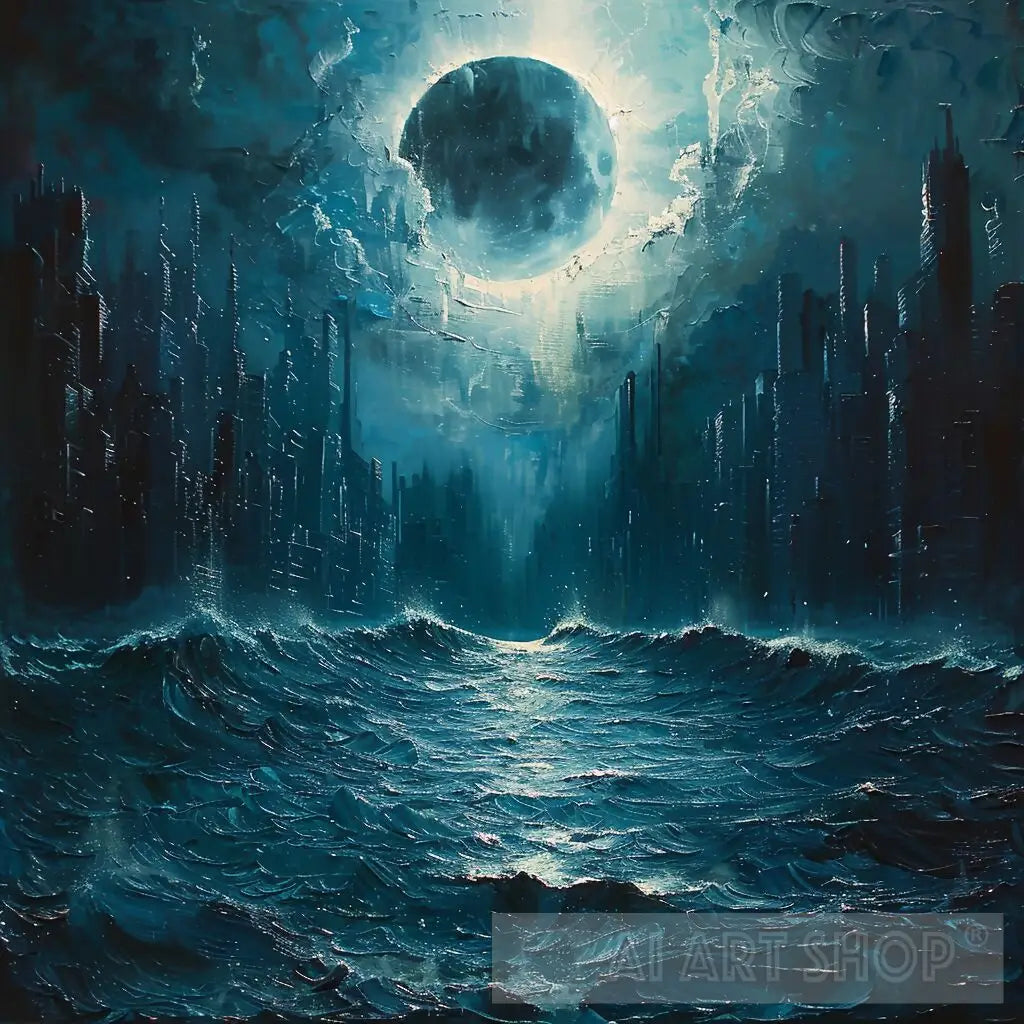
The image above is a testament to the surrealist’s ability to capture the Gulf Metropolis in all its liquid, melting glory. Here, the city is not a place of solid structures but a dreamscape where the boundaries between land and water dissolve. The buildings sag like overripe fruit, their facades peeling away to reveal the raw energy beneath. This is not a city in decline but a city in flux—a place where the old is being reborn as the new, where the rigid geometry of urban planning gives way to the fluidity of the subconscious.
The Allure of the Unreal
Why do we find these distorted cityscapes so captivating? Because they offer a glimpse into a world where the rules of reality do not apply—a world where the impossible is not just possible but inevitable. The Gulf Metropolis, in its surrealist guise, becomes a place of wonder and terror, a realm where the familiar is rendered strange and the strange feels like home. This is the power of surrealism: it takes the world we know and twists it into something new, something that challenges our perceptions and invites us to see the world anew.
The allure of the unreal is not just in its strangeness but in its truth. The surrealist cityscape is not a flight from reality but a deeper dive into it. It reveals the hidden layers of the Gulf Metropolis—the way its streets hum with unseen energy, the way its buildings cast shadows that tell stories of their own. In these distorted visions, we see the city as it truly is: a place of contradictions, a dreamscape where reality and fantasy blur into one.
The Gulf Metropolis, as seen through the surrealist’s lens, is not just a city but a living, breathing entity—a chameleon that changes with the light, the mood, the era. It is a place where the old and the new coexist in a state of perpetual tension, where the rigid geometry of urban planning gives way to the fluidity of the subconscious. To wander through these distorted cityscapes is to step into a hall of mirrors, where the reflections are not of the self, but of the city’s fractured soul. And in that fractured soul, we find the true essence of the Gulf—a place where reality and reverie are not opposites but dance partners, twirling in an endless, mesmerizing waltz.


Leave a Comment