

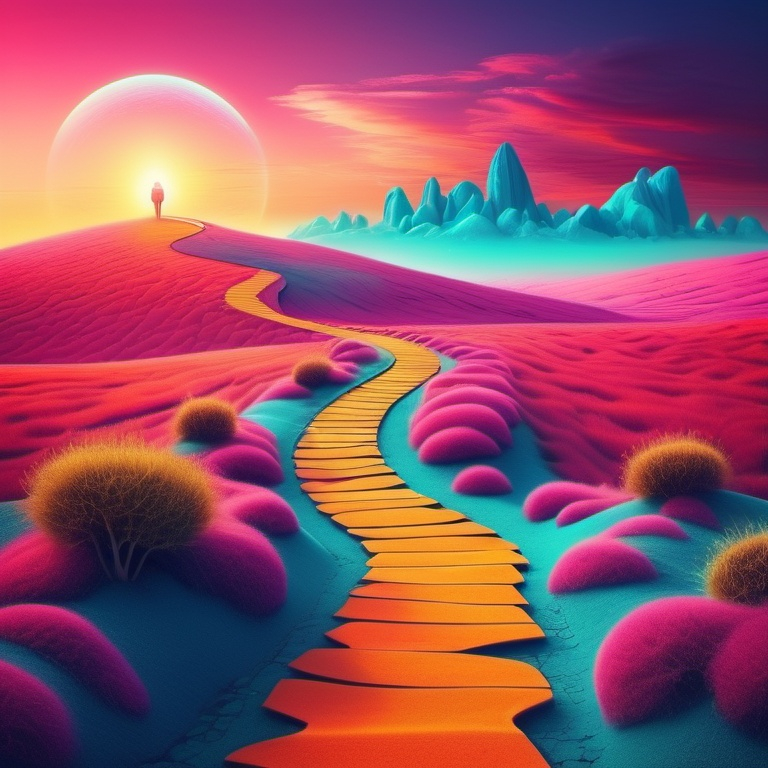
In the hush of dawn, when the world is still wrapped in the gauzy veil of twilight, there exists a fleeting moment where reality bends its rigid edges. It is here, in this liminal space between sleep and waking, that the surrealist sunrise unfurls its canvas—a landscape not of mere light, but of revelation. The sky, a molten palette of violet and tangerine, drips like syrup from the heavens, pooling into rivers that defy gravity. Trees stand as sentinels of the impossible, their branches twisting into spirals that whisper secrets to the wind. This is not the sunrise of calendars or postcards; it is a waking dream, a world where the mundane dissolves into the extraordinary, and the ordinary becomes a portal to the uncanny.
The allure of the surrealist sunrise lies in its refusal to be tamed. It is not a passive spectacle but an active invitation—to see the world not as it is, but as it could be. Every dawn is a fresh conspiracy of colors and shapes, a collaboration between the earth and the cosmos. The horizon is not a line but a frayed edge, where the sky and land dissolve into one another in a slow, hypnotic dance. The first light does not merely illuminate; it transmutes. A field of grass becomes a sea of emerald fire. A lone cloud, stretched thin by the wind, morphs into the silhouette of a dreaming giant. This is the magic of the surrealist hour: the world is not just seen—it is reimagined.
The Alchemy of Light: When Dawn Transmutes Reality
Light, in its purest form, is the architect of the surreal. At sunrise, it behaves like a liquid, seeping into every crevice of the landscape, coaxing shadows to stretch and contort. The surrealist sunrise is not content with mere illumination; it seeks to transform. A dew-kissed spiderweb becomes a constellation of diamonds. A flock of birds, startled into flight, sketches hieroglyphs across the sky. The air itself seems to thicken, carrying the scent of ozone and possibility, as if the very atmosphere is conspiring to blur the boundaries between the real and the imagined.
Consider the way dawn paints the edges of objects with a golden halo, as though the world has been dipped in liquid gold. This is not mere refraction; it is a transubstantiation. A simple fence post, when kissed by the first rays, becomes a monolith from another dimension. The surrealist sunrise does not flatter reality—it distorts it, revealing the hidden poetry in the mundane. It is as if the universe, in a moment of whimsy, has decided to rewrite its own rules. The laws of physics are suspended. Gravity is optional. The sky is a canvas, and the sun, a mischievous painter, smears its brushstrokes with abandon.
This alchemy is not confined to the natural world. Urban landscapes, too, are not spared the surrealist’s gaze. A city skyline at dawn is a jagged silhouette against a watercolor sky, its buildings stretching like the spines of slumbering leviathans. The glow of a streetlamp, usually a mundane artifact, becomes a beacon from a distant galaxy. The surrealist sunrise does not discriminate—it finds wonder in the cracks of sidewalks and the grime of alleyways, turning the overlooked into the extraordinary. In this way, the dawn is not just a time of day; it is a philosophy, a reminder that beauty is not inherent but created.
The Surreal as a Mirror: What the Uncanny Dawn Reveals
The surrealist sunrise is more than a visual feast; it is a mirror, reflecting the hidden currents of the human psyche. In its distorted light, we see not just the world, but the versions of the world we carry within us. The twisted trees, the molten sky, the rivers that flow upward—these are not just artistic flourishes. They are the language of the subconscious, speaking in metaphors too vivid to ignore. The surrealist dawn is a Rorschach test, inviting us to project our fears, desires, and curiosities onto its shifting canvas.
Psychologists have long noted that the moments between sleep and wakefulness—hypnagogia—are fertile ground for the surreal. In this twilight state, the mind is unshackled from logic, and the impossible becomes plausible. The surrealist sunrise is the waking world’s equivalent of this phenomenon. It is as if the universe, in its infinite playfulness, has decided to grant us a glimpse into the other side of reality. The horizon is not a boundary but a veil, and the first light of day is the hand that lifts it.
This is why the surrealist sunrise resonates so deeply. It does not just show us a world that is strange; it shows us a world that is familiar in its strangeness. The melting clocks of Dalí, the floating islands of Ernst—these are not just artistic conceits. They are echoes of the way we, too, perceive the world when our guard is down. The surrealist dawn is a reminder that reality is not a fixed thing but a collaboration between perception and possibility. It asks us: What if? What if the trees could dance? What if the sky could rain fire? What if the sunrise was not just a beginning, but an invitation?
The Poetics of the Impossible: Crafting a New Dawn
The surrealist sunrise is not merely observed—it is participated in. It is a call to action, a challenge to see the world not as it is, but as it could be. Artists, writers, and dreamers have long been drawn to this liminal hour, where the rules of the real are suspended, and the rules of the imagined take over. The surrealist dawn is a blank page, a fresh canvas, a universe waiting to be written upon.
Consider the work of those who have captured this magic. A surreal landscape is not just a backdrop; it is a character, a living entity that breathes and shifts with the light. The poplar trees that lean into the wind are not just trees—they are sentinels of a forgotten realm. The river that carves through the land is not just water—it is a vein of liquid time, carrying fragments of other worlds. This is the poetics of the impossible: the ability to take the familiar and twist it into something that feels both alien and deeply personal.
For the surrealist, the dawn is not just a time of day but a state of mind. It is the moment when the mind is most receptive to the whispers of the subconscious, when the veil between the real and the imagined is thinnest. To wake up to a surrealist sunrise is to wake up to a world that is alive—not just in the biological sense, but in the sense of being aware. The trees are watching. The clouds are thinking. The light is conspiring. This is not a passive experience; it is an engagement.
The Dawn of the New Epoch: Why the Surreal Matters Now
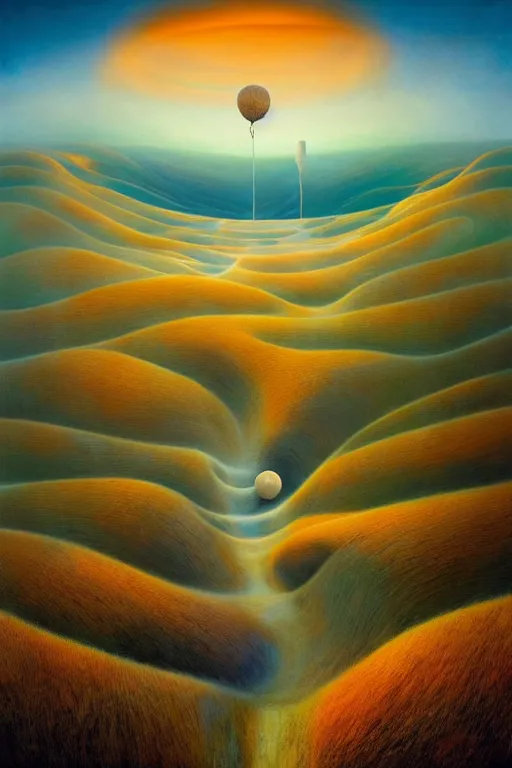
In an age where algorithms dictate our perceptions and reality is increasingly curated, the surrealist sunrise is a rebellion. It is a reminder that the world is not a fixed entity but a living dream, a place of infinite possibility. The surreal does not just challenge our senses; it challenges our assumptions. It asks us to question the boundaries we take for granted—the line between dream and reality, between the possible and the impossible.
This is why the surrealist dawn is more than a visual spectacle; it is a necessity. In a world that often feels rigid and predictable, the surreal offers a breath of fresh air—a way to see the world not as it is, but as it could be. It is a call to embrace the weird, the wonderful, and the inexplicable. The surrealist sunrise is not just a moment in time; it is a movement, a philosophy, a way of being.
And so, the next time you wake to the first light of day, take a moment to look closer. See the way the sky bleeds into the earth. Notice the way the trees lean as if listening to a secret. Feel the air thicken with possibility. This is not just a sunrise. This is an invitation. To see the world differently. To dream while awake. To embrace the surreal not as an escape, but as a revelation.
The surrealist sunrise is not just a phenomenon of the natural world. It is a state of grace, a fleeting glimpse into the heart of reality itself. And it is waiting for you—every single dawn.


Leave a Comment