

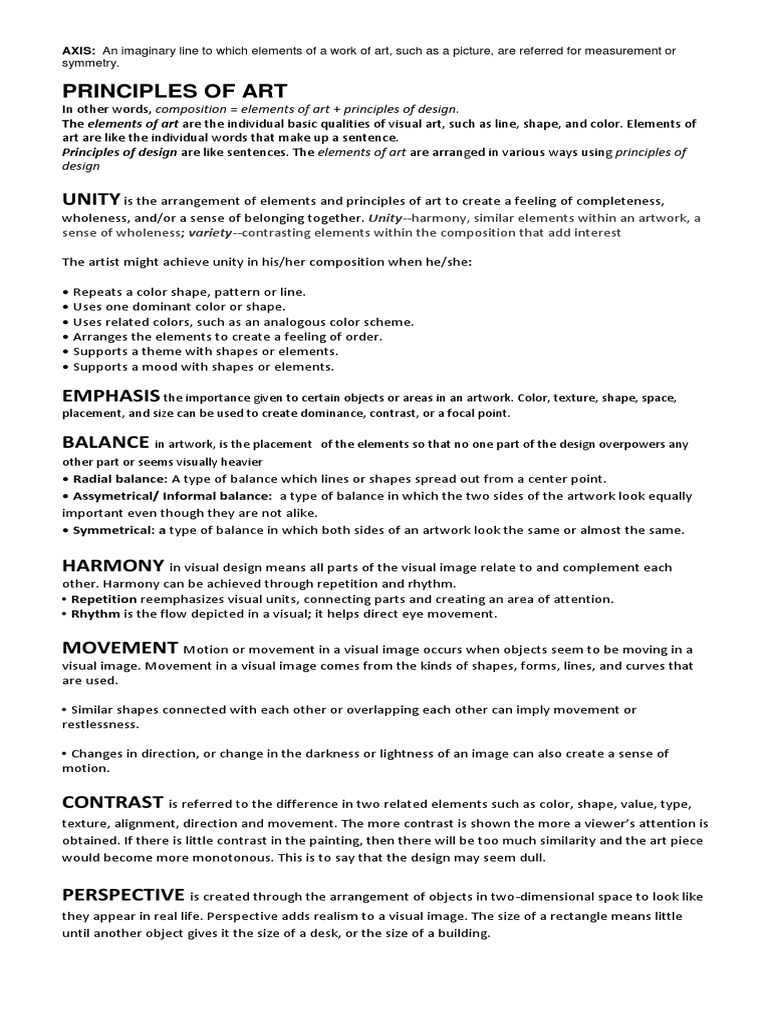
Art, in its myriad forms, is akin to a grand symphony where various elements come together in harmonious unity. Within this orchestration, the Principles of Design act as guiding conductors, delineating how to navigate the complexities and nuances of creation. These principles, much like compass points, steer artists and designers alike towards a sublime payoff—captivating compositions that resonate deeply with viewers. This exploration into the principles of art promises a journey through the heart of creativity, meticulously unearthing their essence, with examples and visual breakdowns illuminating the path.
1. Balance: The Equilibrium of Elements
The concept of balance in art is akin to the delicate act of tightrope walking, requiring a meticulous calibration of visual weight. Balance can manifest in two primary forms: symmetrical and asymmetrical. Symmetrical balance is reminiscent of a perfectly mirrored reflection in tranquil waters, where both sides of the artwork hold equal visual weight. An exemplary illustration is Leonardo da Vinci’s “The Last Supper.” Here, the central figure of Christ anchors the composition, providing an eye-catching fulcrum amidst the symphony of disciples. Conversely, asymmetrical balance defies convention, employing varied elements that create tension and dynamism without overt equality. An artist like Vincent van Gogh, in “Starry Night,” uses swirling skies and brightly lit stars to create a sense of unbalanced yet captivating harmony that keeps viewers entranced.
2. Contrast: The Dance of Opposites
Contrast is a powerful design principle that enchants and enlivens a composition, akin to the clash of thunderous storms and serene sunrises. It employs opposing elements, be it through color, shape, or texture, to create visual interest and draw attention to specific areas. The chiaroscuro technique used by Caravaggio exemplifies contrast, where the jarring interplay of light and shadow highlights the dramatic narrative of his subjects. In the contemporary realm, artists like Yayoi Kusama also utilize contrast, her polka dots creating a striking interplay against stark color backgrounds that commands the viewer’s attention. Thus, through the juxtaposition of visual dichotomies, contrast does not merely catch the eye; it ignites the imagination.
3. Emphasis: The Inviting Apex of Attention
Emphasis in art emerges as a beacon, a focal point that invites viewers into a narrative or emotion within the piece. This principle is akin to a spotlight casting its glow upon a performer, demanding attention. Artists employ various techniques, such as color, contrast, and placement, to create emphasis. A classic example is Edvard Munch’s “The Scream,” where the haunting figure in the foreground captivates attention through stark colors and the swirling backdrop. In modern design, emphasis can also be strategically utilized in advertisements, where a singular product is highlighted amidst a busy background, escalating its desirability. Ultimately, emphasis serves not only to captivate but also to communicate—guiding the viewer through a deeper understanding of the artwork.
4. Movement: The Flow of Elements
Movement in art encapsulates the suggestion of action or the passage of time, reminiscent of a river flowing gracefully toward the horizon. This principle can be expressed through lines, shapes, and forms that guide the viewer’s eye throughout the composition. Consider how Gustav Klimt’s “The Kiss” weaves an intricate narrative through the entwining bodies of the lovers, drawing the viewer into their intimate world. Similarly, in kinetic sculptures, such as those by Alexander Calder, movement becomes literal, enhancing the experience as viewers engage with the evolving forms. This principle invites engagement, instilling a sense of dynamism that propels emotion and experience.
5. Pattern: The Repetitive Minority
Patterns serve as the intricate tapestry that weaves together the aesthetic fabric of art. Much like a well-crafted poem, patterns provide rhythm and visual intrigue through repetition and variation. They create a sense of order, much like a well-tuned clock, intricate yet predictable. Decorative art, especially that of Islamic cultures, is renowned for its masterful use of patterns, where geometric shapes create continuing motifs, inviting contemplation. In contemporary art, the use of pattern can be seen in the works of artists like Damien Hirst, whose spot paintings employ repetitive imagery to explore themes of branding and consumerism, resulting in a unique commentary on modern society.
6. Rhythm: The Pulse of Creation
Rhythm acts as the heartbeat of design, establishing a visual tempo that guides the viewer’s journey through the artwork. It can be created through repetition, alternation, or progression of elements, akin to musical notes composing a melody. Claude Monet’s “Water Lilies” series exemplifies rhythm, where the repetitive motifs of water lilies and reflections create a soothing harmony that invites the viewer to linger. Layered rhythms in artwork can incite varying emotional responses—from serenity to chaos—depending on the arrangements of its elements. Thus, rhythm not only governs pace but imbues works with life and narrative.
7. Unity: The Cohesive Whole
Unity is the underlying force that harmonizes all principles of design, much like the conductor of our symphonic ensemble. Achieving unity requires a thoughtful approach to how elements interact, ensuring that every component contributes to the overall message and experience. An iconic representation of unity can be observed in Pablo Picasso’s “Guernica,” where fragmented forms coalesce into a powerful anti-war statement, rendering chaos into coherence. In design, unity can be achieved through consistent color schemes, recurring shapes, and thematic continuity, ultimately leading to a cohesive interpretation that resonates on multiple levels.
In summation, the principles of art function as essential navigational tools that enrich the creative process. From balance and contrast to rhythm and unity, these elements intertwine to create captivating compositions, evoking emotion, narrative, and deeper understanding. By exploring these principles, artists can harness their power to build extraordinary visual experiences that transcend time, ultimately drawing us into the depth of human creativity and expression.





Leave a Comment