

In an era where artificial intelligence can conjure hyper-realistic portraits or reimagine landscapes in the style of Van Gogh with unsettling precision, one might assume that the sacred craft of Renaissance painting has been fully digitized. Yet, beneath the shimmering veneer of AI-generated art lies a labyrinth of subtleties—subtleties that remain stubbornly beyond the algorithm’s grasp. These are not mere technical oversights; they are the soul of a movement that thrived on human intuition, cultural resonance, and an almost mystical connection between artist and subject. As AI continues to blur the boundaries of creativity, it inadvertently highlights what it cannot replicate: the ineffable essence of Renaissance artistry. Here are five of its most elusive tricks, each a testament to the irreplaceable magic of human hands and hearts.
The Alchemy of Layered Glazes: Where Light Becomes Liquid
Imagine standing before a Titian masterpiece, where the crimson of a saint’s robe seems to glow from within, as if lit by an inner flame. This luminosity is no accident—it is the result of sfumato, a technique refined by Leonardo da Vinci and others, where translucent layers of oil paint, known as glazes, are meticulously applied over dry layers. Each glaze, sometimes numbering in the dozens, filters light in a way that mimics the way sunlight dances through stained glass. AI, for all its computational prowess, struggles to replicate this effect because it cannot intuit the physics of light refraction through successive layers of pigment. The algorithm may approximate color gradients, but it cannot replicate the tactile patience required to build a painting from the inside out, where each glaze is a whispered secret between artist and canvas.
Consider the work of Jan van Eyck, whose Arnolfini Portrait appears to breathe with a quiet vitality. The fur trim on the woman’s gown, the sheen of the mirror’s glass—these are not flat applications of paint but strata of translucency, each layer altering the refractive index of the surface. AI can mimic the visual outcome, but it cannot replicate the alchemy of time and touch that transforms oil into something akin to captured light itself. The Renaissance masters understood that true brilliance lay not in the pigment, but in the patience to let it breathe.
The Whisper of Chiaroscuro: Sculpting with Shadow
Caravaggio’s The Calling of Saint Matthew is a symphony of darkness and revelation, where a beam of divine light carves through the gloom to illuminate a single outstretched hand. This mastery of chiaroscuro—the interplay of light and shadow—is not merely a stylistic choice but a narrative device, a way to guide the viewer’s eye and evoke emotional depth. AI can generate high-contrast images with ease, but it cannot replicate the organic way shadows behave in the real world, where they are not static blocks of darkness but living entities that bend, stretch, and breathe with the contours of form.
The challenge lies in the unpredictability of light. In a Renaissance painting, shadows are not merely the absence of light; they are the artist’s silent collaborator, shaping the drama of the scene. A fold in a robe, the curve of a cheek, the angle of a hand—each casts a shadow that tells a story. AI, bound by its training data, can approximate these effects but cannot intuit the emotional weight of a shadow that feels as though it has been pulled from the air itself. The Renaissance artist did not just paint what they saw; they painted what they felt, and that feeling is the chasm AI has yet to cross.
The Unseen Hand: The Artist’s Intuitive Gesture
Every brushstroke in a Renaissance painting is a fingerprint of the artist’s soul. Take Raphael’s School of Athens, where the figures seem to step out of the frame, their postures and expressions alive with purpose. These are not static representations but dynamic compositions, where each stroke is a deliberate choice—whether to soften an edge, sharpen a contour, or leave a trace of the brush’s movement. AI, for all its ability to generate images, cannot replicate the spontaneity of the human gesture. It can mimic the final product, but it cannot capture the moment of creation, where the artist’s hand trembles with intuition, where a single stroke can shift the entire emotional tenor of the work.
Consider the way Michelangelo’s David seems to pulse with life, the marble not merely carved but coaxed into existence. The Renaissance artist did not merely depict reality; they coaxed it into being through a dance of hand and eye. AI lacks this organic spontaneity. It can generate a face that resembles a Renaissance portrait, but it cannot replicate the way an artist’s hand might hesitate before committing to a line, the way a single brushstroke can convey centuries of human experience. The algorithm is a mimic, not a creator—it can imitate the shell, but never the spirit.
The Cultural Zeitgeist: Painting the Soul of an Era
Renaissance art was not created in a vacuum. It was a reflection of the intellectual and spiritual ferment of its time—a rebirth of classical ideals, a celebration of human potential, a dialogue between faith and reason. Raphael’s Sistine Madonna is not just a painting; it is a manifesto of divine grace and mortal beauty. AI, no matter how advanced, cannot replicate this cultural resonance. It can generate images that mimic the style, but it cannot infuse them with the weight of history, the echoes of Plato’s Academy, or the theological debates that shaped the era.
The Renaissance was a conversation—a dialogue between artists, philosophers, and patrons that spanned generations. AI, by contrast, is a monologue, a vast repository of patterns without context. It can regurgitate the visual language of the Renaissance, but it cannot replicate the cultural DNA that made it possible. The artist of the 15th century was not just a technician; they were a participant in a grand narrative, a storyteller whose work was steeped in the ideals of humanism, the rediscovery of antiquity, and the unshakable belief in the power of art to elevate the human spirit. AI cannot replicate this. It can only mimic the echoes.
The Unquantifiable: The Spark of the Divine
Perhaps the most elusive trick of all is the one that defies categorization: the je ne sais quoi that separates a masterpiece from a mere painting. It is the difference between a photograph and a portrait, between a copy and an original. This spark is not something that can be taught, programmed, or replicated. It is the result of a lifetime of observation, of struggle, of seeing the world not as it is, but as it could be. It is the moment when an artist looks at a blank canvas and sees not emptiness, but possibility.
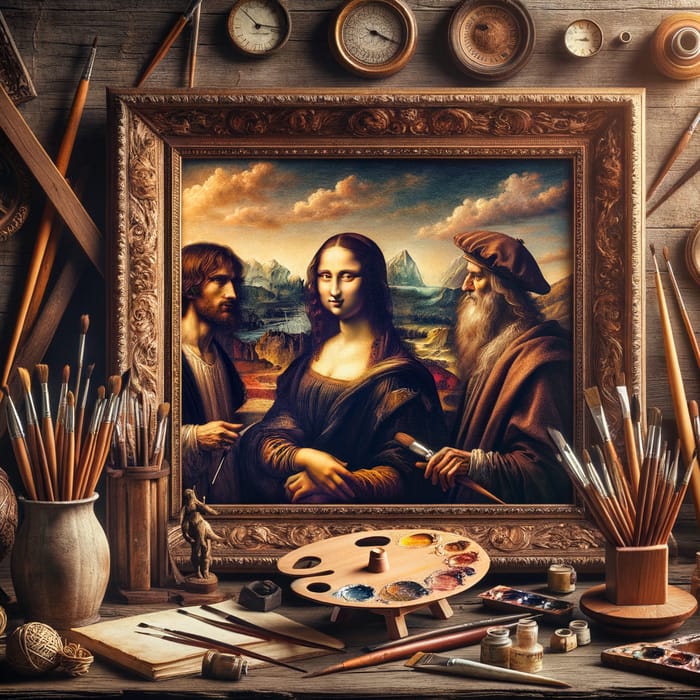
Consider the eyes of the Mona Lisa. They follow you. They seem to hold a secret. This is not the result of technical skill alone; it is the result of an artist who understood that art is not just about representation, but about connection. AI can generate a face that resembles the Mona Lisa, but it cannot replicate the way her gaze seems to pierce the veil between the viewer and the painted world. It cannot replicate the way a single brushstroke can evoke a thousand emotions, the way a painting can become a mirror for the soul.
This is the final frontier of AI’s limitations: the inability to replicate the ineffable. The Renaissance artist did not just paint what they saw; they painted what they believed. They painted the divine in the human, the eternal in the ephemeral. They painted not just a scene, but a revelation. And that, perhaps, is the trick that AI will never master.
The next time you stand before a Renaissance masterpiece, take a moment to appreciate not just what you see, but what you feel. That shimmer of light, that play of shadow, that spark of life—these are not tricks of the trade. They are the whispers of a human spirit that dared to believe in the power of art to transcend the ordinary. And in a world where AI can generate almost anything, these whispers remain uniquely, irrevocably, human.


Leave a Comment