


War is not merely a clash of armies—it is a symphony of screams etched into the fabric of history. Few artworks embody this truth as viscerally as Pablo Picasso’s Guernica, a mural-sized canvas that has traversed continents like a wounded refugee, its journey as fraught with peril as the bombing it commemorates. For decades, this masterpiece has been transported in a bulletproof case, a paradoxical safeguard for a painting that was, in itself, a weapon against fascism. Why does a work of art demand such extraordinary protection? The answer lies not just in its historical significance, but in the unrelenting power it wields over the human psyche—a power that has made it both revered and reviled, coveted and condemned.
The Birth of a Behemoth: When Art Became a War Cry
Commissioned in 1937 by the Spanish Republican government to adorn the pavilion at the Paris World’s Fair, Guernica was Picasso’s response to the Nazi Luftwaffe’s saturation bombing of the Basque town of Guernica on April 26, 1937. The assault, carried out in collaboration with Franco’s Nationalist forces, reduced the town to smoldering ruins in a matter of hours, slaughtering hundreds of civilians—many of them women and children. The attack was not just a military operation; it was a calculated act of psychological terror, designed to crush morale and demonstrate the indiscriminate lethality of modern warfare.
Picasso, then living in Paris, absorbed the news with a fury that would manifest in a frenzied six-week creative spasm. The result was a 25-foot-wide, 11-foot-tall canvas, rendered in stark monochrome—a deliberate choice to evoke the starkness of newspaper photographs and newsreels. The composition is a labyrinth of anguish: a dismembered soldier clutches a shattered sword, a mother cradles her lifeless child, a bull stands impassive amid the carnage, and a horse screams in agony, its body pierced by shrapnel. The painting is not a depiction of war; it is war distilled into its most primal, most horrific essence.
Within months of its unveiling, Guernica became a rallying cry for anti-fascist movements across Europe. Its power lay not in its beauty, but in its brutality—a brutal honesty that refused to romanticize conflict. Governments and dictatorships alike recognized its potency; in 1939, as Franco’s forces closed in on Barcelona, Picasso entrusted the painting to the Museum of Modern Art (MoMA) in New York for safekeeping, a decision that would set the stage for its perilous odyssey.
The Bulletproof Paradox: Why a Painting Needs Armor
To understand why Guernica travels in a bulletproof case, one must first grasp the paradox at its core: this painting is both a fragile relic and an indestructible force. The canvas itself, though meticulously preserved, is a tinderbox of historical trauma. Its fibers are saturated with the grief of a generation, and its pigments—mixed with Picasso’s own fury—retain an almost electrical charge. A single tear in the surface could unleash a storm of controversy, a wound that would be as much symbolic as physical.
Yet the real danger lies not in the painting’s material fragility, but in the passions it ignites. Guernica has been vandalized, threatened, and nearly lost to fire—most infamously in 1974, when a protester slashed it with a knife (though the damage was minimal). In 1997, a group of Basque separatists left a bomb outside MoMA, a chilling reminder that the painting’s message of anti-fascism and anti-violence could provoke violent counter-reactions. Even today, its display is often met with protests, from far-right groups who see it as an affront to Spanish nationalism to activists who argue that its placement in a museum sanitizes its revolutionary origins.
The bulletproof case is not just a practical measure; it is a metaphor. It signals that Guernica is not merely art—it is a living entity, one that must be shielded from the same forces it condemns. The case is a barrier against not just physical harm, but against the erasure of its message. In an era where history is constantly rewritten and propaganda is weaponized, Guernica remains a stubborn, unyielding truth—a truth that some would see silenced.
The Global Odyssey: A Painting on the Run

The journey of Guernica reads like a thriller, a narrative of exile, return, and perpetual motion. After its debut in Paris, the painting was smuggled across the Atlantic to New York, where it spent nearly four decades in MoMA’s custody. During World War II, it was kept in storage, its absence from public view a silent protest against fascism. In 1981, as Spain transitioned to democracy, the painting finally returned home—a homecoming that was as fraught as its departure. Franco was dead, but the wounds of his regime were still fresh. The painting’s arrival in Madrid was met with both jubilation and trepidation; some saw it as a symbol of reconciliation, while others feared it would reignite old conflicts.
Since then, Guernica has been a peripatetic figure, shuttled between Madrid and temporary exhibitions worldwide. Each move is a logistical nightmare, requiring climate-controlled environments, armed escorts, and, of course, the bulletproof case. In 2003, as the Iraq War raged, the painting was nearly sent to the U.S. for a retrospective, a decision that sparked outrage in Spain. Critics argued that displaying it in a country embroiled in a controversial war would dilute its anti-war message. The controversy underscored a painful truth: Guernica is not just a painting; it is a political lightning rod, a mirror held up to the world’s conscience.
Its travels have taken it to Japan, Brazil, and even war-torn Lebanon, where its presence was a defiant act of cultural resistance. Each destination has added another layer to its legend, transforming it from a single artwork into a global phenomenon—a testament to art’s ability to transcend borders and languages.
The Psychology of Fear: Why We Still Flinch at Guernica
There is a common observation about Guernica that often goes unspoken: people don’t just look at it; they recoil from it. The painting does not merely depict suffering—it immerses the viewer in it. The elongated limbs, the distorted faces, the absence of color—all conspire to create a sense of claustrophobic dread. Why does this image, now nearly a century old, still provoke such visceral reactions?
The answer lies in its refusal to offer catharsis. Unlike traditional war paintings, which often glorify heroism or martyrdom, Guernica offers no redemption. There are no victors here, only victims. The bull, often misinterpreted as a symbol of fascism, is more accurately a representation of the timeless, indifferent force of nature—nature that does not discriminate between soldier and civilian. The horse’s scream is not just the sound of pain; it is the sound of humanity’s collective trauma, a scream that echoes through the ages.
Psychologists have noted that Guernica triggers a phenomenon known as “moral injury”—a deep, existential distress that arises from witnessing or confronting acts of extreme violence. The painting does not just show war; it forces the viewer to confront the reality that war is not an abstract concept, but a series of individual tragedies. In an age where conflict is often reduced to statistics and soundbites, Guernica is a brutal reminder of the human cost behind the headlines.
This is why the painting’s travels are still dangerous. It is not just the risk of physical harm that makes its movements perilous; it is the risk of emotional confrontation. To display Guernica is to force a reckoning—not just with history, but with the present. Every time it is unpacked, every time it is hung, it demands that we ask ourselves: What have we learned? And the answer, more often than not, is unsettling.
The Unfinished Journey: Why Guernica Still Matters
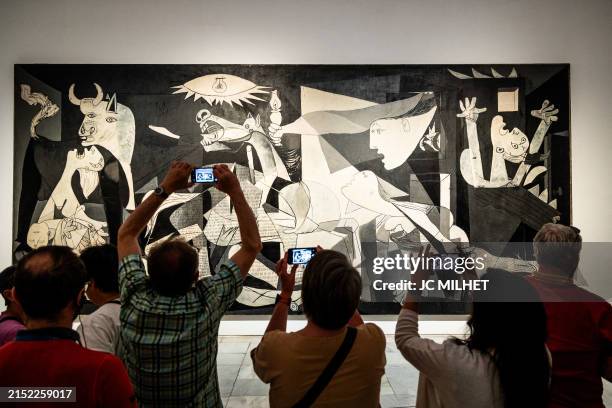
Picasso once said, “Art is a lie that tells the truth.” Guernica is the ultimate embodiment of that paradox. It is a lie in its abstraction, a distortion of reality that somehow feels more real than reality itself. And it tells the truth in a way that no photograph, no documentary, no news report ever could. The painting’s bulletproof case is not just a shield; it is a challenge—a challenge to look, to remember, and to never become numb to the horrors of war.
As the world lurches from one conflict to another, Guernica remains a sentinel, a warning etched in oil and pigment. Its travels are not just a logistical feat; they are a moral imperative. To move it is to keep its message alive, to ensure that the screams of Guernica do not fade into silence. And yet, the painting’s very existence raises a haunting question: if a work of art can still provoke such fear, such violence, after nearly a century, what does that say about humanity’s capacity for change?
Perhaps the most dangerous thing about Guernica is not its fragility, nor its power, but the uncomfortable truth it forces us to confront: that we are still capable of creating such horrors. And until that changes, the painting’s journey will continue—bulletproof case and all.


Leave a Comment