

The first time you witness two actors locked in the Meisner repetition exercise, it feels like watching a magic trick performed in slow motion—awkward at first, then suddenly electric. Their eyes meet. One repeats a phrase. The other echoes it back, but the words aren’t just repeated; they’re reborn. The air thickens. A spark ignites. What began as mechanical mimicry transforms into something raw, alive, and deeply human. In just three minutes, strangers become collaborators, and repetition becomes revelation. This is the alchemy of the Meisner repetition exercise, a cornerstone of modern acting training that turns the mundane into the mesmerizing.
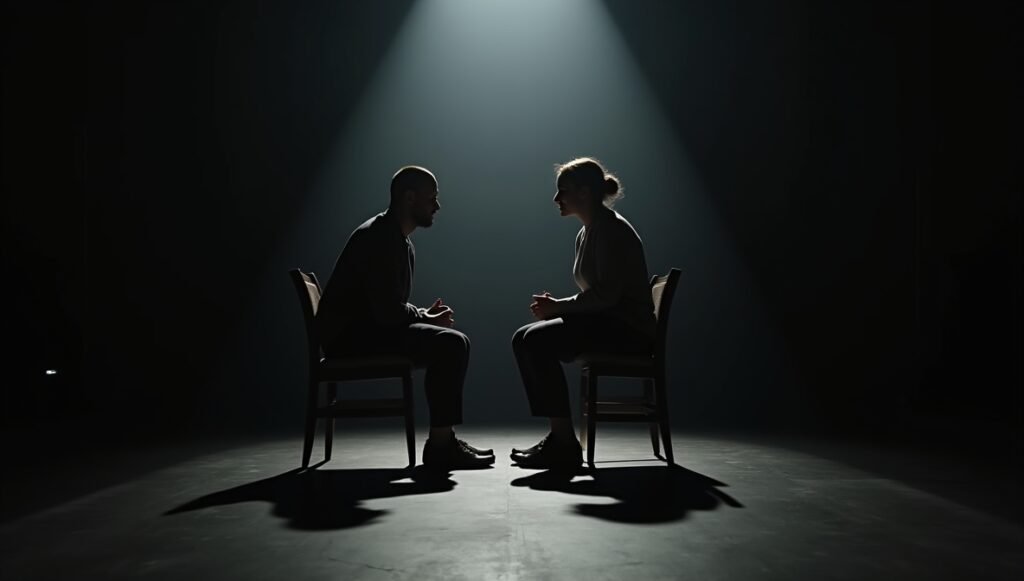
At its core, the repetition exercise is deceptively simple. Two actors sit facing each other. One delivers a line—any line, often as simple as “You look tired”—and the other repeats it back verbatim. No embellishments. No acting. Just echo. Yet within this simplicity lies a profound truth: acting isn’t about pretending; it’s about responding. The exercise strips away the layers of performance we’ve been taught—overthinking, forcing emotions, chasing results—and forces us to confront the raw material of human connection. It’s not about being interesting; it’s about being present. And in a world that rewards performance over authenticity, that’s a radical act.
The Illusion of Control and the Birth of Spontaneity
Most actors enter training with a deep-seated belief in control. We rehearse lines until they’re memorized. We choreograph movements. We craft backstories to justify every emotion. We treat the stage or screen like a laboratory where every variable must be accounted for. But the Meisner repetition exercise shatters this illusion. It’s not a scripted scene. There’s no director calling “cut.” There’s just two people, a phrase, and the terrifying freedom of the present moment.
When an actor first attempts repetition, the results are often stilted. The words feel hollow. The delivery is flat. The actor might try to “make it work” by adding inflection or urgency, but the exercise resists. It demands surrender. The key insight here is that repetition isn’t about the words—it’s about the impulse behind them. The first actor doesn’t just say, “You look tired.” They say it because something in the other person’s demeanor triggered a reaction. Maybe it’s exhaustion. Maybe it’s concern. Maybe it’s annoyance. The repetition exercise forces the actor to listen—not to the words, but to the truth they conceal. And that truth is always shifting.
This is where spontaneity is born. Spontaneity isn’t randomness; it’s responsiveness. It’s the ability to meet the moment without premeditation. In repetition, the actor learns to abandon the script of their own expectations and instead follow the thread of what’s happening in real time. It’s a muscle that atrophies under the weight of over-rehearsal and self-consciousness. But once strengthened, it becomes the actor’s most potent tool—a way to transform even the most mundane interaction into a scene of electric tension.
The Alchemy of Listening: Why Repetition Feels Like a Superpower
Actors are often told to “listen,” but repetition teaches what that really means. It’s not about waiting for your turn to speak. It’s not about formulating a response while the other person talks. True listening, as the Meisner exercise reveals, is a form of absorption. It’s the act of letting the other person’s energy, tone, and subtext seep into you until you can’t help but respond—not with words, but with your entire being.
Consider the difference between a rehearsed line and a repeated one. In a scripted scene, the actor might deliver a line with perfect timing and emotional precision, but it can still feel hollow if it’s not rooted in a genuine response. Repetition eliminates that possibility. There’s no time to plan. No room for performance. The actor must react to the now, not the “what if.” This is why repetition often feels like a superpower—it unlocks access to emotions that feel authentic because they’re not manufactured. They’re discovered.
There’s a fascinating paradox here: the more an actor tries to control the outcome of repetition, the more it eludes them. The magic happens when they stop trying to be interesting and instead focus on being affected. The first actor’s phrase isn’t just words; it’s a stimulus. The second actor’s repetition isn’t just mimicry; it’s a reaction. And when that reaction is pure—unfiltered by the actor’s ego—the room crackles with energy. It’s the difference between a performance and a conversation. Between artifice and truth.
From Awkward to Alive: The Three-Minute Transformation
The first minute of repetition is often the most painful. The actors feel exposed. The words feel empty. The silence stretches. But this is where the real work begins. The first actor must resist the urge to “make it better.” They must say the phrase with honesty, not performance. The second actor must resist the urge to “fix” the delivery. They must listen to the subtext—the unspoken emotion beneath the words.
By the second minute, something shifts. The repetition starts to feel less like an exercise and more like a dialogue. The actors begin to notice nuances—the slight hesitation in the other’s voice, the flicker of an emotion they didn’t expect. The words start to carry weight. The air between them grows charged. This is the moment where repetition transcends mechanics and becomes art.
In the third minute, the transformation is complete. The actors are no longer performing. They’re reacting. The phrase “You look tired” might now carry layers of concern, frustration, or even humor. The repetition isn’t just a mirror; it’s a conversation. And in that conversation, the actors find something rare: the ability to be fully present, fully alive, and fully themselves. It’s not about being a “good” actor. It’s about being a real one.
This three-minute arc—awkward to alive—isn’t just a training tool. It’s a metaphor for acting itself. Most of us spend our lives performing roles we’ve been handed, whether it’s the “perfect” employee, the “ideal” partner, or the “convincing” friend. But repetition teaches us that authenticity isn’t about fitting into a mold. It’s about responding to what’s in front of us, even when it’s uncomfortable. Even when it’s messy. Especially when it’s messy.
The Ripple Effect: How Repetition Changes Everything
The benefits of the Meisner repetition exercise extend far beyond the training room. Once actors internalize the principles of responsiveness and presence, they carry them into every aspect of their craft. Scripted scenes become more dynamic because the actor isn’t waiting for their cue—they’re reacting to their scene partner. Improvisation becomes effortless because the actor trusts their instincts. Even auditions transform, as the actor learns to listen to the casting director’s questions instead of reciting a memorized monologue.
But the ripple effect goes deeper. Repetition teaches actors to embrace vulnerability. It shows them that the most powerful performances come from the willingness to be affected—to let the world in and respond honestly. In a culture that often equates strength with control, repetition is a radical act of surrender. It’s the acknowledgment that we’re not in control of the moment, but we can be present within it.
There’s also a quiet rebellion in repetition. It rejects the idea that acting is about being “interesting” or “entertaining.” Instead, it champions the idea that acting is about being real. And in a world saturated with performances—on social media, in advertisements, even in casual conversations—authenticity is a revolutionary act. It’s the difference between a persona and a person. Between a role and a soul.
The Deeper Fascination: Why Repetition Resonates Beyond Acting
What makes the Meisner repetition exercise so compelling isn’t just its effectiveness as a training tool. It’s the way it mirrors something fundamental about human connection. We’re all, in some way, performing roles. We curate our lives for social media. We craft narratives about who we are. We hide our vulnerabilities behind scripts of our own making. But repetition reminds us that the most meaningful interactions aren’t the ones we’ve planned—they’re the ones we respond to in real time.
There’s a quiet magic in that realization. It’s the magic of two strangers sitting across from each other, saying the same words over and over, until the words lose their meaning and gain something far more powerful: truth. It’s the magic of watching someone transform from a performer into a person, simply by listening. And it’s the magic of discovering that the most profound connections aren’t built on grand gestures or perfect lines, but on the willingness to be present, to be affected, and to respond.
In a world that often feels scripted, the Meisner repetition exercise is a reminder that life isn’t about following a predetermined path. It’s about reacting to the moment, embracing the messiness of human connection, and finding the extraordinary in the ordinary. It’s not about being interesting. It’s about being alive.
So the next time you find yourself in a conversation that feels stale or a scene that feels forced, remember the repetition exercise. Strip away the performance. Listen to the subtext. Respond honestly. And watch as the mundane becomes mesmerizing. Because that’s where the real magic happens—not in the grand gestures, but in the quiet, unscripted moments of human connection.


Leave a Comment