

In the labyrinth of poetic expression, abstract poems often resemble a misty forest—beautiful in theory, but frustratingly elusive in practice. Readers wander through vague imagery, grasping at wisps of meaning that dissolve like morning dew. The problem isn’t the ambition; it’s the absence of a tangible foothold. Concrete images act as the sturdy bridges that transform abstract musings into vivid landscapes, inviting readers to step into the poem rather than merely observe it from a distance. This article explores why abstract poetry can feel like a puzzle missing half its pieces—and how concrete imagery can turn it into a masterpiece you can see, touch, and feel.
The Fog of Abstraction: Why Readers Struggle to Connect
Abstract poetry thrives on ambiguity, but that very quality can leave readers adrift in a sea of uncertainty. When a poem relies solely on broad concepts—love, time, sorrow—without grounding them in sensory detail, it becomes a cerebral exercise rather than an emotional experience. The mind, hungry for clarity, rebels against the void, leaving readers to decipher meaning like archaeologists piecing together shattered pottery. Consider the difference between a poem describing “the weight of grief” versus one that paints “a widow’s hands trembling as she folds a funeral shroud.” The latter doesn’t just name an emotion; it immerses the reader in its texture, its weight, its raw physicality. Without concrete anchors, even the most profound themes risk floating away like dandelion seeds on a windless day.
Concrete Imagery as the Poem’s Compass
Concrete imagery is the antidote to abstraction’s vagueness. It acts as a compass, guiding readers through the poem’s terrain with precision. Instead of saying “the night was dark,” a concrete image might describe “a moonless void where the only light came from the flicker of a dying candle.” The difference isn’t just in the specificity—it’s in the invitation. Concrete details engage the senses: the scent of damp earth after rain, the roughness of bark under fingertips, the metallic tang of blood on a kitchen knife. These details don’t just describe; they evoke. They transform a poem from a puzzle to be solved into a world to be inhabited. When readers can *see* the “cracked teacup on the windowsill” or *hear* the “whisper of silk against skin,” they no longer need to decode meaning—they *feel* it.

The Alchemy of Metaphor: Turning Abstract into Tangible
Metaphors are the poet’s alchemy, but they only work when the base materials are real. A weak metaphor, like “her heart was a storm,” leaves readers untouched because the comparison is too broad. A strong one, however, fuses the abstract with the concrete: “Her heart was a storm trapped in a glass jar, rattling against the walls with a sound like a trapped bird’s wings.” Here, the abstract emotion of heartbreak becomes tangible through the image of a storm in a jar—a vivid, almost claustrophobic picture. The key is to anchor the metaphor in something the reader can visualize. Ask yourself: *What does grief smell like? What does joy sound like?* Then, weave those sensory details into your comparisons. The result? A poem that doesn’t just *say* something—it *shows* it in living color.
Sensory Overload: Engaging All Five Senses
Poetry that lingers in the mind doesn’t just appeal to sight—it assaults all five senses. A concrete poem should be a feast for the senses, where every line is a course in a multi-sensory banquet. Consider this passage: “The soup simmered, releasing tendrils of steam that curled like question marks around the kitchen, carrying the scent of thyme and burnt onions.” Here, the reader doesn’t just *see* the soup; they *smell* it, *taste* the bitterness of the onions, *feel* the warmth of the steam on their skin. To write concrete poetry, you must become a detective of the senses. What does despair *taste* like? The answer might be “a mouthful of rusted nails and old pennies.” What does hope *sound* like? Perhaps “the first note of a violin tuning up in a half-empty concert hall.” The more senses you engage, the more real the poem becomes.
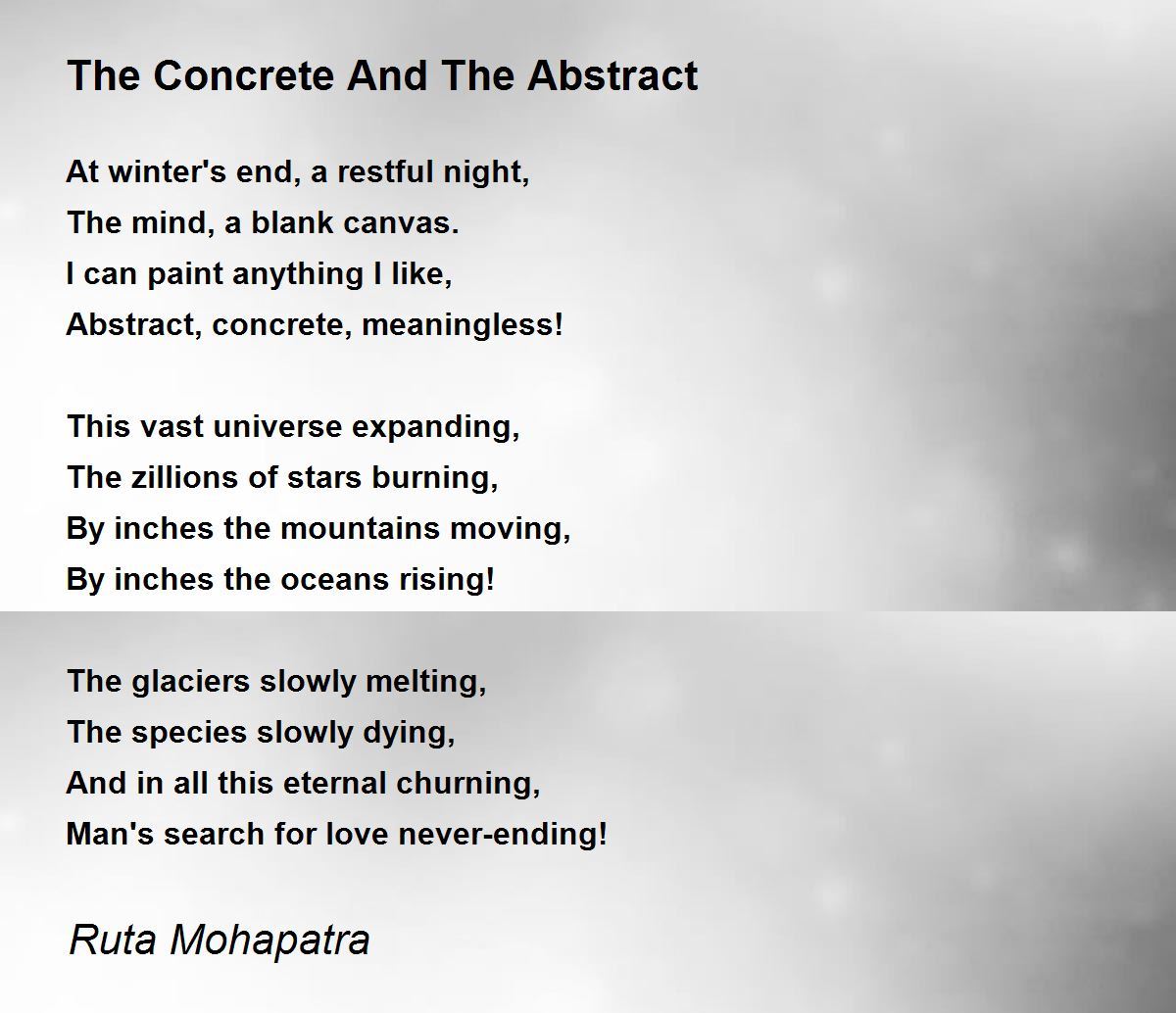
The Pitfalls of Over-Concretizing: When Details Drown the Meaning
While concrete imagery is a poet’s best friend, there’s a fine line between vivid detail and sensory overload. A poem that lists every object in a room—”the chipped teacup, the frayed doily, the rusted hinge on the door”—without purpose risks becoming a catalog rather than a poem. The goal isn’t to describe everything; it’s to describe the *right* things. Every concrete image should serve a dual purpose: it should ground the reader in the poem’s world *and* deepen the emotional or thematic resonance. Ask: *Does this detail reveal character? Advance the plot? Amplify the mood?* If not, it’s excess baggage. The best concrete poems are like well-composed photographs—every element is intentional, every shadow and highlight serves the whole.
Case Studies: From Abstract to Concrete Mastery
Let’s dissect two poems to see how concrete imagery transforms them. First, an abstract version: “The city was a place of loneliness.” Now, a concrete rewrite: “The city was a place of loneliness, where neon signs buzzed like dying insects and the subway’s groan echoed like a ghost’s last breath.” The first line states a feeling; the second *embodies* it. The concrete version doesn’t just tell us about loneliness—it immerses us in its sounds, its textures, its oppressive weight. Another example: “She felt trapped.” Concrete rewrite: “She felt trapped, like a moth pinned beneath a collector’s glass, its wings fluttering against the cold barrier of the frame.” The abstract version is a statement; the concrete version is a visceral experience. The lesson? Never settle for describing emotions—*stage* them.
Exercises to Train Your Concrete Eye
If your poetry leans too heavily on abstraction, try these exercises to sharpen your concrete instincts:
- Sensory Inventory: Pick an abstract emotion (e.g., jealousy) and list five concrete sensory details that evoke it. What does jealousy smell like? What sound does it make? What texture does it have?
- Object as Metaphor: Choose a mundane object—a rusted key, a cracked mirror—and write a poem where it symbolizes an abstract concept (e.g., lost love, shattered identity).
- Rewrite the Abstract: Take a vague line from your own work and rewrite it using only concrete imagery. Strip away all abstract nouns and verbs.
- Sensory Walk: Go for a walk and jot down every sensory detail you notice—the way sunlight filters through leaves, the scent of wet pavement, the distant hum of traffic. Use these in your next poem.
These exercises aren’t just drills; they’re a way to retrain your brain to see the world—and your poetry—in vivid, tangible terms.

The Future of Poetry: Where Concrete Meets Innovation
In an era of digital distraction, poetry’s survival depends on its ability to cut through the noise. Concrete imagery is the secret weapon that makes poetry *unignorable*. It’s why spoken-word poets command auditoriums and why Instagram poets amass millions of followers—because they don’t just *tell* stories; they *paint* them in the reader’s mind. The future of poetry isn’t in abandoning abstraction but in *balancing* it with the concrete. The most enduring poems are those that can soar into the ethereal while keeping one foot firmly planted in the tangible. Whether you’re writing a sonnet or a free-verse manifesto, remember: the best poems don’t just *say* something—they *make* you feel it.
So the next time you sit down to write, ask yourself: *What can my reader see, hear, touch, taste, or smell?* If the answer is “nothing,” it’s time to trade the fog for the forest. The world is already abstract enough. Your poetry should be the oasis of clarity in its midst.


Leave a Comment