

Woodworking is a craft that marries precision with artistry, where the union of two pieces of timber can tell a story of strength, elegance, and ingenuity. While screws and glue are the go-to fasteners for many projects, there exists a realm of joints that defy the need for such modern conveniences. These traditional connections rely solely on the innate properties of wood—its grain, its density, and its ability to interlock with remarkable tenacity. They are the silent heroes of joinery, whispering tales of craftsmanship from eras when tools were simpler, but the understanding of wood was profound. Let’s explore ten such joints, each a testament to the timeless marriage of form and function.
The Dovetail Joint: A Dance of Geometry and Strength
The dovetail joint is the quintessential example of how geometry can create an unbreakable bond. Its trapezoidal shape, wider at the base and tapering outward, locks two pieces of wood together with a tenacity that rivals any mechanical fastener. When two tails fit snugly into their corresponding pins, the joint resists pulling apart with a ferocity that seems almost supernatural. This joint is a favorite among drawer construction, where the relentless tug of gravity demands unwavering resistance. The beauty of the dovetail lies not just in its strength but in the way it showcases the woodworker’s skill—each cut must be exact, each angle immaculate. There’s a poetic irony in how something so rigid can feel so fluid in the hands of a master.
The Mortise and Tenon: The Ancient Bond of Timber
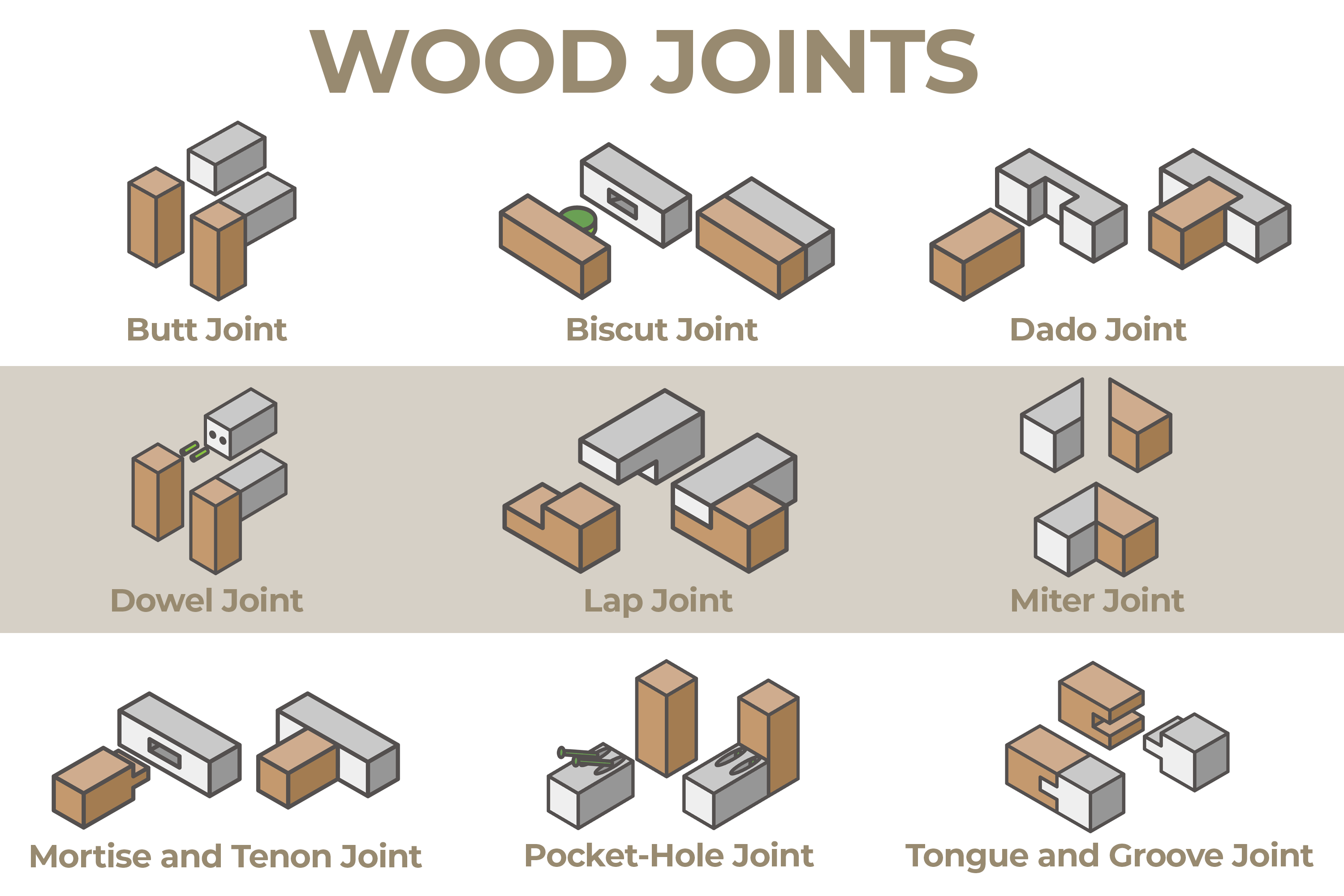
Few joints carry the weight of history like the mortise and tenon. Dating back millennia, this joint consists of a protruding tenon that fits snugly into a corresponding mortise, or cavity, in the adjoining piece. The simplicity of its design belies its incredible strength, making it a staple in everything from furniture to timber framing. What makes this joint so fascinating is its adaptability—it can be wedged for extra security, haunched to prevent twisting, or even blind to maintain a clean surface. The mortise and tenon is a silent testament to the enduring nature of woodworking traditions, where the same principles that built ancient barns still hold true in modern workshops.
The Bridle Joint: A Bridge Between Precision and Power
Often overshadowed by its more famous counterparts, the bridle joint is a marvel of structural integrity. It involves a slot cut across the end of one piece, which then receives the entire end of another piece, creating a connection that spans the width of the wood. This joint is particularly useful in frames, where it distributes weight evenly and resists racking forces. The bridle joint’s elegance lies in its simplicity—no complex angles, no intricate carvings, just a clean, strong union. It’s the kind of joint that whispers rather than shouts, a quiet but unmistakable statement of craftsmanship.
The Finger Joint: A Modern Twist on an Old Classic
While the finger joint may seem like a contemporary innovation, its roots stretch back centuries. This joint features interlocking “fingers” that mesh together like a three-dimensional puzzle, creating a bond that is both visually striking and remarkably strong. It’s a favorite in box construction, where its interlocking design prevents the wood from pulling apart under stress. The finger joint is a celebration of repetition and precision, where each cut must align perfectly to ensure a seamless fit. There’s a rhythmic satisfaction in cutting finger joints, a meditative process that rewards patience with a connection that feels almost alive.
The Half-Lap Joint: Where Simplicity Meets Substance
Sometimes, the most effective solutions are the simplest ones. The half-lap joint involves cutting halfway through two pieces of wood so that they overlap and sit flush with one another. This joint is a masterclass in minimalism, using the natural strength of the wood to create a bond that requires no additional fasteners. It’s a joint that thrives in applications where aesthetics matter as much as function, such as in frame construction or panel assemblies. The half-lap joint is a reminder that not all strength needs to be overt—sometimes, the quietest solutions are the most enduring.
:max_bytes(150000):strip_icc()/Wood-Joints-fdf0ae5b6e2c40438e6800fe91fe2733.png)
The Rabbet Joint: The Unsung Hero of Flush Connections
In a world of complex joints, the rabbet joint stands out for its straightforward utility. It involves cutting a recess, or rabbet, along the edge of one piece of wood, which then fits snugly against another piece. This joint is a staple in cabinetry and case construction, where it creates a seamless, flush connection that hides unsightly end grain. The rabbet joint’s strength lies in its ability to distribute stress evenly, making it ideal for applications where stability is paramount. It’s the kind of joint that doesn’t seek the spotlight but quietly does its job with unassuming efficiency.
The Tongue and Groove: A Marriage of Form and Function
Few joints are as ubiquitous—or as underappreciated—as the tongue and groove. This joint features a protruding tongue on one piece that fits into a corresponding groove on another, creating a connection that is both strong and adaptable. It’s a favorite in flooring, paneling, and even some furniture applications, where it allows for wood movement without sacrificing stability. The tongue and groove’s genius lies in its ability to accommodate expansion and contraction, a feature that makes it indispensable in environments where temperature and humidity fluctuate. It’s a joint that embodies the harmony between nature and craftsmanship.
The Scarf Joint: A Seamless Extension of Wood
When the length of a board isn’t quite enough, the scarf joint steps in to save the day. This joint involves cutting an angled face on the ends of two boards, which are then glued or clamped together to create a seamless extension. While it’s often associated with glue, a well-cut scarf joint can hold together without any adhesive, relying solely on the friction and grain alignment of the wood. It’s a joint that speaks to the woodworker’s ability to think beyond the constraints of raw materials, transforming limitations into opportunities for innovation.
The Box Joint: A Cousin of the Dovetail with Its Own Charm
Like the dovetail, the box joint features interlocking fingers, but with a crucial difference: the fingers are square rather than trapezoidal. This creates a joint that is easier to cut—especially with a router or table saw—but still boasts impressive strength. The box joint is a favorite in box and drawer construction, where its clean, geometric lines add a touch of modernity to traditional woodworking. There’s a satisfying symmetry to the box joint, a balance between simplicity and sophistication that makes it a joy to both create and behold.

The Knuckle Joint: A Hidden Gem of Complexity
For those seeking a challenge, the knuckle joint offers a delightful puzzle of interlocking curves. This joint involves cutting a series of convex and concave shapes that fit together like puzzle pieces, creating a connection that is both strong and visually intriguing. The knuckle joint is a favorite among advanced woodworkers, who appreciate its complexity and the way it showcases the natural beauty of the wood. It’s a joint that demands patience and precision, rewarding the effort with a connection that feels almost organic in its strength.
Woodworking joints that don’t require screws or glue are more than just mechanical connections—they are a testament to the enduring relationship between human ingenuity and the natural world. Each joint tells a story, whether it’s the ancient wisdom of the mortise and tenon or the modern elegance of the finger joint. They remind us that true craftsmanship isn’t about relying on the latest tools or materials, but about understanding the inherent properties of wood and harnessing them with skill and creativity. In a world where disposable solutions are the norm, these joints stand as a quiet rebellion—a celebration of permanence, precision, and the timeless art of making things by hand.


Leave a Comment