

In the grand ballet of woodworking, where each cut and shave tells a story, there exists a moment of raw, unfiltered beauty—the transformation of a rough-hewn slab into a canvas of polished potential. Yet, this metamorphosis often feels like a luxury reserved for those wielding the gleaming, thunderous might of a $2,000 drum sander. But what if the secret to flattening a slab wasn’t locked behind a vault of expensive machinery, but instead whispered through the grain of the wood itself? What if the path to a flawless surface was paved not with gold-plated tools, but with ingenuity, patience, and a touch of audacious creativity?
Imagine the slab as a sleeping giant, its surface a rugged landscape of peaks and valleys, waiting to be tamed. The drum sander, with its industrial roar, is but one way to awaken this giant—though a costly one. But why should the giant’s awakening be confined to the whims of machinery? The true artistry lies in coaxing the wood to reveal its smoothness through methods that are as much about dialogue as they are about force. Flattening a slab without a drum sander isn’t just a workaround; it’s a rebellion against the notion that perfection requires a king’s ransom in tools. It’s about embracing the wood’s inherent character while gently guiding it toward its most refined self.

The Slab as a Canvas: Understanding the Wood’s Whispers
Before any flattening begins, the slab must be understood—not as an inert chunk of timber, but as a living, breathing entity with its own idiosyncrasies. Each slab, whether oak, walnut, or maple, carries a unique narrative in its grain, knots, and imperfections. The first step is to listen. Run your fingers along the surface. Feel the undulating topography, the resistance of the harder grain, the yielding softness of softer pockets. This tactile reconnaissance is your first brushstroke in the grand composition of flattening.
Wood, in its raw state, is a storyteller. The medullary rays in walnut whisper of ancient forests, while the swirling burls in maple hint at the tree’s tumultuous life. To flatten a slab without a drum sander is to honor these stories while gently reshaping them. The goal isn’t to erase the wood’s character but to amplify it, revealing the hidden depths beneath the rough exterior. This is where the metaphor of the slab as a canvas comes alive—every plane, every scrape, every pass with a hand tool is a stroke of the artist’s brush, guided by intuition rather than rigid machinery.
The Hand Plane: Your Silent Partner in the Flattening Dance
Enter the hand plane—a tool as old as woodworking itself, yet as versatile as any modern marvel. The hand plane is not merely a scraper; it is a silent partner in the flattening dance, a tool that demands patience but rewards with an intimacy that no machine can replicate. The key to using a hand plane effectively lies in understanding its dance with the wood. Start with a jack plane, a workhorse designed to remove material quickly. The initial passes should be aggressive, shaving off the highest peaks with a rhythmic, almost meditative motion. The sound of the plane’s iron biting into the wood is the symphony of flattening, a crescendo of shavings curling like ribbons from the surface.
But the hand plane’s true magic emerges in its ability to reveal the slab’s true form. As you progress, switch to a smoother plane, a tool that whispers rather than roars. This is where the slab begins to transform. The smoother’s finer blade dances across the surface, teasing out the last vestiges of unevenness. The goal isn’t speed but precision—each pass a deliberate stroke, each shaving a testament to the wood’s gradual surrender to flatness. The hand plane, in this context, is not just a tool; it is a translator, converting the slab’s rough language into the smooth prose of a finished surface.
The Router Jig: A Modern Alchemy for the Flattening Alchemist
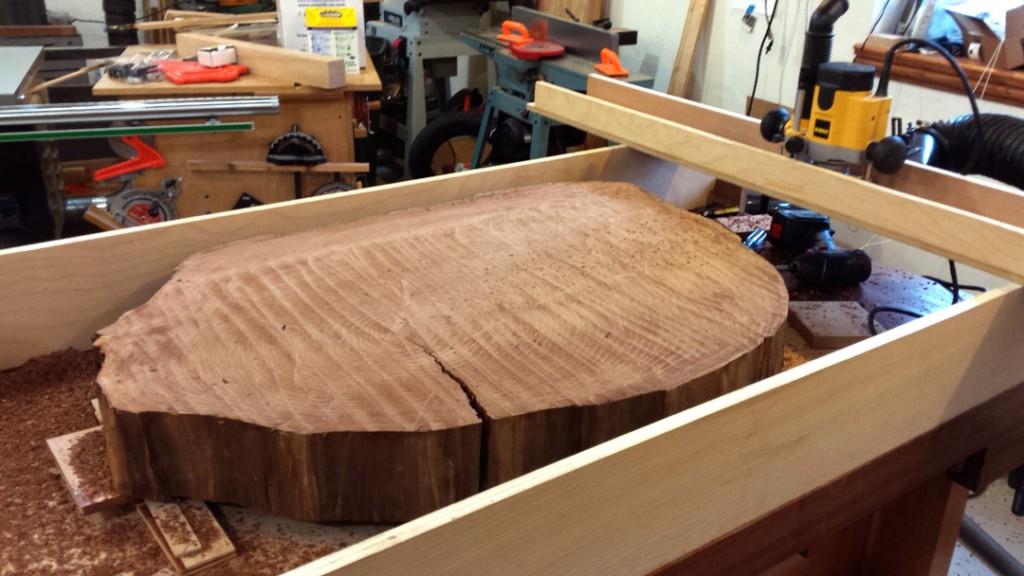
For those who seek a blend of old-world craftsmanship and modern ingenuity, the router jig is a revelation. This method transforms a humble router—a tool often relegated to edge profiling—into a precision flattening machine. The secret lies in the jig itself, a custom-built scaffold that guides the router’s bit in a controlled, level path across the slab’s surface. The jig’s design is where the alchemy happens: a flat, stable base, often constructed from MDF or plywood, with rails to keep the router on a predetermined course.
The router’s bit becomes the sculptor’s chisel, carving away the high points with surgical precision. The beauty of this method is its adaptability. Whether you’re working with a 24-inch slab or a monstrous 6-foot giant, the jig can be scaled to match. The router’s speed and depth of cut can be adjusted to suit the wood’s hardness, allowing for a tailored approach. As the bit glides across the surface, the slab’s transformation is almost cinematic—a rough, uneven expanse slowly yielding to a level plane, like a sculptor chipping away at a block of marble to reveal the figure within.
The router jig also democratizes flattening, making it accessible to those without access to a drum sander or a fleet of hand planes. It’s a testament to the idea that flattening isn’t about the tool, but about the mind behind it. With a well-built jig and a steady hand, even the most unruly slab can be tamed, its surface smoothed to a mirror-like sheen.
The Scraper’s Serenade: The Unsung Hero of Flattening
In the pantheon of woodworking tools, the scraper is often the overlooked stepchild, dismissed as a relic of a bygone era. Yet, in the realm of slab flattening, it is a virtuoso. The scraper—a simple piece of hardened steel with a slightly curved edge—is capable of producing surfaces so smooth they rival those of a finely tuned machine. The secret to its power lies in its simplicity and the skill of the hand that wields it.
To use a scraper effectively, the slab must first be brought close to flatness using other methods, such as a hand plane or router jig. The scraper then takes over, refining the surface with a series of delicate, almost surgical passes. The motion is gentle, the pressure light, as if the scraper is coaxing the wood to reveal its secrets. The result is a surface so smooth that it feels like silk beneath the fingertips, a testament to the wood’s natural beauty rather than the imposition of machinery.
The scraper’s serenade is not just about the end result; it’s about the process. There’s a meditative quality to working with a scraper, a rhythm that slows the heart rate and sharpens the mind. It’s a reminder that flattening a slab isn’t just about achieving a flat surface—it’s about the journey, the dance between tool and wood, and the quiet satisfaction of seeing a rough giant transformed into a thing of elegance.
The Final Flourish: Sanding with Purpose
Even after the hand plane, router jig, and scraper have worked their magic, the slab may still require a final touch—sanding. But this isn’t the mindless, back-and-forth sanding of a drum sander’s belt. This is sanding with purpose, a deliberate process that refines the surface to its final glory. Start with a coarse grit, perhaps 80 or 100, to knock down any remaining high spots or tear-out from the previous steps. The key here is to sand with the grain, following the wood’s natural direction to avoid scratching the surface.
As the grits progress—120, 150, 220—the slab begins to glow. Each pass removes the scratches from the previous grit, leaving behind a surface that is increasingly refined. The final grits, 320 and above, are where the magic happens. The wood takes on a lustrous sheen, its grain popping with depth and richness. This is the moment when the slab’s true character is revealed, when the flattening process transitions from a technical endeavor to an artistic one.
Sanding, in this context, is not just a means to an end but an act of reverence. It’s the woodworker’s final bow to the slab, a gesture of respect for the material’s journey from rough-hewn timber to a thing of beauty. The sandpaper becomes a paintbrush, and the slab, the canvas, ready to be transformed into a tabletop, a counter, or a piece of art.
Flattening a slab without a $2,000 drum sander is not about settling for less. It’s about embracing more—more creativity, more intimacy with the material, more connection to the craft. It’s a rebellion against the idea that perfection requires a king’s ransom in tools, and a celebration of the idea that the most profound transformations often begin with the simplest of tools. The slab, in all its rugged glory, becomes a testament to the woodworker’s skill, patience, and vision. And when the final pass is made, when the surface is smooth as glass and the grain sings with life, you’ll realize that the secret to flattening a slab wasn’t hidden in the price tag of a machine—it was always there, in the wood itself, waiting to be coaxed into its most elegant form.


Leave a Comment