

Ever stared at a blank page, palette knife trembling, wondering how to transform your artistic journey into a document that screams professionalism—even if your exhibition history is more barren than a desert mirage? Crafting an artist CV when you’re still building your reputation feels like trying to paint the Sistine Chapel with a toothbrush. But what if I told you that a lack of exhibitions doesn’t have to relegate your CV to the recycle bin of mediocrity? What if your artistic narrative could leap off the page, bold and unapologetic, even before your first gallery debut?
Imagine walking into a room where every glance at your CV feels like a handshake—firm, confident, and impossible to ignore. Whether you’re a painter who’s never hung a piece in a public space, a sculptor whose work exists only in your studio, or a digital artist whose portfolio is a digital ghost town, your CV can still command respect. The secret? It’s not about what you’ve done—it’s about how you frame it. Let’s dive into the art of crafting an artist CV that doesn’t just survive the professional wilderness but thrives in it.
The Myth of the Exhibition-Driven CV: Why Your Story Matters More Than the Walls You’ve Hung On
There’s a pervasive myth in the art world that your CV is a ledger of exhibitions, residencies, and awards—a trophy case of where your work has been seen. But what if your greatest strength lies not in where you’ve exhibited, but in how you’ve evolved? The blank spaces on your CV aren’t voids; they’re opportunities to narrate a journey that’s uniquely yours. Think of it this way: every artist who ever mattered started somewhere. The difference between a forgettable CV and a magnetic one is the ability to turn absence into anticipation.
Consider the sculptor who’s spent years refining their technique in solitude, or the painter who’s experimented with mediums no one else has dared to touch. These aren’t gaps—they’re chapters waiting to be told. The key is to reframe your narrative. Instead of listing exhibitions that haven’t happened yet, highlight the evolution of your practice. Have you explored new techniques? Collaborated with other creatives? Pushed the boundaries of your medium? These are the threads that weave a compelling story, one that doesn’t rely on external validation to shine.

Take inspiration from the way a novel unfolds. The best stories don’t begin with a checklist of achievements; they begin with a question, a challenge, or a moment of transformation. Your CV can do the same. Start with a bold statement about your artistic philosophy. Follow it with a section on your education and training—even if it’s self-directed. Then, pivot to your artistic practice, emphasizing the depth of your exploration rather than the breadth of your exhibitions. This approach doesn’t just fill the page; it invites the reader into your world.
Education and Self-Directed Learning: The Hidden Goldmine of Your CV
If exhibitions are the currency of the art world, education is the foundation upon which your career is built. But what if your formal education is sparse? What if you’re entirely self-taught? Fear not—this isn’t a liability; it’s a unique selling point. The art world is increasingly valuing raw, unfiltered creativity over pedigree. The question isn’t whether you’ve attended a prestigious art school; it’s whether you’ve relentlessly pursued your craft, whether you’ve devoured books, attended workshops, or engaged in online courses that pushed your boundaries.
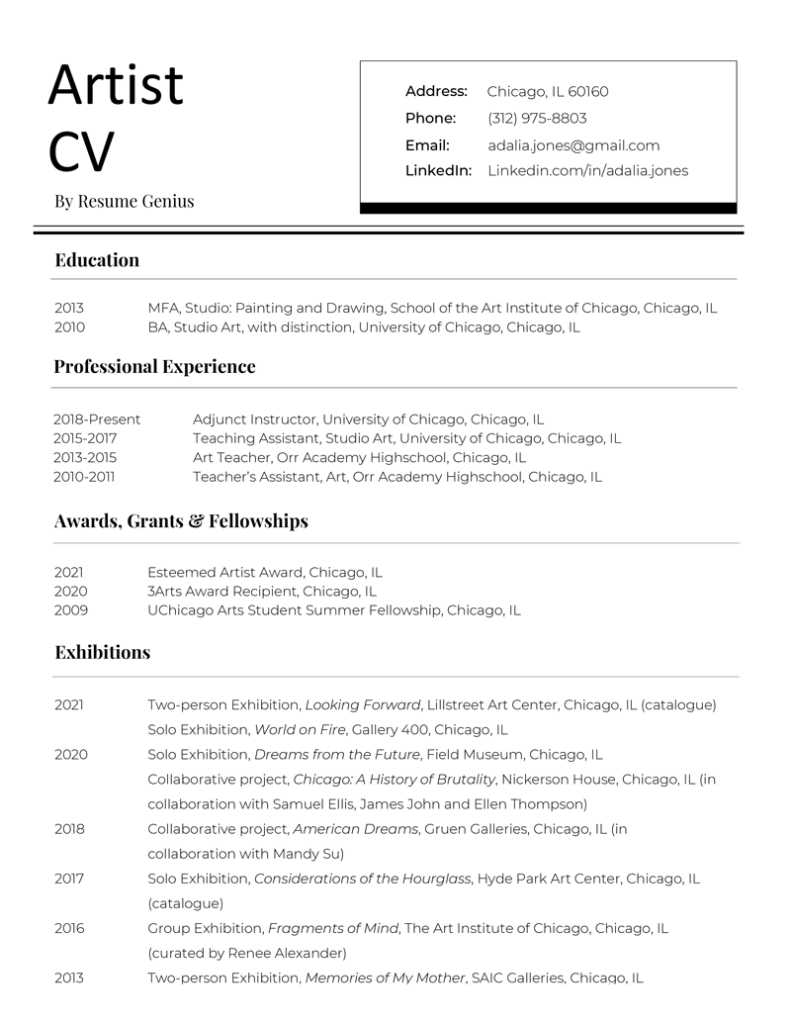
Start by listing any formal education you’ve completed, but don’t stop there. Include workshops, online courses, and even informal learning experiences. Did you spend a summer studying under a local artist? Did you complete a series of online tutorials that transformed your technique? These are the details that paint a picture of a dedicated practitioner. The goal isn’t to impress with a laundry list of credentials; it’s to demonstrate a commitment to growth that transcends traditional boundaries.
Consider adding a section titled “Continuing Education” or “Professional Development.” Here, you can highlight any relevant courses, books, or mentorships that have shaped your artistic journey. For example:
- “2022: Masterclass in Abstract Expressionism, Online”
- “2021: Workshop on Mixed Media Techniques, Local Art Center”
- “2020: Self-Study in Digital Illustration, Comprehensive Online Course”
This approach not only fills the page but also subtly communicates that your artistic journey is one of perpetual evolution. It’s a narrative that says, “I may not have exhibited yet, but I’m not waiting for permission to create.”
Artistic Practice: Where the Magic Happens (And How to Make It Shine)
Now, let’s talk about the heart of your CV—the section where your artistic practice takes center stage. This is where you transform your work from a hobby into a profession, not through exhibitions, but through the sheer force of your dedication. Start by describing your medium, your techniques, and the themes that drive your work. Be specific. Instead of saying, “I paint,” say, “I explore the interplay of light and shadow through oil on canvas, using a layering technique inspired by the Old Masters.”

Next, highlight any projects or bodies of work you’ve completed, even if they’ve never been shown publicly. Have you created a series of paintings exploring a particular theme? Have you experimented with a new medium that pushed your boundaries? These are the details that make your CV feel alive. For example:
- “Ongoing Series: ‘Fragments of Memory’ – A collection of 12 oil paintings exploring the ephemeral nature of recollection.”
- “Experimental Project: ‘Digital Collage as a Bridge Between Traditional and Contemporary Art’ – A 6-month exploration of mixed media techniques.”
Don’t shy away from including works in progress or future projects. This isn’t about lying about what’s been completed; it’s about showcasing the dynamism of your practice. It signals to potential collaborators, galleries, or patrons that you’re not just an artist—you’re a force of creative energy.
Consider adding a section titled “Exhibitions in Progress” or “Upcoming Projects.” Even if these are speculative or in the planning stages, they demonstrate ambition and forward momentum. For example:
- “Upcoming Solo Exhibition: ‘Echoes of Silence’ – Planned for 2025, featuring a new body of work exploring the intersection of sound and visual art.”
This approach turns your CV into a living document, one that evolves alongside your artistic journey. It’s a subtle reminder that your career isn’t defined by what’s already happened—it’s defined by what you’re capable of creating next.
Grants, Residencies, and Other Opportunities: The Unseen Threads of Professionalism
Even if you haven’t exhibited, you may have applied for grants, residencies, or other opportunities that, for one reason or another, didn’t come to fruition. Don’t let these rejections gather dust in a digital folder. Instead, list them under a section titled “Applications and Proposals.” This isn’t about boasting about near-misses; it’s about demonstrating that you’re actively engaging with the professional art world. It shows that you’re not just waiting for an opportunity to fall into your lap—you’re creating them.
For example:
- “2023: Submitted proposal for ‘Emerging Voices’ Residency at the XYZ Art Foundation.”
- “2022: Applied for the ABC Grant for Innovative Artistic Practice.”
This section serves as a testament to your ambition and your willingness to put your work out there, even when the odds aren’t in your favor. It’s a subtle but powerful way to communicate that you’re serious about your craft and committed to growing as an artist.
Additionally, consider including any relevant professional affiliations or memberships. Are you part of an online art community? Have you volunteered at local art events? These details, while seemingly minor, add depth to your CV and paint a picture of an artist who is deeply embedded in the creative ecosystem.
References and Testimonials: The Power of Third-Party Validation
Even if you haven’t exhibited, you’ve likely collaborated with other artists, mentors, or professionals who can speak to your talent and dedication. Don’t underestimate the power of a well-placed testimonial. Reach out to former instructors, peers, or even clients (if you’ve done any freelance or commissioned work) and ask if they’d be willing to provide a short quote about your artistic practice. These testimonials can be included in a section titled “References and Testimonials” or woven into the narrative of your CV.
For example:
“[Your Name]’s dedication to their craft is unparalleled. Their experimental approach to mixed media has pushed the boundaries of what’s possible in contemporary art.” – Jane Doe, Art Instructor
These testimonials serve as external validation, lending credibility to your CV even in the absence of exhibitions. They transform your document from a personal statement into a collaborative narrative, one that’s backed by the voices of those who’ve witnessed your growth firsthand.
Formatting and Design: The Silent Ambassador of Your Professionalism
A CV isn’t just about content—it’s about presentation. The way your CV looks is as important as what it says. A cluttered, poorly designed document can undermine even the most compelling narrative. Conversely, a clean, professional layout can elevate your CV from forgettable to unforgettable.
Start with a simple, elegant font—something that’s easy to read but still carries a touch of personality. Avoid overly decorative fonts that distract from the content. Next, consider the structure. Use clear headings and subheadings to guide the reader through your CV. Bullet points are your friend; they break up dense blocks of text and make your CV scannable.
White space is your ally. Don’t cram every inch of the page with text. Instead, allow for breathing room. This not only makes your CV easier to read but also conveys a sense of professionalism and intentionality. Think of it as the difference between a cluttered studio and a curated gallery space—both can hold incredible work, but one invites the viewer in while the other overwhelms them.
Finally, consider the overall aesthetic. If you’re a painter, could your CV incorporate subtle nods to your artistic style? If you’re a digital artist, could the layout reflect your digital savvy? This isn’t about turning your CV into a piece of art itself (unless that’s your intention), but about ensuring that the design complements the narrative you’re trying to convey.
The Final Brushstroke: Why Your CV Isn’t Just a Document—It’s Your First Exhibition
As you stand back and admire your newly crafted CV, remember this: it’s not just a list of achievements or a summary of your artistic journey. It’s your first exhibition. It’s the first impression you make on gallerists, patrons, and collaborators. It’s the document that transforms you from an unknown artist into a professional worthy of attention.
So, the next time you stare at a blank page, wondering how to fill it, remember that your CV isn’t a ledger of what you’ve done—it’s a canvas for what you’re capable of. It’s a testament to your dedication, your creativity, and your unshakable belief in your craft. And when the time comes for your first real exhibition, you’ll look back at this document not as a placeholder, but as the foundation upon which your career was built.
Now, go forth and let your CV speak for you. Let it be the brushstroke that introduces you to the world—not as an artist waiting for a chance, but as an artist who’s already arrived.


Leave a Comment