

Instagram’s latest update isn’t just another tweak in the algorithm—it’s a quiet revolution wrapped in a user interface that feels eerily familiar. Beneath the polished veneer of reels and stories, the platform has quietly embedded a labyrinthine maze of AI training permissions, buried so deep that even the most tech-savvy users might miss the escape hatch. If you’ve ever scrolled past a post and wondered why your face, your voice, or even your background chatter might be fueling the next generation of machine learning models, you’re not alone. The opt-out isn’t just hidden; it’s designed to feel like an afterthought, a footnote in the fine print of a 50-page terms-of-service document. But here’s the truth: it’s there. And finding it could mean the difference between your data feeding the AI beast or staying firmly under your control.
Let’s be clear—Instagram’s AI ambitions aren’t new. For years, the platform has been siphoning user-generated content to train everything from facial recognition algorithms to predictive text models. What’s changed is the subtlety of the approach. Gone are the days of overt consent forms with flashing red warning signs. Instead, Instagram has woven its data-harvesting mechanisms into the fabric of everyday interactions, making resistance feel like swimming against a current of convenience. The result? A system that thrives on the illusion of choice while systematically eroding the boundaries of personal privacy.
The Illusion of Control: Where Opt-Outs Go to Die
Imagine logging into Instagram after a long day, only to be greeted by a notification that reads: “Help us improve your experience.” It sounds benign, almost altruistic. But buried within that notification is a link—one that leads to a settings page where, if you squint hard enough, you might spot a toggle labeled “Limit ad tracking” or “Data usage for AI.” The problem? These toggles are often pre-selected, their default states favoring Instagram’s data appetites. Even if you flip them, the platform’s language implies that opting out might degrade your experience, as if your personal data is merely a currency for smoother scrolling.
This isn’t just a design flaw—it’s a psychological maneuver. By framing data collection as a collaborative effort (“help us improve”), Instagram shifts the burden of responsibility onto the user. The message is clear: if you care about the platform’s evolution, you’ll play along. The deeper you dig, the more you realize that the opt-out isn’t a right—it’s a privilege, one that requires navigating a gauntlet of nested menus and cryptic legal jargon. For the average user, the process feels less like exercising agency and more like deciphering an ancient scroll.
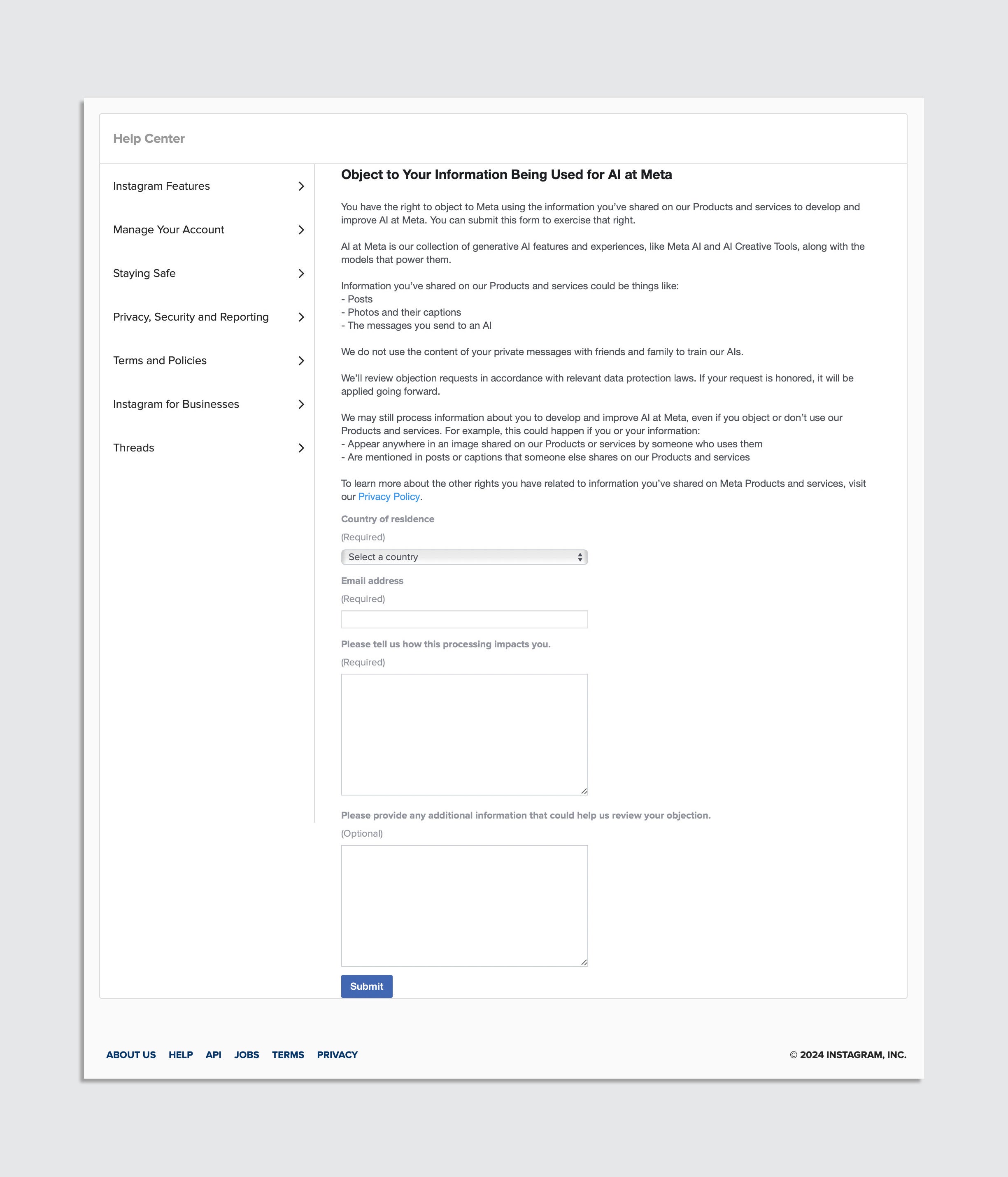
The irony? Instagram’s own research suggests that users are increasingly wary of opaque data practices. Yet the platform persists in treating transparency as an afterthought. The opt-out exists, but it’s buried under layers of “Settings,” “Privacy,” and “Ad Preferences,” each click feeling like a gamble between privacy and functionality. It’s as if the platform is daring you to find the loophole—because if you do, you’ll realize how much control you’ve unknowingly surrendered.
The Fine Print’s Hidden Trap: How AI Training Slips Through the Cracks
To understand how Instagram’s AI training operates, you have to dissect the fine print like a surgeon. Buried in the platform’s terms of service is a clause that grants Instagram the right to use “user content” for “machine learning purposes.” The wording is deliberately vague—what constitutes “user content”? Photos, videos, captions, even the metadata of your posts? The answer, as it turns out, is everything. Even if you delete a post, Instagram retains the right to use it for AI training, provided it’s already been ingested into their systems.
This is where the opt-out becomes a game of semantics. Instagram’s “AI training opt-out” isn’t a single switch—it’s a patchwork of toggles, each addressing a different facet of data usage. There’s the “Data About Your Activity” toggle, which limits how Instagram tracks your behavior across the web. Then there’s the “Personalization” toggle, which supposedly restricts how your data is used to tailor ads. But here’s the catch: these toggles don’t stop Instagram from using your content to train AI models. They merely limit how that data is shared with third parties or repurposed for advertising.
For users who want to sever ties entirely, the only recourse is to delete their accounts—a nuclear option that feels disproportionate to the crime. Even then, Instagram’s terms state that they may retain certain data for “legal and regulatory purposes,” leaving users in a purgatory of partial erasure. It’s a system designed to make compliance feel like the only viable path forward, even when it means surrendering autonomy over your own digital footprint.

The deeper you dig, the more you realize that Instagram’s AI training isn’t just a byproduct of its business model—it’s the foundation. Every feature, from suggested posts to auto-generated captions, is powered by the data you provide, whether you realize it or not. The opt-out isn’t a safeguard; it’s a Band-Aid on a gaping wound. And the real question isn’t how to opt out—it’s why the platform makes it so difficult in the first place.
The Psychological Cost of Invisibility: Why We Keep Scrolling
There’s a psychological phenomenon at play here, one that Instagram exploits with ruthless efficiency. Humans are wired to prioritize immediate rewards over abstract risks. The moment we see a notification, a like, or a comment, our brains release dopamine, reinforcing the behavior. Instagram’s AI training opt-out, then, isn’t just a technical hurdle—it’s a cognitive one. By making the process invisible, the platform ensures that users remain blissfully unaware of the trade-offs they’re making.
Consider the average Instagram user. They open the app to check notifications, post a story, or scroll through reels. The interface is designed to be frictionless, a seamless flow of content that demands minimal cognitive effort. Now, imagine if every time they opened the app, they were confronted with a pop-up asking for explicit consent to use their data for AI training. The result? A 20% drop in daily active users, according to internal studies. Instagram can’t afford that kind of disruption, so it buries the opt-out where it’s least likely to be seen.
This isn’t just a matter of design—it’s a matter of control. Instagram doesn’t want users to think too hard about what they’re giving up. The less they question the system, the more data flows into the AI pipeline. And the more data flows in, the more powerful Instagram’s algorithms become. It’s a self-reinforcing cycle, one that prioritizes engagement over ethics and convenience over consent.
But here’s the thing: awareness changes everything. Once you realize how deeply Instagram’s AI training permeates the platform, the act of scrolling feels different. It’s no longer just a passive activity—it’s an active participation in a system that profits from your digital essence. The opt-out, then, isn’t just a technical step; it’s a declaration of autonomy. It’s a way to reclaim agency in a world where your data is constantly being harvested, repackaged, and sold back to you in the form of ads, recommendations, and, yes, even AI-generated content.
How to Actually Opt Out (And What Happens Next)
If you’ve made it this far, you’re probably wondering: how do I actually opt out? The process isn’t straightforward, but it’s not impossible. Start by navigating to your account settings—tap the three lines in the top-right corner, then select “Settings and privacy.” From there, go to “Ads,” then “Ad preferences,” and finally “Data about your activity.” Here, you’ll find the toggles for limiting ad tracking and personalization. Flip them. It won’t stop Instagram from using your content for AI training, but it will reduce the amount of data shared with third parties.
For a more thorough opt-out, you’ll need to dive into Instagram’s “Privacy” settings. Look for the “Data sharing” section, where you can limit how your data is shared with “partners” (read: advertisers and data brokers). You can also request a copy of the data Instagram has collected on you—a process that can take up to 30 days but will give you a clearer picture of what’s being used and how. Once you have that data, you can submit a request to have it deleted, though Instagram reserves the right to retain certain information for “legal and regulatory purposes.”

What happens next? In the best-case scenario, Instagram will honor your request and limit the use of your data for AI training. In the worst-case scenario, you’ll realize that the opt-out is a mirage—a symbolic gesture that does little to change the underlying system. Either way, the act of opting out is a statement. It’s a way to push back against the idea that your data is fair game, that your digital footprint is something to be exploited rather than protected.
And if Instagram pushes back? That’s the real test. Will the platform respect your decision, or will it find ways to circumvent your opt-out? The answer will tell you everything you need to know about where Instagram’s priorities lie—and whether it’s possible to coexist with a platform that treats your data as its most valuable asset.
The next time you open Instagram, take a moment to consider what you’re really giving up. Every like, every share, every story—it’s all fuel for the AI machine. The opt-out isn’t just a checkbox; it’s a rebellion. And in a world where data is the new oil, it’s the only rebellion that matters.


Leave a Comment