

There’s something almost alchemical about cross-hatching. It’s not just the act of drawing lines—it’s the transformation of blank paper into a landscape of light and shadow, where every stroke whispers secrets of depth and texture. Imagine the artist’s pencil as a cartographer, charting invisible territories of value across the page. With each intersecting line, the flat surface blooms into a three-dimensional illusion, a silent symphony of contrasts that dances between the tangible and the ethereal. Cross-hatching isn’t merely a technique; it’s a language of whispers, where silence speaks volumes through the density of marks. Whether you’re sketching a stormy sky or the delicate folds of a velvet cloak, mastering this craft is less about perfection and more about embracing the journey from tentative beginner to confident maestro.
But where do you begin? How do you move beyond the shaky lines of a novice and into the realm of those who wield cross-hatching like a seasoned storyteller? The answer lies not in grand gestures, but in deliberate, focused exercises that build muscle memory, intuition, and confidence. Think of it as a sculptor chiseling away at marble—each strike refines the form, each layer reveals the hidden figure within. In this guide, we’ll embark on a three-step odyssey: from the foundational drills that teach your hand to obey your eye, to the rhythmic patterns that turn chaos into harmony, and finally, the expressive flourishes that make your work unmistakably yours. By the end, you won’t just draw shadows—you’ll sculpt light itself.
The Groundwork: Laying the Foundation with Controlled Chaos
Every masterpiece begins with a single, unassuming step—and for cross-hatching, that step is control. Before you can weave intricate webs of lines, you must first tame the wildness of your hand. Start with a simple exercise: the parallel line grid. Grab a pencil, any pencil, and a sheet of paper. Draw a series of straight, evenly spaced lines across the page, then repeat the process vertically, creating a grid of intersecting strokes. The goal isn’t perfection; it’s rhythm. Let your lines wobble. Let them breathe. The beauty of this exercise lies in its unyielding honesty—it exposes every tremor, every hesitation in your grip. But here’s the secret: those imperfections are your allies. They teach you to see the page not as a battlefield, but as a canvas where even the “mistakes” can become part of the story.
Next, elevate the challenge with the value scale challenge. Draw a rectangle and divide it into ten equal sections. Your mission? To fill each section with a gradient of hatching, from the palest whisper of a single line to the inky density of overlapping strokes. This isn’t just about shading—it’s about understanding how lines interact. Notice how the spaces between strokes create their own luminosity, how the density of marks dictates the illusion of form. As you work, ask yourself: Where does the light live? The answer isn’t in the lines themselves, but in the negative space they carve out. This exercise is the crucible where beginners forge their first understanding of light as an active participant in their art.

Finally, introduce texture with the organic chaos drill. Find an object with a complex surface—a crumpled piece of paper, a rough tree bark, or even the folds of your own shirt. Your task is to replicate its texture using only intersecting lines. Resist the urge to outline first. Instead, dive straight into the hatching, letting your lines follow the contours of the object’s undulations. This exercise is less about accuracy and more about developing a tactile relationship with your subject. The lines should feel like the ridges of a fingerprint, each one a testament to the object’s unique character. When you finish, step back. You’ll see that the object isn’t just represented—it’s felt through the density and direction of your strokes.
The Rhythm: Finding Harmony in Repetition and Pattern
Once you’ve conquered the basics, it’s time to let your hand find its own cadence. Cross-hatching thrives on repetition, but not the mindless kind—it’s about discovering the music in the marks. Enter the rhythmic wave exercise. Draw a series of undulating lines, like the ripples of a pond after a stone is thrown. Then, layer another set of lines, this time crossing the waves at a slight angle. The key here is consistency. Your lines should flow like a metronome, each stroke reinforcing the next. As you build layers, the waves will begin to shimmer with depth, as if the paper itself is breathing. This exercise teaches you to think in movement rather than static shapes, a skill that will serve you well when tackling subjects like flowing hair or billowing clouds.
Now, let’s introduce a twist with the broken symmetry drill. Draw a symmetrical shape—a leaf, a snowflake, or a geometric pattern—and hatch it with perfect mirroring on one side. Then, on the opposite side, deliberately break the symmetry. Introduce a slight variation in line weight, spacing, or angle. The contrast between order and chaos will create a dynamic tension in your work, a visual whisper that something is off—in the best possible way. This exercise is a masterclass in intentional imperfection, teaching you that rules are meant to be bent, not broken. The result? A piece that feels alive, as if it’s evolving right before your eyes.
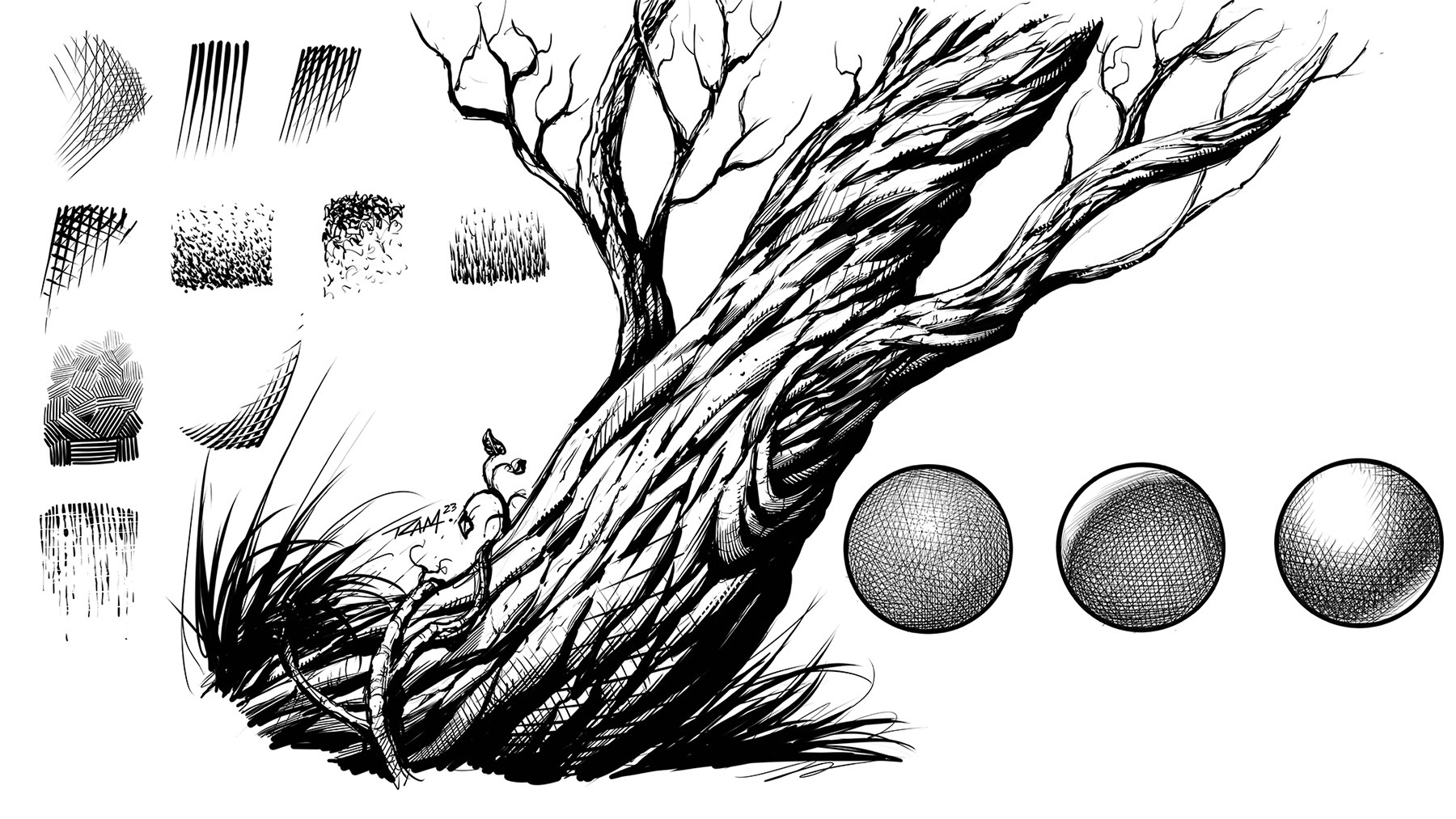
For a final challenge, try the cross-hatching mandala. Draw a circular shape and divide it into sections like a pie chart. In each section, experiment with a different hatching style: parallel lines, crisscrossing grids, circular strokes, or even scribbled textures. The mandala format forces you to think in segments, each one a mini-experiment in line density and direction. As you fill each section, you’ll notice how the interplay between them creates a hypnotic, almost meditative effect. This exercise isn’t just about skill—it’s about play. It reminds you that cross-hatching is as much about joy as it is about precision, a dance between discipline and whimsy.
The Mastery: Infusing Personality and Expression into Your Work
By now, your lines should feel like extensions of your hand, no longer stiff and hesitant but fluid and deliberate. This is where the real magic begins. The final phase of mastery is about transcending technique and infusing your work with soul. Start with the light and shadow narrative. Choose a subject with strong contrasts—a portrait, a still life, or a landscape—and focus on telling a story through your hatching. Instead of merely shading, think of each layer as a chapter. The first layer might be the soft glow of dawn, the second the midday sun, the third the deep shadows of dusk. Use your lines to guide the viewer’s eye, creating pathways that lead them through the narrative. The densest hatching should feel like a secret only the paper knows, a place where light dares not tread.
Next, explore the expressive line weight. Not all lines are created equal. A light, feathery stroke can suggest a gentle breeze, while a thick, deliberate line might evoke the weight of a storm cloud. Practice varying your pressure as you hatch, letting some lines fade into the paper while others assert themselves with bold authority. This isn’t just about contrast—it’s about emotion. A portrait hatched with soft, delicate lines feels tender and intimate, while one rendered with sharp, angular strokes might feel intense or even confrontational. The way you wield your pencil becomes a language, and your viewer will instinctively understand the unspoken words.
Finally, challenge yourself with the negative space revelation. Often, the most striking cross-hatching occurs not in the lines themselves, but in the spaces between them. For this exercise, draw a subject and hatch only the negative space around it, leaving the subject itself untouched. The result is a paradox: the more you focus on the void, the more the subject emerges as a luminous presence. This technique is a reminder that cross-hatching isn’t just about filling the page—it’s about revealing what’s already there. It’s the difference between shouting and whispering, between overwhelming the viewer and inviting them into a quiet, contemplative moment.

As you refine your skills, don’t be afraid to break the rules. Cross-hatching isn’t a rigid formula—it’s a playground. Mix media. Combine hatching with stippling or scribbling. Let your lines wander off the page, or introduce unexpected textures like wood grain or fabric weave. The most memorable artists aren’t those who follow the rules flawlessly, but those who dare to rewrite them. Your unique perspective is your greatest tool. Whether your style is delicate and refined or bold and chaotic, let it shine through in every stroke. After all, the goal isn’t to create a perfect replica of reality, but to capture the essence of it—the way light bends, the way shadows whisper, the way a single line can make the heart skip a beat.
Cross-hatching is more than a technique; it’s a conversation between the artist and the unseen. It’s the act of coaxing light from darkness, of turning flat paper into a window into another world. Along the way, you’ll discover that the real mastery isn’t in the lines themselves, but in the patience, curiosity, and courage it takes to keep drawing—even when the page seems blank, even when the lines feel unruly. Every great artist started with a single stroke, a tentative line that wobbled but dared to begin. Yours is the next line in that endless, beautiful conversation. So pick up your pencil. The page is waiting.


Leave a Comment