

Hard surface modeling is the art of crafting mechanical objects, futuristic weapons, or intricate architectural elements with precision and flair. Yet, beneath the gleaming surfaces and sharp edges lies a hidden struggle—one that pits raw creativity against the unforgiving laws of topology. Every artist has stared at a screen, watching their carefully sculpted mesh collapse into a spaghetti nightmare after a boolean operation. The frustration is universal: why does something so seemingly simple—cutting a hole, adding a bevel—unravel an entire model’s integrity? The answer isn’t just technical; it’s rooted in the fundamental tension between control and chaos in digital craftsmanship.
At the heart of this struggle are three pillars: booleans, bevels, and clean topology. These tools are the Swiss Army knife of hard surface modeling, yet wielding them without finesse often leads to disaster. Booleans, for all their brute-force utility, can carve jagged scars into your mesh. Bevels, meant to soften edges, sometimes amplify ugliness if misapplied. And clean topology? It’s the invisible scaffold that holds everything together—or crumbles under the weight of poor decisions. Mastering these elements isn’t just about following steps; it’s about understanding the *why* behind the workflow. Let’s dive into the mechanics, the pitfalls, and the philosophy that transforms hard surface modeling from a chore into a craft.
The Boolean Paradox: Precision’s Double-Edged Sword
Booleans are the sledgehammers of 3D modeling. They let you subtract, intersect, or unite shapes with surgical precision—or, more often, with the subtlety of a wrecking ball. The allure is undeniable: drag a cube over your model, hit “difference,” and voilà—an instant window or vent appears. But this convenience comes at a cost. Booleans generate non-manifold geometry, duplicate vertices, and tangled faces, leaving your mesh in a state of digital dysentery. The deeper issue isn’t the tool itself but the assumption that it’s a one-click solution.
Consider the humble cylinder. A boolean subtraction to create a hole seems straightforward—until the cylinder’s edges intersect with the target mesh at odd angles. The result? A mangled topology where faces fold into each other like crumpled paper. The problem isn’t the boolean; it’s the lack of preparation. Booleans thrive when the cutting object aligns with the target’s geometry. A misaligned cutter is like a surgeon using a chainsaw—technically possible, but the patient (or in this case, the mesh) won’t survive intact. To mitigate this, modelers often pre-slice their meshes with loop cuts or use boolean modifiers in a non-destructive workflow, preserving the original shape while refining the cuts.
Another quirk of booleans is their love for clean, watertight geometry. A single non-manifold edge or overlapping vertex can turn a boolean operation into a digital abyss. This is where the deeper fascination lies: booleans expose the fragility of our digital constructs. They force us to confront the reality that 3D modeling isn’t just about vision—it’s about respecting the underlying mathematics. A failed boolean isn’t a personal failure; it’s a reminder that geometry, like physics, has immutable rules. The key is to treat booleans as a starting point, not a finish line. Clean them up with retopology tools, weld stray vertices, and reinforce edges with supporting loops. Only then does the boolean become a tool of empowerment rather than destruction.
Bevels: The Art of Controlled Chaos
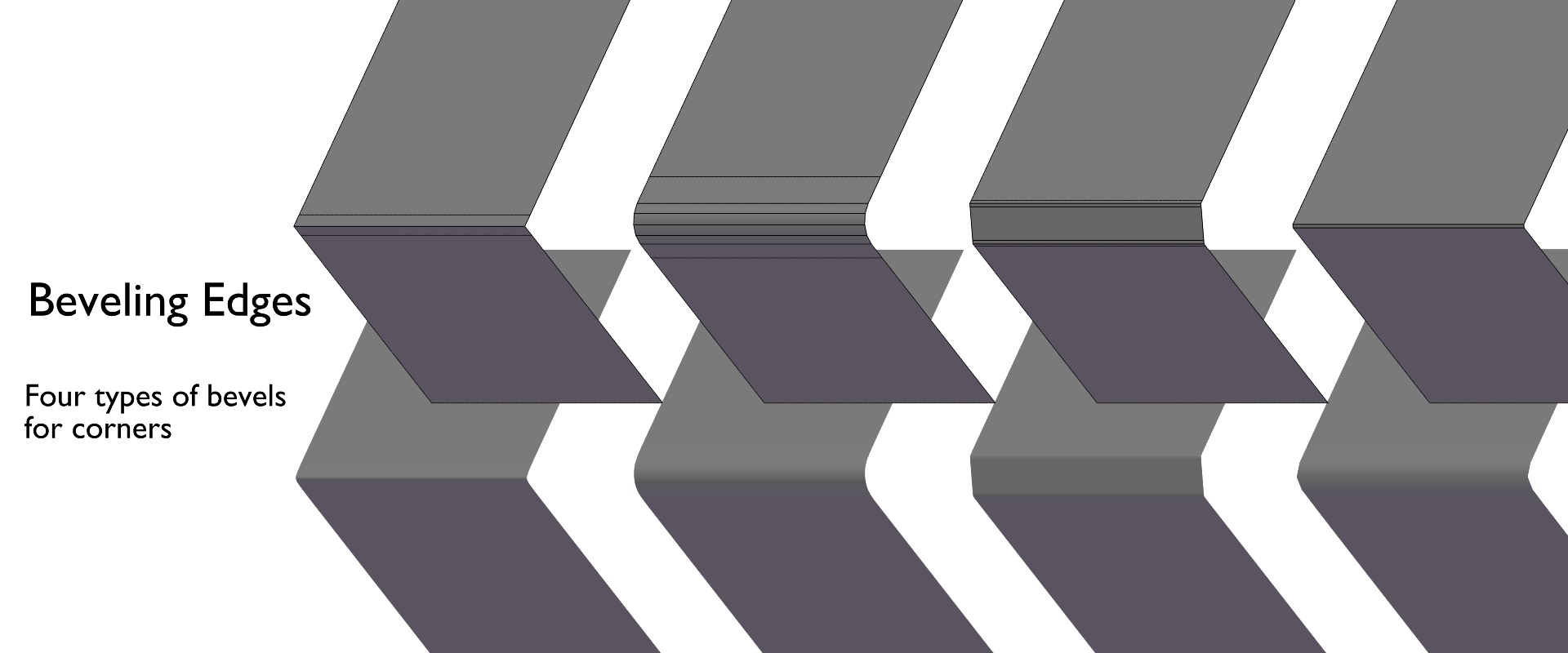
Bevels are the unsung heroes of hard surface modeling, the subtle brushstrokes that turn a blocky mess into a polished masterpiece. Yet, their misuse is a rite of passage for every aspiring modeler. A bevel applied too aggressively can turn a sleek sci-fi panel into a melted candle. Too conservatively, and your model looks like it was carved from a single slab of granite. The challenge lies in balancing realism with stylization, function with form. A bevel isn’t just an aesthetic choice; it’s a storytelling device. It can imply wear, manufacturing processes, or even the passage of time.
The technical hurdle is the bevel’s relationship with topology. A sharp edge might seem simple, but beveling it introduces new geometry that must flow seamlessly into the surrounding mesh. Poorly placed bevels create pinching, shading artifacts, or even holes where faces fail to connect. The solution? Plan ahead. Use edge loops to define where bevels should occur, ensuring the new geometry has room to breathe. Think of it like building a road: if you don’t widen the shoulders, the lanes will collapse under traffic. Similarly, a bevel’s width should be proportional to the surrounding edges. A 0.1-unit bevel on a 10-unit panel will look lost; a 2-unit bevel on the same panel might overwhelm it.
Another layer of complexity is the bevel’s role in normal calculations. When a bevel is too aggressive, it can distort the normals, causing light to bounce erratically across the surface. This is where the deeper intrigue of hard surface modeling reveals itself: it’s not just about making things look good, but making them *feel* good. A well-beveled edge should guide the viewer’s eye, creating a sense of depth and tactility. It’s the difference between a model that looks flat and one that feels like it could exist in the real world. To achieve this, modelers often use weighted normals or custom normal maps to fine-tune the shading, ensuring that bevels enhance rather than detract from the design.
Clean Topology: The Invisible Architecture
Clean topology is the skeleton of a hard surface model, the framework that determines whether it bends, deforms, or collapses under scrutiny. It’s the difference between a model that holds up in a game engine and one that glitches out at the seams. Yet, clean topology isn’t just about quad dominance or avoiding triangles—it’s about creating a mesh that’s efficient, flexible, and future-proof. The obsession with clean topology stems from a fundamental truth: 3D modeling is as much about engineering as it is about art. Every edge, every loop, every vertex serves a purpose.
The first rule of clean topology is quad dominance. While triangles and n-gons have their place, quads are the gold standard because they deform predictably under subdivision or animation. A mesh riddled with triangles is like a building with random support beams—it might stand, but it won’t withstand stress. The challenge is maintaining quad flow, especially in complex intersections. For example, a hard surface model with cylindrical protrusions requires careful edge loop planning to ensure the topology flows around the curves without pinching. This often involves adding supporting loops or using techniques like the “bridge” tool to connect disparate parts of the mesh.
Another critical aspect is edge density. Too few edges, and the model looks blocky; too many, and it becomes a resource hog. The key is to match edge density to the model’s purpose. A high-poly sculpt might need dense topology for sculpting details, while a game-ready asset should prioritize efficiency. This is where the deeper philosophy of hard surface modeling shines: it’s a constant negotiation between detail and performance. Every additional edge is a trade-off, a decision that balances visual fidelity with practical constraints. Modelers often use retopology tools to simplify high-poly meshes, preserving the silhouette while reducing unnecessary geometry.
Clean topology also extends to UV unwrapping and baking. A well-structured UV map ensures that textures and materials apply seamlessly, while a messy UV layout can introduce stretching or seams that ruin the illusion of realism. The process of cleaning topology doesn’t end with the mesh—it’s an ongoing dialogue between the model and its downstream applications. Whether it’s for animation, rendering, or 3D printing, a clean topology is the foundation that makes everything else possible.

Workflow Alchemy: Combining Tools for Maximum Impact
The true magic of hard surface modeling lies in the synergy between booleans, bevels, and clean topology. Alone, each tool is powerful but flawed; together, they form a workflow that’s greater than the sum of its parts. The key is to treat these tools as stages in a process rather than standalone solutions. Start with a base mesh, refine it with booleans for rough cuts, then apply bevels to soften edges and add detail. Finally, clean up the topology to ensure everything flows smoothly. This isn’t a linear process—it’s iterative, with each step informing the next.
One effective technique is the “boolean then bevel” approach. First, use booleans to carve out large shapes or add complex features. Then, apply bevels to the resulting edges, using the boolean cuts as guides for where the bevels should occur. This ensures that the bevels follow the natural contours of the model, avoiding awkward transitions. For example, when modeling a futuristic gun, you might use a boolean to create the barrel’s internal cavity, then bevel the outer edges to add a sense of depth and realism. The boolean sets the stage; the bevel brings it to life.
Another pro tip is to use non-destructive workflows wherever possible. Boolean modifiers, subdivision surfaces, and bevel modifiers can all be applied non-destructively, allowing you to tweak parameters without permanently altering the mesh. This is especially useful for hard surface modeling, where early decisions can have ripple effects on the final result. By keeping your workflow flexible, you can experiment with different shapes and details without fear of irreversible mistakes. It’s the digital equivalent of sketching with pencil before committing to ink.
The final step is optimization. Once your model is complete, it’s time to refine it for its intended use. This might mean reducing polygon count for a game asset, optimizing UVs for texture baking, or adding supporting geometry for rigging. Clean topology isn’t just about the initial creation—it’s about preparing the model for its journey through the pipeline. Whether it’s for a cinematic render or a real-time application, a well-optimized model is a model that stands the test of time.
Hard surface modeling is a dance between control and creativity, a balancing act that rewards patience and precision. Booleans, bevels, and clean topology are the tools that make this dance possible, but they’re only as effective as the artist wielding them. The real magic happens when you step back and see your model not as a collection of polygons, but as a living, breathing entity—one that tells a story, evokes emotion, and stands as a testament to your skill. So the next time you’re staring at a boolean disaster or a bevel gone wrong, remember: it’s not just about fixing the problem. It’s about understanding the deeper principles that turn a digital sculpture into something extraordinary.


Leave a Comment