

What if the most iconic animal print in art history emerged not from meticulous observation, but from a single, glaring error? What if that error—spread across centuries like a stubborn myth—became the very thing that immortalized an artist’s vision? Welcome to the curious tale of Dürer’s Rhinoceros, a woodcut so influential that it redefined how the world imagined an entire species. This isn’t just a story about art. It’s a story about how a mistake can outlive the truth, how a flawed sketch can shape reality, and how one man’s misinterpretation became the blueprint for rhinoceroses in the Western imagination for over 400 years.
Imagine, for a moment, that you are Albrecht Dürer in 1515. The German master is at the height of his powers, crafting engravings that would define Renaissance art. Then, a rhinoceros arrives in Lisbon—not just any rhino, but the first living one seen in Europe in over a thousand years. It’s a sensation. News spreads like wildfire. Dürer, ever the observer, hears of this marvel. But he never sees it. Instead, he relies on a secondhand sketch, a rough drawing sent by a correspondent. And from that sketch, he creates a woodcut that will echo through time. But here’s the twist: Dürer’s rhinoceros isn’t just inaccurate—it’s almost unrecognizable. Yet, somehow, that inaccuracy became its power. So, how did a misdrawn beast become the greatest animal print of all time?
The Arrival of the Marvel: A Rhinoceros in Lisbon
In May 1515, a ship docked in Lisbon carrying an unusual cargo: a live Indian rhinoceros, a gift from Sultan Muzaffar Shah II of Cambay to King Manuel I of Portugal. The animal, named “Ganda,” was a sensation. Europeans had not seen a rhinoceros since Roman times, and this one was a living relic—armored, horned, and utterly alien. Drawings and descriptions of Ganda circulated across Europe, sparking curiosity and awe. Artists, scholars, and printers scrambled to capture its likeness. But in an era before photography, before reliable visual documentation, the truth of the rhinoceros was as slippery as the ink on a woodblock.
Among those who heard the news was Albrecht Dürer, then 44 years old and already a legend in printmaking. He was not one to chase trends, but this was different. A rhinoceros—how could he resist? Yet, Dürer never laid eyes on the creature. Instead, he worked from a sketch sent to him by a correspondent, likely a merchant or diplomat who had seen Ganda in Lisbon. That sketch, now lost, was the foundation of Dürer’s masterpiece. But it was flawed. The artist who drew it had never seen a rhinoceros either. And so, the misinformation began.
The Woodcut That Wasn’t: How Dürer Reinvented the Beast
Dürer’s woodcut, completed in 1515, is a marvel of Renaissance artistry—but not for its accuracy. The creature he depicts is a fantastical hybrid: a rhinoceros with the body of a turtle, the legs of an elephant, and a second horn sprouting from its shoulder. Its skin is segmented like armor, its posture rigid, almost heraldic. It looks less like a real animal and more like a knight in a jousting tournament. Yet, despite these glaring inaccuracies, the woodcut is breathtaking. Dürer’s mastery of line and texture transforms the flawed sketch into something monumental. The creature is dignified, almost noble. It commands attention.
But why did Dürer alter the rhinoceros so drastically? Some art historians suggest he conflated the animal with descriptions of the mythical “unicorn” or the armored “Indian ox.” Others argue that the original sketch was so rudimentary that Dürer, working from memory and imagination, filled in the gaps with his own artistic sensibilities. Whatever the reason, the result was a rhinoceros that bore little resemblance to reality. Yet, paradoxically, this was the rhinoceros that Europe would come to know.
Dürer’s woodcut was reproduced and distributed widely across Europe. Printers made copies. Artists copied his version. The image became the standard. For centuries, whenever someone in the West thought of a rhinoceros, they pictured Dürer’s armored beast—not the sleek, horned mammal that actually existed. The mistake became the truth. It was a case of artistic osmosis: the flawed image seeped into the collective consciousness, replacing the real animal with a myth.
The Ripple Effect: How One Image Shaped History
The impact of Dürer’s rhinoceros cannot be overstated. It appeared in bestiaries, encyclopedias, and travelogues. It was referenced in scientific texts, even as naturalists began to correct the record. By the 18th century, when real rhinoceroses were being studied and dissected, artists still relied on Dürer’s version. The discrepancy between the real animal and the mythic one became a source of fascination. Some scholars even speculated that Dürer’s rhinoceros was a separate species entirely—a “Dürer’s rhinoceros,” distinct from the Indian or African varieties.
This phenomenon isn’t unique to Dürer’s rhinoceros. Throughout history, artists have shaped our perception of the natural world. Think of the dragons of medieval manuscripts, the mermaids of Renaissance paintings, or the exaggerated proportions of early anatomical drawings. But Dürer’s case is particularly striking because the error was so glaring, yet the image was so compelling. The woodcut’s power lay in its ability to transcend its own inaccuracies. It wasn’t just a picture of a rhinoceros; it was a symbol. A knight’s steed. A heraldic emblem. A creature of legend.
Even today, Dürer’s rhinoceros lingers in the cultural imagination. It has been referenced in literature, film, and even video games. Artists continue to reinterpret it, playing with the tension between the mythic and the real. The woodcut is a reminder that art doesn’t always mirror reality—sometimes, it creates it.
The Challenge of Seeing: Why Accuracy Isn’t Always the Point
Here’s a playful challenge: Try to imagine a rhinoceros without ever seeing one. Close your eyes and picture it. What do you see? For most people, the answer is Dürer’s rhinoceros. The armored plates, the rigid stance, the almost regal bearing. It’s a testament to the power of art to shape our understanding of the world. But it also raises a provocative question: Does accuracy even matter in art?
Consider this: Dürer’s rhinoceros is not a scientific document. It’s not a photograph. It’s an interpretation. And in that interpretation, Dürer captured something essential about the rhinoceros—not its physical form, but its essence. The creature in his woodcut is majestic, untouchable, almost mythical. It’s a rhinoceros as seen through the lens of Renaissance humanism—a symbol of strength, resilience, and otherworldly beauty. In that sense, Dürer’s mistake was also his genius. He didn’t just draw a rhinoceros; he created an icon.
This raises another intriguing possibility: What if the real rhinoceros was less interesting than Dürer’s version? What if the creature that arrived in Lisbon was, in its own way, too mundane? A rhinoceros is, after all, a large, somewhat grumpy herbivore. It doesn’t have the grace of a deer or the majesty of a lion. But Dürer’s rhinoceros? It’s a force of nature. It’s a dragon in armor. It’s a creature that demands to be seen.
The Legacy: From Woodblock to Digital Age
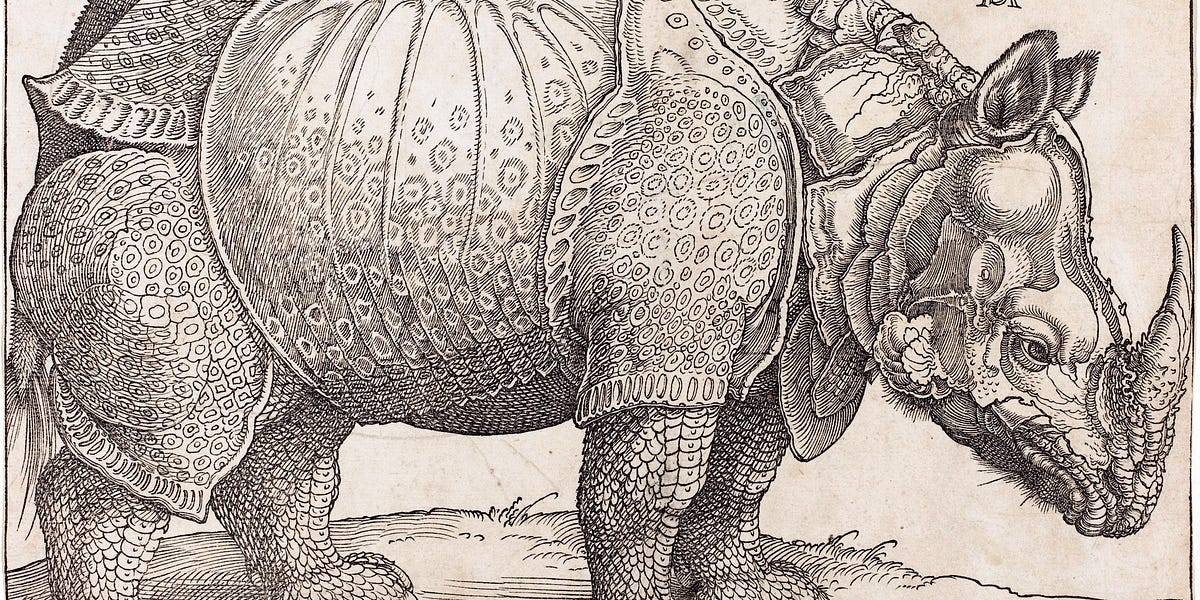
Centuries after its creation, Dürer’s rhinoceros continues to captivate. It has been reimagined by modern artists, from Salvador Dalí to contemporary digital illustrators. It appears in memes, in tattoos, in fashion. The woodcut has transcended its medium, becoming a cultural touchstone. And yet, its origins remain rooted in a mistake—a single, flawed sketch that somehow became the definitive image of an entire species.
This is the paradox of Dürer’s rhinoceros: the more we learn about the real animal, the more we appreciate the power of the myth. The woodcut is a reminder that art doesn’t exist in a vacuum. It’s shaped by the limitations of its time, the biases of its creator, and the expectations of its audience. And sometimes, those limitations and biases are what make the art extraordinary.
So, the next time you see a rhinoceros—whether in a museum, a documentary, or a wildlife reserve—take a moment to consider Dürer’s version. Think about the armored plates, the rigid stance, the almost regal bearing. And ask yourself: Which rhinoceros is more real? The one that walked the earth in 1515, or the one that has lived in our imaginations ever since?
Perhaps the answer is both. Perhaps the greatest animal print of all time isn’t a record of what was, but a celebration of what could be. A rhinoceros not just as it is, but as it should be. A creature of legend, armor, and myth. A beast that, through the magic of art, became immortal.


Leave a Comment