

In the grand symphony of classical music, few instruments are as misunderstood—or as stubbornly ignored—as the humble metronome. Beethoven, that tempestuous titan of composition, wielded it like a conductor’s baton, insisting that his works be played at speeds that would make modern musicians blanche. His metronome marks, etched in ink and etched in controversy, were not mere suggestions; they were decrees from a composer who heard the music in his head with a precision that bordered on the supernatural. Yet, more than two centuries later, we find ourselves in a curious predicament: we play his pieces slower than he intended, as if the very act of slowing down were a form of reverence. But what if this sluggishness isn’t homage—it’s heresy?
Imagine, for a moment, that Beethoven’s metronome marks are not just tempo indications but manifestos. They are the composer’s way of shouting into the void, demanding that we listen not just with our ears but with our entire being. His markings are not arbitrary; they are the rhythmic DNA of his genius, the pulse of his emotional landscape. When we ignore them, we don’t just play the notes wrong—we betray the very essence of the music. This isn’t about pedantry; it’s about fidelity to an artistic vision that was, in its time, revolutionary. So why do we drag our feet, why do we dawdle in the slow lanes of tempo, when the music begs to be unleashed?
The Metronome as a Mirror: Reflecting Our Own Reluctance
Beethoven’s metronome marks are, in many ways, a mirror held up to our own artistic laziness. They force us to confront a truth we’d rather avoid: we play slowly because it’s easier. It’s comfortable. It allows us to wallow in the richness of the sound, to savor every note like a fine wine, to avoid the challenge of precision. But music, at its core, is not meant to be savored in stillness—it is meant to move. The metronome doesn’t just measure time; it measures our willingness to engage with the music’s vitality.
Consider the opening of the Fifth Symphony, where the famous “ta-ta-ta-TAAA” motif is marked at a brisk 108 beats per minute. To play it slower is to dilute its urgency, to turn a thunderclap into a drizzle. Beethoven didn’t write it as a languid meditation; he wrote it as a declaration of war against complacency. When we drag the tempo, we’re not just playing the notes wrong—we’re neutering the music’s power. The metronome, in this context, becomes a tool of accountability. It doesn’t lie. It doesn’t flatter. It simply is.

Yet, the irony is delicious. We revere Beethoven as a revolutionary, a composer who shattered conventions and defied expectations. But when it comes to his tempo markings, we treat them like optional accessories—something to be adjusted based on our mood, our skill level, or our sheer unwillingness to keep up. It’s as if we’ve decided that Beethoven’s genius was only half of what he intended, and the other half is ours to reinterpret at will. This isn’t evolution; it’s erasure.
The Tempo Debate: A Battle of Wills Between Past and Present
The controversy surrounding Beethoven’s metronome marks is not new. For decades, scholars and performers have clashed over whether his markings were even accurate—or if they were, whether they were meant to be taken literally. Some argue that the metronome, a relatively new invention in Beethoven’s time, may have been misused or misunderstood. Others claim that his deafness distorted his perception of time, rendering his markings suspect. But to dismiss them outright is to ignore the composer’s own words. Beethoven was meticulous. He revised his works obsessively. If he had doubts about his metronome marks, he would have changed them.
What’s fascinating is how this debate reveals our own biases. We cling to the idea that tempo is subjective, that music should bend to our interpretation. But Beethoven’s markings suggest otherwise. They imply that tempo is not a suggestion but a command, a fundamental part of the composition itself. To alter it is to alter the music’s DNA. It’s as if we’ve decided that the composer’s vision is merely a starting point, a rough sketch to be refined by our own sensibilities. But where does this stop? If we can change the tempo, why not the key? Why not the orchestration? The slippery slope is real, and Beethoven’s metronome marks are the first domino in a long line of potential betrayals.
Consider the Hammerklavier Sonata, a work so complex that even today’s virtuosos approach it with trepidation. Beethoven marked its opening movement at a breakneck 138 beats per minute. To play it slower is to turn a mountain into a hill. Yet, many performers opt for a more leisurely pace, as if the music’s difficulty is an excuse for dilution. But Beethoven didn’t write it to be easy. He wrote it to be transcendent. The metronome, in this case, is not a tyrant—it’s a guide, leading us toward the summit of his artistic vision.
The Psychological Pull of Slowness: Why We Resist the Beat
There’s a psychological undercurrent to our slow playing, one that goes beyond mere technical challenges. Slow tempos feel safer. They allow us to linger, to savor, to avoid the risk of making mistakes. Fast tempos, by contrast, demand precision, control, and a willingness to embrace imperfection. They force us to confront our own limitations. No wonder we resist them.
But here’s the thing: music is not meant to be safe. It’s meant to be alive. When we play slowly, we’re not just playing the notes—we’re playing it safe. We’re avoiding the raw energy that makes music thrilling. Beethoven’s metronome marks are a challenge, a dare to rise to the occasion. They ask us to be better, to play with more urgency, more commitment. To ignore them is to settle for less than we’re capable of.
Think of it this way: if a composer wrote a piece marked “presto,” and we played it “adagio,” we wouldn’t say, “Well, I just interpreted it differently.” We’d say, “I butchered it.” The same should hold true for metronome marks. They are not optional. They are not negotiable. They are the composer’s way of telling us how the music should feel.
The Metronome as a Time Machine: Reconnecting with Beethoven’s World
There’s another layer to this debate, one that’s often overlooked. Beethoven’s metronome marks are not just about tempo—they’re about time itself. In his day, the metronome was a revolutionary invention, a way to impose order on the chaos of musical performance. It was a tool of precision in an era when music was often played loosely, subjectively. By insisting on specific tempos, Beethoven was not just dictating how his music should sound—he was redefining how music should be experienced.
To play his works at his marked tempos is to step into his world, to hear the music as he intended. It’s a form of time travel, a way to bridge the gap between the 19th century and our own. When we slow down, we’re not just altering the music—we’re erasing history. We’re saying that our modern sensibilities are more important than the composer’s vision. But music, like all art, is a dialogue between past and present. To ignore Beethoven’s metronome marks is to silence that dialogue, to reduce his genius to a mere echo of our own preferences.
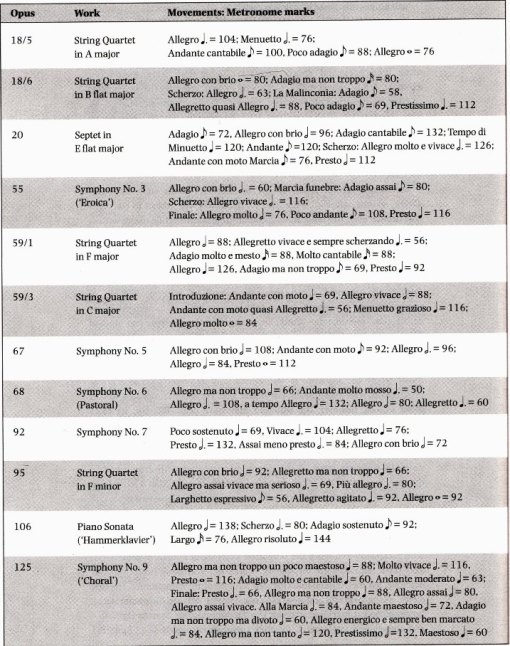
There’s a certain irony in the fact that we, as modern listeners, have access to more information about Beethoven’s intentions than any generation before us. We have his manuscripts, his letters, his metronome marks. And yet, we often choose to ignore them, as if our own interpretations are somehow more valid. But art is not a democracy. It’s a monarchy. The composer is the king, and his markings are the law. To play his music without adhering to those markings is to commit treason against his vision.
The Future of Tempo: Will We Ever Reclaim Beethoven’s Urgency?
The question, then, is not whether Beethoven’s metronome marks are correct—but whether we have the courage to follow them. In an era where music is increasingly democratized, where every listener is a critic and every critic is a curator, the idea of absolute fidelity to a composer’s vision can feel quaint, even oppressive. But fidelity is not oppression. It’s respect. It’s love. It’s the difference between playing a piece and honoring it.
So, what’s the solution? It starts with a shift in mindset. Instead of viewing metronome marks as constraints, we should see them as invitations. Invitations to play with more energy, more precision, more commitment. Invitations to connect with the music on a deeper level. Invitations to stop dallying and start living the music.
Beethoven’s metronome marks are not a burden. They are a gift. They are his way of reaching across the centuries, grabbing us by the shoulders, and saying, “Wake up! The music is not yours to dilute—it’s yours to unleash.” And when we finally heed his call, when we play his works at the tempos he intended, something magical happens. The music comes alive. It breathes. It moves. And we realize, perhaps for the first time, that we’ve been playing it wrong all along—not because we lacked skill, but because we lacked the courage to listen.
The metronome is not our enemy. It is our guide. It is our conscience. It is the steady, unyielding heartbeat of Beethoven’s genius, reminding us that great music is not meant to be savored in slow motion—it is meant to be experienced.


Leave a Comment