

The Tarantella: The Dance That Literally Cured Spider Bites (Allegedly)
The air hums with the frenetic pulse of tambourines, the sharp staccato of castanets, and the thunderous stomp of leather-soled shoes. A whirlwind of color and motion erupts—skirts flare like crimson and indigo petals, arms twist in serpentine arcs, and laughter spills between ragged breaths. This is the Tarantella, a dance so visceral it was once believed to extract venom from the fangs of a tarantula’s bite. Not merely a folk tradition, but a ritual of survival, a catharsis of the body, and a symphony of southern Italian identity. To witness it is to step into a world where music is medicine, where rhythm is salvation, and where every twirl is a whispered incantation against the unseen.
But what is the Tarantella, truly? Is it a dance born of hysteria, a cure for a poisoned mind, or a celebration of life so intense it borders on the ecstatic? To unravel its mystery, we must journey through the sun-baked fields of Puglia, the volcanic slopes of Calabria, and the labyrinthine alleys of Naples, where the dance still pulses through the veins of the people. We’ll explore its mythic origins, dissect its regional variations, and uncover the science—and skepticism—behind its legendary curative powers. Along the way, we’ll meet the musicians who keep its heartbeat alive, the dancers who surrender to its trance, and the historians who trace its lineage back to the ancient world. Prepare to be swept into a vortex of sound, sweat, and soul—where every step is a story, and every note is a spell.
The Mythic Core: How a Spider’s Bite Spun a Dance into Legend
In the scorching summer of 16th-century Puglia, a peasant woman collapsed in the fields, her body wracked with convulsions. A tarantula—perhaps the venomous Lycosa tarantula—had struck. Villagers rushed to her side, whispering of the curse. But instead of summoning a priest, they called for a fiddle and a drum. As the first notes of a wild, repetitive melody filled the air, the woman’s limbs began to jerk, her fingers clawing at the earth. Slowly, her movements synchronized with the rhythm. Hours passed. The sun dipped low. And then—miraculously—she rose, weak but alive, her spirit seemingly purged of poison.
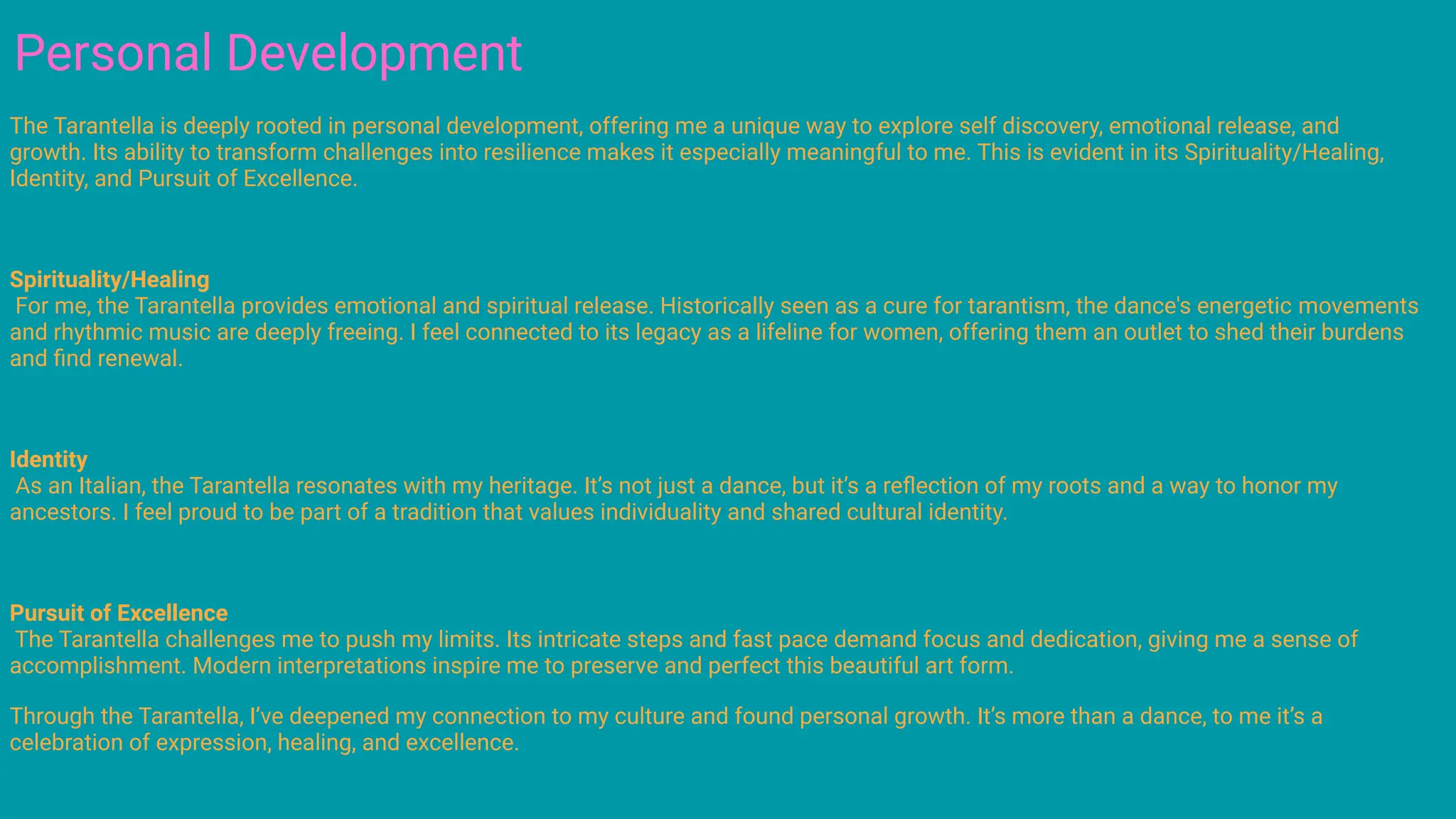
This is the foundational myth of the Tarantella, a tale repeated in countless variations across southern Italy. The dance, so the story goes, was not merely entertainment but a therapeutic exorcism. The venom of the tarantula, it was believed, could only be expelled through relentless, trance-inducing motion. The faster the dancer moved, the more the poison dissipated. The music, often in 6/8 or 3/4 time, acted as a sonic antidote, its hypnotic repetition lulling the venom into submission. Some accounts even suggest that specific melodies were associated with different spider species—each requiring its own rhythmic antidote.
The dance’s name itself is a linguistic relic. Derived from the Italian tarantola (tarantula), it also echoes the Greek tarantismos, a term used to describe the frenzied state induced by the bite. But the Tarantella’s roots may run even deeper, intertwining with ancient rituals of Dionysian ecstasy and pre-Christian fertility rites. Some scholars propose that its origins lie in the pizzica dances of the Mediterranean, where rhythmic movement was a bridge between the human and the divine. Whatever its true genesis, the Tarantella evolved into something far greater than a folk cure—it became a cultural lifeline, a defiant celebration of life in the face of death.
A Tapestry of Rhythms: The Regional Flavors of the Tarantella
If you were to trace the Tarantella’s path across southern Italy, you’d find not one dance, but a constellation of regional variations, each with its own tempo, costume, and cultural heartbeat. In Puglia, the dance is a tempest—Pizzica Tarantata, where the music is raw and unfiltered, played on the tamburello (a frame drum), the violino (fiddle), and the organetto (a small accordion). Dancers move in tight, swirling circles, their feet barely touching the ground, as if defying gravity itself. The women’s skirts billow like storm clouds, while the men’s movements are sharp and percussive, their bodies striking the earth as if to summon the spirits of the land.
Venture south to Calabria, and the Tarantella takes on a darker, more brooding character. Here, the dance is often performed in pairs, with a slow, deliberate courtship unfolding between partners. The music is slower, more melancholic, with the ciaramella (a double-reed instrument) wailing like a lost soul. The costumes are simpler, the movements more restrained—yet no less intense. This version of the Tarantella is less about frenzy and more about duende, that ineffable Spanish term for the raw, emotional power of art. It’s a dance that lingers in the bones, a slow-burning ember of passion and sorrow.
In Campania, particularly around Naples, the Tarantella becomes a spectacle of theatrical flair. The Tarantella Napoletana is a whirlwind of color and humor, with dancers performing acrobatic leaps and comedic pratfalls. The music is brisk, almost playful, with the mandolin and the tromba marina (a bowed string instrument) adding a bright, metallic shimmer. This version of the dance is less about healing and more about celebration—though its roots in the ancient world are undeniable. Some historians link it to the Sicilian Tarantella, where the dance is performed in a circle, with dancers holding hands and moving in a hypnotic, wave-like motion.
Each regional variation is a testament to the Tarantella’s adaptability. It is a dance that absorbs the spirit of the land, the history of the people, and the mood of the moment. Whether it’s the frenetic energy of Puglia, the brooding intensity of Calabria, or the theatrical joy of Naples, the Tarantella is a living, breathing entity—one that refuses to be confined by borders or definitions.

The Science of the Spell: Did the Tarantella Really Cure Spider Bites?
The Tarantella’s reputation as a venom-neutralizing ritual is as persistent as it is controversial. Modern science offers a skeptical lens through which to view this claim. Tarantula venom, while painful, is rarely lethal to humans. The primary symptoms—a sharp sting, localized swelling, and muscle cramps—typically subside within hours. So, how did the Tarantella earn its curative reputation? The answer lies in the interplay of psychology, physiology, and cultural belief.
First, consider the placebo effect. If a community believes that a dance can cure a spider bite, the act of dancing—especially in a trance-like state—can trigger the release of endorphins, the body’s natural painkillers. The rhythmic movement may also improve circulation, helping to flush out toxins and reduce inflammation. Additionally, the social support of a communal dance can alleviate stress, which in turn may lessen the perception of pain. In this light, the Tarantella wasn’t so much a literal cure as it was a psychosomatic intervention—a way to harness the mind’s power to heal the body.
But the Tarantella’s curative potential may extend beyond mere psychology. Some researchers suggest that the dance’s repetitive, aerobic nature could have inadvertently treated symptoms of tarantula envenomation. The venom of the Lycosa tarantula contains neurotoxins that cause muscle spasms and rigidity. Vigorous, sustained movement—such as the Tarantella’s relentless spinning—could have helped to metabolize these toxins more quickly, reducing their duration. Moreover, the dance’s emphasis on deep, rhythmic breathing may have aided in oxygenating the blood, counteracting the venom’s effects on the nervous system.
Of course, the Tarantella’s healing properties weren’t limited to spider bites. In many communities, the dance was prescribed for a range of ailments—melancholy, fatigue, even heartbreak. The idea of dancing out one’s sorrows was not unique to Italy; similar traditions exist in cultures worldwide, from the Sufi whirling dervishes to the Haitian Vodou dances. The Tarantella, then, was a holistic remedy—a way to purge the body and soul of whatever ailed them. Whether through science, superstition, or sheer willpower, the dance became a symbol of resilience, a defiant act of joy in the face of suffering.
Yet, the Tarantella’s legacy is not without its critics. Skeptics argue that the dance’s curative reputation was exaggerated, a product of a superstitious era. They point to the lack of empirical evidence and the fact that tarantula venom is not as dangerous as folklore suggests. But to dismiss the Tarantella as mere myth is to overlook its deeper significance. It was never just about curing a bite—it was about reclaiming agency, about turning pain into power, and about transforming a moment of vulnerability into a celebration of life.
The Instruments of Ecstasy: The Music That Fuels the Tarantella
No Tarantella exists without its music—a pulsating, hypnotic soundtrack that propels dancers into a state of trance. The instruments of the Tarantella are as varied as the regions that nurtured the dance, each contributing a unique timbre to the symphony of sound. At the heart of it all is the tamburello, a frame drum that beats like a second heart, its rhythm syncopated and insistent. The tamburello’s sound is the pulse of the dance, the heartbeat that keeps the dancers moving, even as their lungs burn and their limbs tremble.
Complementing the tamburello is the violino, or fiddle, whose mournful, wailing notes rise and fall like the wind through the olive groves. The violin’s melody is often improvisational, weaving in and out of the rhythm with a freedom that mirrors the dancers’ movements. In some regions, the organetto—a small, portable accordion—takes center stage, its bright, reedy tones adding a playful, almost mischievous quality to the music. The organetto’s sound is infectious, impossible to resist, and its presence often signals the transition from a slow, brooding Tarantella to a frenetic, foot-stomping finale.
Other instruments contribute to the Tarantella’s rich tapestry of sound. The ciaramella, a double-reed instrument akin to the oboe, lends a haunting, pastoral quality to the music, its sound evoking the open fields and rugged hills of southern Italy. The tromba marina, a bowed string instrument with a nasal, almost electronic timbre, adds a surreal, otherworldly dimension to the performance. And in some traditions, the human voice joins the fray—whether through wordless ululations, rhythmic chants, or the occasional folk lyric that tells the story of a tarantula’s curse and the dance that broke it.
The music of the Tarantella is more than accompaniment; it is the lifeblood of the dance. It is the force that drives the dancers into a trance, the sound that binds them in a communal frenzy, and the rhythm that transforms individual movement into a collective ritual. To listen to a Tarantella is to feel the earth tremble beneath your feet, to sense the very air vibrating with energy. It is music that demands participation, that refuses to be passive. It is, in every sense, a call to arms—a summons to dance, to sweat, to surrender.
The Tarantella Today: A Dance Reborn in the Modern World
The Tarantella of the 21st century is a paradox—a dance rooted in ancient superstition, yet thriving in the digital age. In southern Italy, the tradition never truly died; it merely adapted. Festivals like the Notte della Taranta in Puglia draw tens of thousands of spectators, their hands clapping in time with the tamburello’s beat. The event is a modern-day exorcism, a collective catharsis where the past and present collide in a whirlwind of sound and motion. Dancers in traditional costumes perform alongside contemporary artists, their movements a fusion of old and new. The Tarantella, it seems, refuses to be confined by time.
Beyond Italy, the Tarantella has found new life in the global folk scene. In cities like New York, Berlin, and Buenos Aires, communities of expatriates and enthusiasts gather to keep the tradition alive. Workshops teach the steps, bands play the music, and festivals celebrate the dance’s enduring appeal. The Tarantella has become a symbol of cultural resilience, a way for diasporic communities to reconnect with their heritage. It is also a dance that transcends borders, its universal appeal lying in its raw, unfiltered emotion. Whether you’re a seasoned dancer or a curious onlooker, the Tarantella invites you to lose yourself in its rhythm, to let go of inhibitions, and to embrace the moment.
Yet, the Tarantella’s modern revival is not without its challenges. As globalization homogenizes traditions, there is a risk that the dance’s regional nuances will be lost. Efforts to preserve the Tarantella’s authenticity are underway, with ethnomusicologists and cultural organizations documenting its variations and teaching its history. There is also a growing interest in the dance’s therapeutic potential, with some therapists exploring its use in treating anxiety, depression, and trauma. The Tarantella, it turns out, may have healing properties that extend far beyond the realm of folklore.
For those who experience the Tarantella firsthand, its power is undeniable. It is a dance that demands everything—your breath, your strength, your focus—and in return, it offers transcendence. To dance the Tarantella is to step into a timeless ritual, to become part of a lineage that stretches back centuries. It is to feel the earth beneath your feet, the music in your bones, and the spirit of a people who turned their pain into joy, their fear into defiance, and their sorrow into song.
The Tarantella endures because it is more than a dance. It is a testament to the human capacity for resilience, a celebration of life’s intensity, and a reminder that even in the darkest moments, rhythm can be salvation. Whether you believe in its curative powers or simply revel in its raw energy, the Tarantella invites you to join the whirlwind—to move, to sweat, to lose yourself in the music, and to emerge, if only for a moment, unburdened by the world. So take a deep breath, feel the beat in your chest, and let the dance begin. The tarantula’s curse may be a myth, but the Tarantella’s magic is very real.


Leave a Comment