

In the relentless pursuit of artistic excellence, dancers often find themselves caught in a paradox: the more they push their bodies to the limits of flexibility and strength, the more they risk injury, burnout, or stagnation. Yet, tucked away in the quiet corners of dance studios and whispered among choreographers, there exists a practice that defies this conventional wisdom. Floor barre, a deceptively simple yet profoundly transformative discipline, has emerged as the unsung hero of modern dance training. It’s not just another exercise regimen—it’s a revelation, a secret weapon that refines technique, prevents injuries, and unlocks a dancer’s full potential without the relentless pounding of traditional barre work.
Imagine a world where every plié feels effortless, where balance is not a fleeting moment but a sustained state, and where the body moves with the precision of a well-oiled machine. This is the promise of floor barre, a practice that has quietly revolutionized the way dancers train. Unlike its upright counterpart, floor barre leverages gravity and controlled resistance to sculpt muscles, improve alignment, and cultivate a deep kinesthetic awareness. It’s where the body learns to dance before it ever steps onto the stage.

The Alchemy of Alignment: How Floor Barre Rewires Your Body’s Blueprint
Alignment is the silent architect of a dancer’s artistry. Without it, even the most technically proficient performer risks injury and aesthetic compromise. Traditional barre work, while foundational, often reinforces imbalances—overworking certain muscle groups while neglecting others. Floor barre, however, flips this script by placing the body in a neutral, supported position where alignment can be meticulously refined.
Consider the dancer’s spine. In an upright barre, the lumbar spine often bears the brunt of weight shifts, leading to compression and misalignment. On the floor, gravity becomes an ally. Exercises like pelvic tilts and spinal articulation on the mat encourage the vertebrae to stack with precision, reducing the risk of herniated discs and chronic back pain. The pelvis, that pivotal fulcrum of movement, finds its natural tilt, allowing for freer hip mobility and more expressive port de bras.
But the magic of floor barre doesn’t stop at the spine. The shoulders, often hunched from years of holding tension, release their grip as the scapulae glide effortlessly along the ribcage. The feet, those unsung heroes of every grand jeté, gain a newfound articulation as the arches strengthen and the toes learn to articulate with purpose. It’s not just about correcting flaws—it’s about rewiring the body’s movement patterns at a cellular level.
Dancers who integrate floor barre into their regimen often report a surprising side effect: their upright barre work feels lighter, more fluid. This isn’t mere coincidence. By training the body in a gravity-neutral environment, floor barre cultivates a proprioceptive awareness that translates seamlessly to vertical movement. The body remembers the alignment it experiences on the floor, carrying that precision into every arabesque and développé.
The Injury-Resistant Dancer: Why Floor Barre Is Your Body’s Best Insurance Policy
Injuries are the silent saboteurs of a dancer’s career. One misstep, one overstretched ligament, and suddenly, months of training vanish like smoke. Traditional barre work, while essential, can be a double-edged sword—its repetitive motions, though strengthening, also wear down joints and connective tissues over time. Floor barre, with its emphasis on controlled resistance and low-impact movement, offers a lifeline.
Take the knee, for instance. In a traditional barre, grand plié can place immense strain on the patellar tendon, especially for dancers with hypermobile joints. On the floor, the same motion can be performed with the knees tracking directly over the toes, reducing shear force and protecting the anterior cruciate ligament (ACL). Similarly, ankle sprains, a dancer’s most dreaded nemesis, become less likely as floor barre strengthens the peroneal muscles and improves proprioception.
But the benefits extend beyond the physical. Floor barre is a masterclass in injury prevention because it teaches dancers to listen to their bodies. The slow, deliberate nature of the exercises forces a mindfulness that’s often absent in the adrenaline-fueled rush of a dance class. Dancers learn to distinguish between productive muscle fatigue and dangerous joint strain, a skill that pays dividends in the long run.
Consider the case of a professional dancer who, after years of battling chronic shin splints, discovered floor barre. By incorporating daily mat work into her routine, she not only alleviated her pain but also improved her jump height by 20%. The secret? Floor barre strengthened her tibialis posterior, a muscle often overlooked in traditional training, while simultaneously reducing the compressive forces on her shins during impact exercises.

From the Floor to the Stage: The Kinesthetic Leap That Transforms Performance
There’s a common misconception that floor barre is merely a conditioning tool—a way to warm up or cool down. In reality, it’s a full-fledged artistic practice that bridges the gap between technique and expression. When dancers train on the floor, they’re not just building strength; they’re refining their movement vocabulary in a way that’s impossible in an upright position.
Take the concept of épaulement, the subtle play of the shoulders and head that defines classical ballet. On the floor, dancers can isolate these movements with surgical precision, free from the distractions of balance and coordination. The result? A more nuanced, intentional épaulement that translates effortlessly to center work. Similarly, the articulation of the spine in floor barre—whether in a gentle undulation or a dramatic cambré—becomes the foundation for breathtaking port de bras in a grand pas de deux.
But the true magic of floor barre lies in its ability to cultivate what dancers call “the line.” In ballet, “line” refers to the elongation of the body, the illusion of effortless extension. Traditional barre work can sometimes create a rigid, angular line, especially in dancers with hypermobile joints. Floor barre, however, encourages a softness, a fluidity that makes the body appear to stretch endlessly. The hamstrings lengthen without overstretching, the quadriceps engage without gripping, and the torso remains buoyant, as if suspended by an invisible thread.
This kinesthetic leap—from the floor to the stage—is what sets floor barre apart. It’s not just about preventing injuries or refining technique; it’s about unlocking a dancer’s artistic potential. When a dancer’s body moves with the precision of a well-tuned instrument, the audience doesn’t just see a performance—they feel it. The spine ripples like a wave, the limbs extend like branches in the wind, and the entire body becomes a vessel for emotion.
The Modern Dancer’s Toolkit: How to Integrate Floor Barre Into Your Routine
Incorporating floor barre into a dancer’s regimen isn’t about replacing traditional training—it’s about enhancing it. The key is consistency and intention. Unlike a quick warm-up, floor barre demands focus. Each exercise should be performed with mindfulness, as if the body is being sculpted from the inside out.
Start with foundational exercises like pelvic tilts and spinal waves to awaken the core and release tension in the lower back. Progress to leg extensions and battements, paying close attention to the alignment of the hips and knees. Incorporate resistance bands to add challenge without impact, and don’t shy away from partner work—two dancers mirroring each other’s movements can deepen the kinesthetic connection.
For the advanced dancer, floor barre becomes a playground for innovation. Experiment with dynamic stretches that mimic the shapes of grand allegro, or use the floor to practice inversions like the arabesque penchée with zero risk of falling. The possibilities are limited only by the dancer’s imagination.
But perhaps the most transformative aspect of floor barre is its accessibility. No studio? No problem. A simple yoga mat and a few square feet of space are all you need to begin. This democratization of training means that dancers of all levels—from aspiring ballerinas to seasoned professionals—can benefit from its magic.
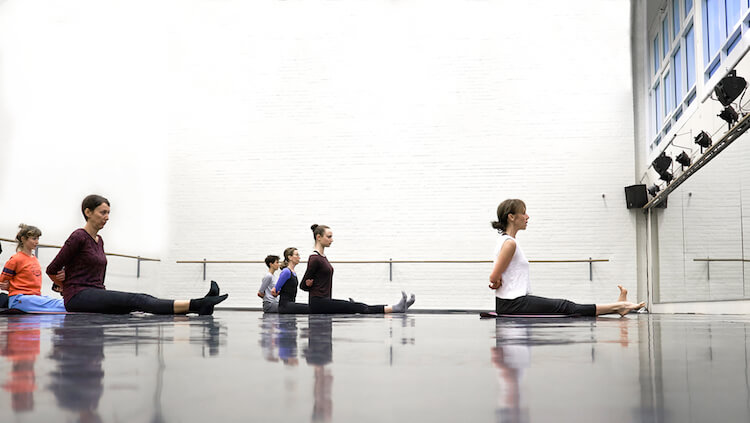
In a world where dance is increasingly competitive and physically demanding, floor barre offers a rare sanctuary—a place where the body can heal, refine, and ultimately, transcend its limits. It’s not just a secret weapon; it’s a revolution in motion. For the modern dancer, it’s the difference between merely performing and truly dancing.
So roll out your mat. Lie down. And let gravity do the rest. The stage awaits, and your body is finally ready.


Leave a Comment