

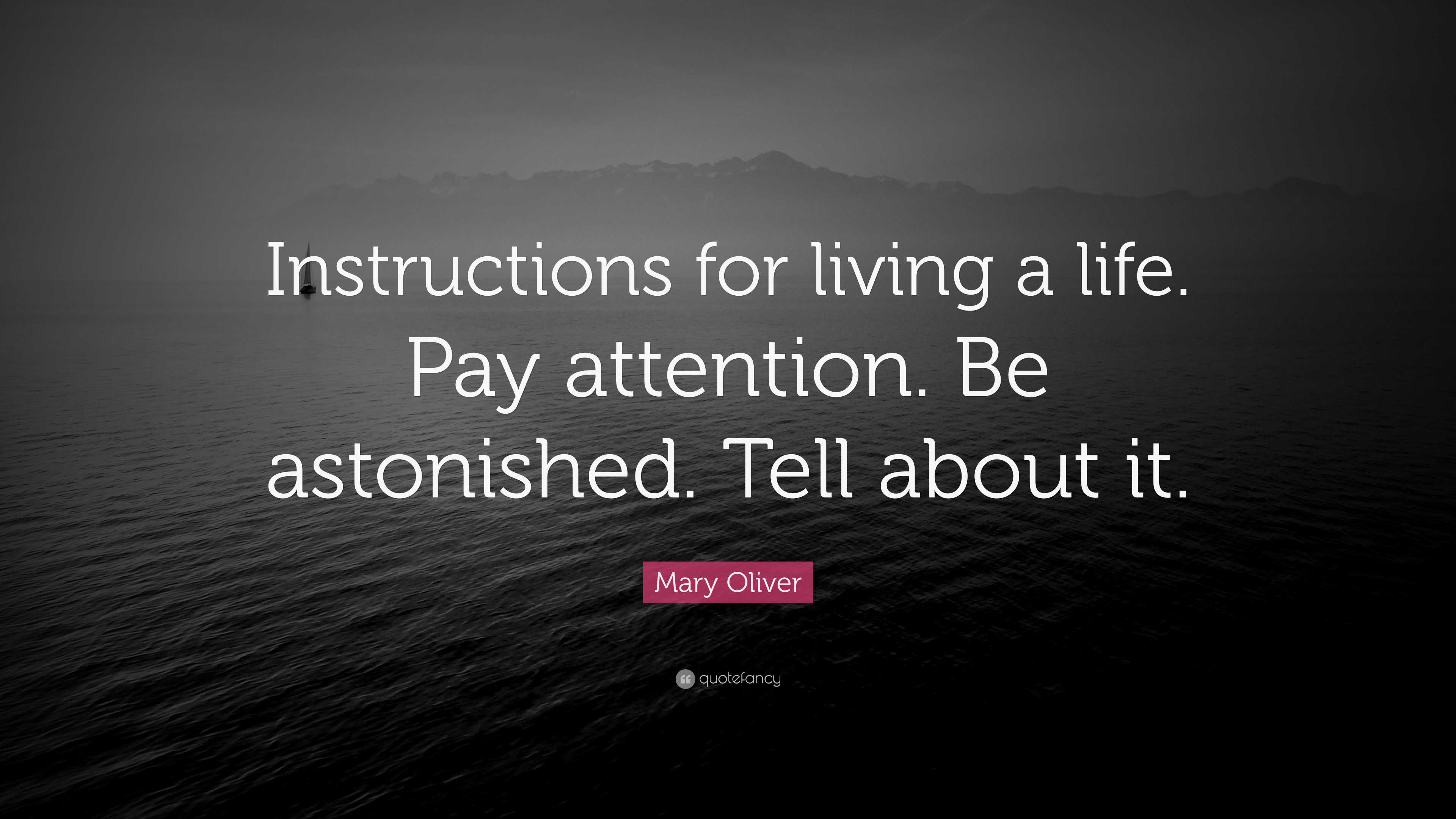
In an era where algorithms dictate the rhythm of our digital lives, few poetic fragments echo as profoundly as Mary Oliver’s “Instructions for living a life. Pay attention. Be astonished. Tell about it.” These three imperatives, distilled into a single sentence, have transcended their origins to become a cultural touchstone—one that continues to flood social feeds, inspire artists, and guide seekers of meaning. The resonance of Oliver’s words lies not merely in their simplicity but in their universality; they are a compass for navigating the cacophony of modern existence. Whether splashed across minimalist posters, whispered in podcasts, or emblazoned on tote bags, her instructions have evolved into a living philosophy, adaptable to the whims of each generation. This is the story of how three lines of verse became a digital mantra, and why, decades after their inception, they still captivate millions.
The Allure of the Minimalist Mantra: Why Oliver’s Words Resonate in a Noisy World
In a landscape saturated with noise—where notifications ping like metronomes and headlines scream for attention—Oliver’s instructions offer a radical act of defiance: silence. The first command, “Pay attention,” is not a suggestion but an invocation to reclaim the sacredness of observation. It’s an antidote to the dopamine-driven scroll, a call to notice the way light fractures through leaves or the unscripted laughter of a stranger. The second, “Be astonished,” is a plea to surrender to wonder, to let the mundane reveal its hidden grandeur. And the third, “Tell about it,” transforms private revelation into shared experience, weaving individual epiphanies into the collective tapestry of human storytelling.
What makes these lines endure is their refusal to be prescriptive. They don’t demand grand gestures or lofty achievements; instead, they celebrate the quiet revolutions of daily life. A child’s first step, the scent of rain on pavement, the unexpected kindness of a barista—these are the miracles Oliver invites us to acknowledge. In an age where content is often manufactured for virality, her words remind us that authenticity thrives in the overlooked corners of existence. It’s no wonder that Instagram feeds and Pinterest boards brim with Oliver-inspired visuals: her instructions are the perfect antidote to the performative hustle of modern life.
Visual Storytelling: How Art and Design Amplify Oliver’s Message
The digital renaissance of Oliver’s words owes much to the alchemy of art and design. Her phrases, when paired with evocative imagery, become more than text—they become experiences. A minimalist watercolor of a solitary figure gazing at a sunset, overlaid with “Be astonished,” doesn’t just convey a message; it evokes a feeling. The juxtaposition of Oliver’s stark, unadorned language against lush, dreamlike visuals creates a cognitive dissonance that lingers in the mind. Designers and artists have seized upon this tension, using color palettes, typography, and composition to amplify the emotional weight of her words.
Consider the proliferation of quote graphics featuring Oliver’s instructions in serif fonts, set against backgrounds of muted greens or deep blues. These choices aren’t arbitrary; they’re deliberate attempts to evoke a sense of calm and introspection. The use of negative space in such designs mirrors the philosophy itself—less is more, and meaning emerges from what is left unsaid. Even in the realm of physical media, her words find new life. Bookmarks, mugs, and framed prints serve as tactile reminders to pause, to breathe, to pay attention. The commercialization of Oliver’s message, far from diluting its power, has democratized it, making her wisdom accessible to those who might never crack open a poetry collection.
From Page to Podcast: The Evolution of Oliver’s Words in Modern Media
The digital migration of Oliver’s instructions hasn’t been confined to static images. Her words have infiltrated the auditory realm, where podcasts, audiobooks, and spoken-word performances give them a cadence and rhythm that written text alone cannot. In a world where attention spans are fragmented, the spoken word offers a respite—a moment of stillness in a storm of soundbites. Podcasts dedicated to mindfulness, creativity, and self-discovery frequently feature Oliver’s phrases as thematic anchors, weaving them into discussions about mental health, artistic practice, and the search for meaning.
Audio platforms have also become incubators for reinterpretations of her work. ASMR artists might whisper her instructions over the sound of rustling leaves, while meditation guides use them as mantras to anchor breathwork sessions. The spoken word breathes new life into Oliver’s text, transforming it from a static quote into an immersive experience. Even in the realm of music, her words have found harmony. Lyricists and composers have set her phrases to melody, creating anthems that urge listeners to slow down, to observe, to marvel. This auditory evolution speaks to the adaptability of Oliver’s message—it is not bound by medium, but rather, it bends to the contours of each new form.
The Community of Seekers: How Oliver’s Instructions Foster Connection
Perhaps the most remarkable aspect of Oliver’s digital ubiquity is the communities it has fostered. Online forums, book clubs, and social media groups have sprung up around her words, each a sanctuary for those who find solace in her philosophy. These spaces are not mere echo chambers; they are crucibles of shared experience, where strangers become confidants in the pursuit of presence. A Reddit thread titled “How do you ‘pay attention’ in your daily life?” might yield responses ranging from a gardener’s observations of pollinators to a musician’s notes on the textures of silence between notes. The diversity of these contributions underscores the universality of Oliver’s call—it is a language without borders, accessible to the urban dweller and the rural dreamer alike.
Artists, in particular, have found in Oliver’s instructions a kindred spirit. Writers pen essays inspired by her words, painters translate her ideas into brushstrokes, and dancers choreograph movements that embody the act of paying attention. These creative acts are not just tributes; they are extensions of her philosophy, proof that her message is not static but alive, evolving with each new interpretation. The digital age has accelerated this cross-pollination of ideas, allowing a poet’s words to bloom in unexpected gardens. In this way, Oliver’s instructions have become a bridge between disciplines, a shared language for those who seek to live with intention.
The Paradox of Virality: When Wisdom Becomes a Commodity
Yet, for all its beauty, the digital proliferation of Oliver’s words is not without its shadows. The same algorithms that catapult her phrases into feeds also risk reducing them to clichés—empty vessels waiting to be filled with whatever meaning the viewer desires. A quote plucked from context and slapped onto a pastel background can lose its teeth, becoming little more than wallpaper for the soul. The challenge, then, is to engage with Oliver’s instructions not as decorative platitudes but as active principles, to let them unsettle rather than comfort.
There’s also the matter of cultural appropriation. Oliver’s words, rooted in a specific time and place, have been co-opted by brands and influencers who wield them as marketing tools. A wellness retreat might plaster her phrases across brochures, divorcing them from their original context of quiet observation and replacing them with the language of productivity. This commodification raises questions: Can a message about defiance against the noise of modern life coexist with the very systems that thrive on distraction? The answer lies in the hands of those who consume her words. To reclaim their power is to use them—not as decoration, but as a compass, a challenge, a call to action.
Living the Instructions: Practical Ways to Integrate Oliver’s Wisdom
So how does one move beyond passive consumption and into the realm of active engagement with Oliver’s philosophy? The answer lies in small, intentional acts. Start with the first instruction: pay attention. Set aside five minutes each day to observe the world without agenda. Notice the way shadows stretch at dusk, or the cadence of a stranger’s voice. Keep a journal of these observations, not as a record of achievements, but as a map of fleeting moments. The second instruction, be astonished, demands a suspension of cynicism. Seek out the extraordinary in the ordinary—a cracked sidewalk where moss has taken root, the geometry of a spider’s web. Let yourself be undone by wonder, even if just for a moment.
Finally, tell about it. Share your astonishments with others, not as boasts, but as invitations. Write a letter to a friend describing the way light hits your kitchen window at dawn. Post a photograph of a dew-kissed spiderweb with the caption “Be astonished.” These acts of telling are not about seeking validation; they are about strengthening the muscle of presence, both in ourselves and in those around us. In doing so, we honor Oliver’s legacy—not as a relic of the past, but as a living, breathing guide for the present.
The digital age has a way of flattening meaning into shareable snippets, but Oliver’s instructions resist this fate. They are not memes to be consumed and discarded; they are seeds, waiting to take root in the soil of our lives. In a world that often feels like it’s spinning faster and faster, her words are an anchor, a reminder that the most profound revolutions are not televised but lived. They are the quiet instructions whispered to the heart, urging us to slow down, to look closely, to marvel, and to share the wonder. And in that sharing, we find not just connection, but a kind of salvation—a way to live, fully and fiercely, in a world that so often asks us to do the opposite.


Leave a Comment