

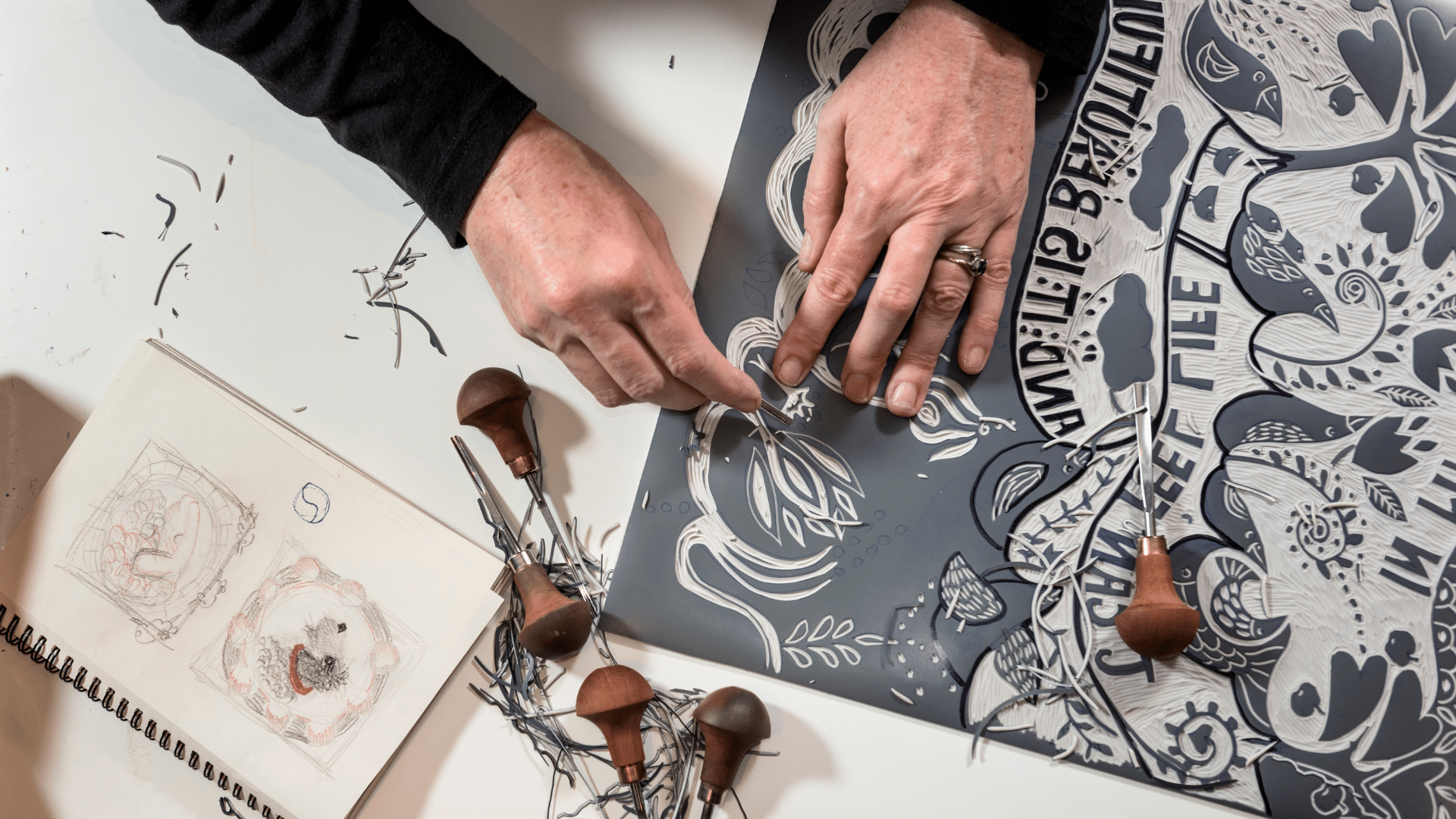
There’s something quietly mesmerizing about watching a fine line emerge from a block of lino as if by magic. The cutter glides, the shavings curl like delicate ribbons, and the image begins to breathe. Yet, behind that effortless stroke lies a truth most carvers only stumble upon after months of frustration: the quality of your lines depends less on your hand and far more on the whisper-sharp edge of your tool. Sharpening isn’t just maintenance—it’s the silent architect of every nuance, the unseen hand that turns a jagged gouge into a velvety groove. This guide doesn’t just show you how to sharpen. It reveals why the finest carvers treat their tools like sacred extensions of their vision—and how you can too.
The Hidden Geometry of a Perfect Cut
Every lino cutter is a tiny wedge of geometry in motion. When the bevel—the sloped face of the blade—meets the surface, it doesn’t slice so much as it coaxes. A properly honed edge doesn’t tear; it parts. The angle of that bevel, typically between 15° and 25°, dictates whether your line will be a crisp incision or a ragged gash. Too steep, and the tool bites aggressively, risking tear-out. Too shallow, and it skates, leaving behind a bruised surface that refuses to hold ink. The sweet spot? A razor-thin apex where the edge meets the bevel at a precise, consistent angle. This isn’t just technique—it’s physics. The lino, after all, is a stubborn medium. It resists, compresses, and rebounds. A dull tool fights that resistance; a sharp one dances with it.
Consider the burr—the tiny curl of metal that forms on the opposite side of the bevel during sharpening. Most guides dismiss it as debris to be wiped away. But the burr is more than waste. It’s a living gauge. When it’s uniform and fine, your edge is ready. When it’s jagged or uneven, your tool is screaming for refinement. Ignore it, and your next cut will drag, catching on microscopic imperfections. Honor it, and your lines will flow like silk.

The Ritual of the Stone: Beyond Grit and Pressure
Sharpening stones are not mere abrasives—they are time machines. A coarse stone (around 400 grit) erases damage and restores form. A medium stone (800–1000 grit) refines the edge. A finishing stone (2000+ grit) polishes it to a mirror. But the magic lies in the ritual, not just the grit. The way you move the blade, the pressure you apply, even the angle at which you tilt the stone—all are acts of intention. Slide the tool across the stone with deliberate strokes, maintaining a constant angle. Rotate the blade slightly with each pass to ensure even wear. The goal isn’t speed; it’s consistency. A hurried stroke creates a micro-serrated edge, one that will shred your lino like a cheese grater.
Waterstones, with their porous surfaces and self-lubricating properties, are favored by purists. Oilstones, slower but more forgiving, appeal to those who value longevity. Diamond plates, though aggressive, demand precision—they can erase years of neglect in minutes, but one misstep can ruin a tool forever. Choose your weapon wisely. And remember: the stone doesn’t sharpen the tool. You do. The stone merely reveals what you’ve already decided to create.
The Burr’s Secret: Why Most Carvers Stop Too Soon
Here’s the paradox: the burr is both enemy and ally. It clings to the blade like a shadow, a reminder of the work done. But it’s also a signpost. When the burr is uniform along the entire length of the blade, your edge is approaching perfection. Yet most carvers stop the moment the burr appears, mistaking it for the final step. They wipe the blade clean, test it on a scrap of lino, and declare it sharp. But the burr is not the destination—it’s the threshold. To achieve a truly refined edge, you must remove the burr. Not by wiping it away, but by refining the bevel further. Use a finer stone. Polish the edge until the burr dissolves into nothingness. Only then will your tool glide, not scrape. Only then will your lines sing.
This is where the artistry deepens. The burr’s disappearance is a moment of revelation. It’s the point where the tool ceases to be a wedge and becomes an extension of your intention. The lino, sensing the shift, will respond with a clarity you’ve never known before. Fine lines will emerge with effortless precision. Delicate textures will hold ink like a whisper. The burr, in its final act, teaches patience. And patience, in the world of lino carving, is the difference between a good print and a masterpiece.

Maintenance as Meditation: Keeping the Edge Alive
Sharpening isn’t a one-time event. It’s a dialogue between you and your tools, a conversation that grows more intimate with each session. After every carving session, clean your tools meticulously. Residual lino dust and ink can corrode the steel, dulling the edge before you even begin. Store them in a dry environment, ideally wrapped in a soft cloth to prevent moisture from seeping into the tang. And before each use, perform a quick touch-up on your finest stone. It takes minutes. It preserves years of craft.
But maintenance extends beyond the physical. It’s a mindset. Treat your tools with reverence. Store them not in a cluttered drawer, but in a dedicated case or roll. Handle them with clean hands. Inspect them regularly for chips or warping. A chipped edge isn’t just dull—it’s broken. It will tear your lino, ruin your prints, and shatter your confidence. Prevention is easier than repair. And repair, when necessary, demands skill. Some edges can be salvaged with careful grinding. Others must be retired. Knowing when to let go is as much a part of the craft as knowing how to sharpen.
There’s a quiet joy in this upkeep. It’s not just about preserving sharpness. It’s about preserving the connection between hand, tool, and material. Every stroke of the stone becomes a meditation. Every pass of the blade across the lino is a conversation. The more you care for your tools, the more they care for you in return.
The Proof in the Print: Witnessing the Transformation
Nothing validates your sharpening like the first print. Load your block with ink, press it to paper, and lift. If your lines are crisp, your textures are rich, and your ink sits in perfect harmony with the carved grooves, you’ve succeeded. If not, don’t despair. Re-examine your edge. Check your angle. Revisit your stones. The print is the final judge, but it’s not the only teacher. Keep carving. Keep refining. Keep sharpening.
Over time, you’ll notice something extraordinary. Your tools will begin to feel like extensions of your body. The angle of the bevel will become instinctive. The pressure required for a fine line will be second nature. The burr will no longer be a mystery—it will be a familiar companion. And the lino? It will respond like a living thing, revealing depths you never knew existed. Fine lines will flow effortlessly. Delicate details will emerge with clarity. The print will not just be a reproduction of your design—it will be a revelation of your intent.
This is the alchemy of lino carving. It’s not just about making marks. It’s about making meaning. And at the heart of that meaning lies the edge—the silent, gleaming heart of every great print.
The next time you pick up your cutter, pause for a moment. Feel the weight of it in your hand. Run your thumb along the bevel. Listen to the whisper of the stone as you prepare to sharpen. This isn’t just preparation. It’s an act of creation. And the finest lines you’ll ever carve begin not with the lino, but with the edge of your tool.


Leave a Comment