

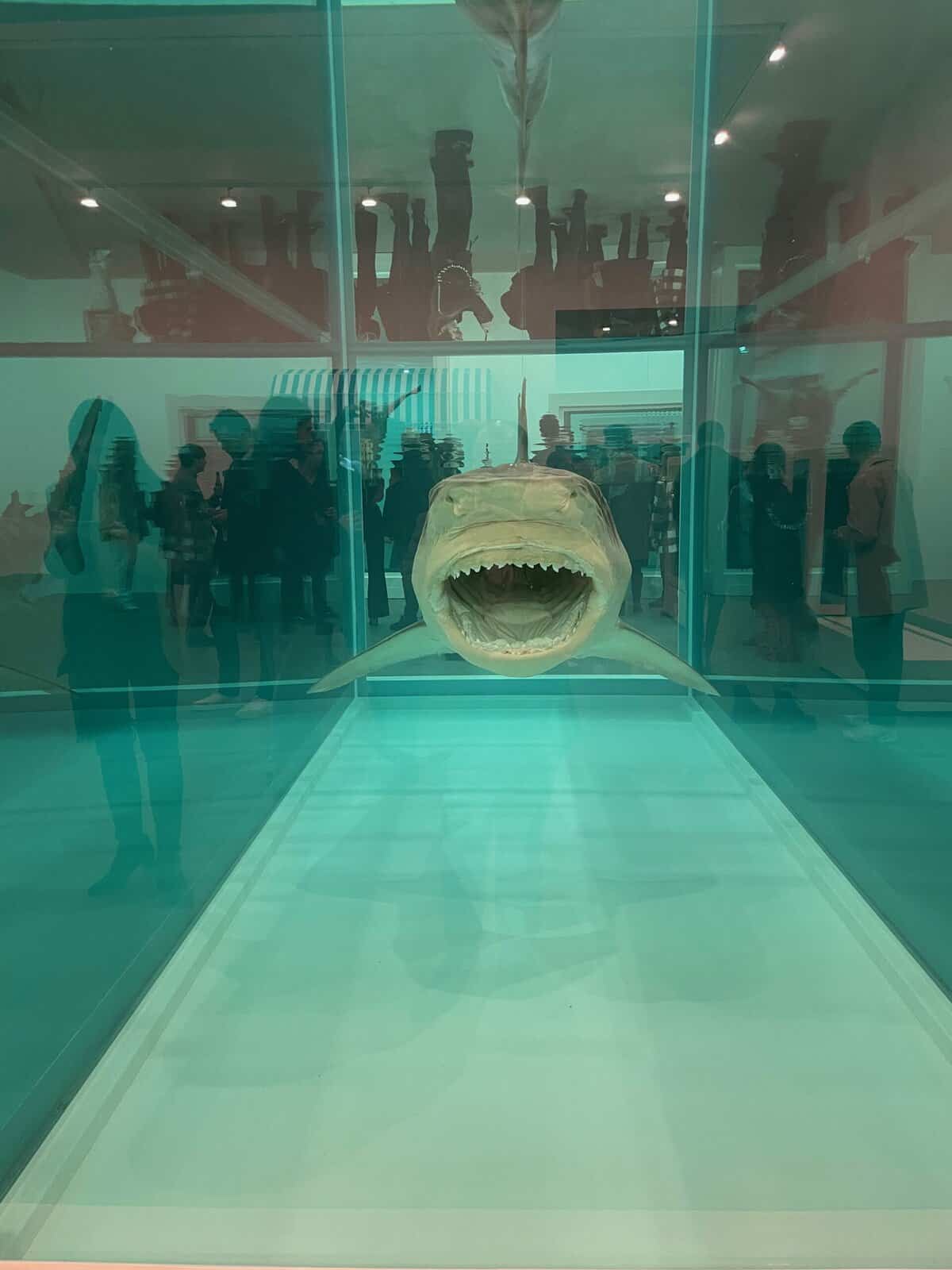
The shark glides through the formaldehyde haze, suspended in eternal stillness—a silent sentinel of modern art’s most infamous provocation. Damien Hirst’s Physical Impossibility of Death in the Mind of Someone Living (1991) is more than a preserved predator; it’s a cultural Rorschach test, a billionaire’s macabre joke, and a philosophical mirror masquerading as a museum piece. Is this titanic tiger shark, floating in its glass sarcophagus, a meditation on mortality, a critique of capitalism’s grotesque excesses, or simply the ultimate flex of an artist who turned shock into currency? The answer, as with all great art, is a murky cocktail of all three—shaken, not stirred.
To dissect this aquatic enigma, we must dive into its three most compelling layers: the metaphysical dread it evokes, the economic absurdity it embodies, and the cultural mythos it spawned. Each perspective peels back a different scale of the shark’s skin, revealing the glistening, unsettling truth beneath.
The Metaphysical Dread: A Mirror Held to the Abyss
Hirst’s shark isn’t just dead; it’s uncannily alive. The formaldehyde preserves its form but not its essence, creating a paradox that gnaws at the viewer’s psyche. This is no mere taxidermy trick—it’s a confrontation with the sublime, that terrifying beauty born from the collision of life and death. The shark’s gaping maw, frozen mid-snarl, forces us to stare into the void of our own mortality. It’s as if Hirst plucked the creature from the depths of our collective unconscious, where ancient fears of the unknown lurk, and plopped it into a sterile white gallery.
Philosophers have long grappled with the uncanny—that eerie sensation when the familiar becomes alien. Freud wrote about it in the context of the heimlich (the homely) turning into the unheimlich (the unhomely). Hirst weaponizes this phenomenon. The shark is both real and unreal, a biological specimen and a surrealist nightmare. Its presence in a museum, a place of reverence for the past, transforms it into a relic of the future—a prophecy of humanity’s own extinction, preserved in a jar of embalming fluid.
Some critics argue that the work is a memento mori, a reminder that death is the great equalizer. Yet, it’s more than that. It’s a memento vivi—a reminder that life, in all its brutal glory, is the thing we’re trying to outrun. The shark doesn’t just die; it haunts. Its glass cage is a one-way mirror, reflecting not the viewer’s image but their existential dread. In this way, Hirst doesn’t just depict death; he embodies it, turning the gallery into a cathedral of the macabre.
The Economic Absurdity: Art as the Ultimate Luxury Good
If the shark’s metaphysical weight is its soul, then its economic reality is its skeleton—a gleaming, gold-plated exoskeleton of capitalism’s most grotesque tendencies. When Hirst sold the piece to collector Steve Cohen for a reported $12 million in 2006, he didn’t just make art history; he made art economics history. The price tag wasn’t just for the shark—it was for the idea of the shark, the mythos, the controversy, and the sheer audacity of turning a dead fish into a status symbol.
This is where the joke becomes deliciously dark. Hirst, a former art student who once worked in a mortuary, understood something fundamental about the art world: it’s not about beauty or meaning, but about value. And value, in the rarefied air of high art, is a construct as fragile as the formaldehyde’s seal. The shark’s price isn’t justified by craftsmanship or emotional resonance—it’s justified by its rarity, its provocation, and, most damningly, its own myth. It’s the ultimate Veblen good, a product whose desirability increases the more expensive it is.
Critics have long decried Hirst’s work as conceptual capitalism, a term that perfectly encapsulates the shark’s dual nature. On one hand, it’s a critique of consumer culture; on the other, it’s the apotheosis of it. The shark is both the artist’s finger pointed at the rot of late-stage capitalism and the very finger that’s rotten to the core. It’s a self-licking ice cream cone of irony, a work that critiques the commodification of art while being the most commodified art of all time.
Then there’s the issue of replacement. In 2006, Hirst replaced the original shark (which had deteriorated) with a new one, a move that critics saw as either pragmatic or cynical. Was it a necessary act of preservation, or a naked admission that the work’s value was tied to its concept rather than its physicality? Either way, the replacement underscored the shark’s status as a brand—a logo for contemporary art’s obsession with spectacle over substance. The formaldehyde wasn’t just preserving the shark; it was preserving the myth.
The Cultural Mythos: How a Dead Fish Became a Pop Icon
Hirst’s shark didn’t just swim into the art world—it erupted like a cultural supervolcano, leaving a crater of influence that’s still expanding. It’s impossible to overstate the shark’s role in shaping the Young British Artists (YBAs) movement, a group of provocateurs who turned the 1990s art scene into a circus of controversy. The shark wasn’t just a single work; it was a manifesto, a declaration that art could be anything—even a dead animal in a tank—as long as it was interesting.
But the shark’s legacy extends far beyond the YBAs. It’s a touchstone for debates about authenticity in art, the role of the artist in a post-conceptual world, and the power of shock in an era of endless stimulation. It’s been parodied in South Park, name-dropped in Breaking Bad, and immortalized in countless memes. It’s the kind of work that transcends art to become cultural shorthand—a visual shorthand for the absurdity, the excess, and the existential dread of modern life.
Yet, for all its cultural ubiquity, the shark remains a Rorschach test. Some see it as a profound meditation on life and death; others, as a cynical cash grab. Some view it as a masterpiece of conceptual daring; others, as a symptom of art’s decline into gimmickry. The beauty of the shark is that it refuses to be pinned down. It’s a work that exists in the negative space between meaning and meaninglessness, a void that each viewer must fill with their own interpretation.
This, perhaps, is its greatest trick. The shark doesn’t just reflect the viewer’s fears and desires—it feeds on them. It’s a black hole of signification, a work that grows more complex the longer you stare into its formaldehyde depths. It’s no wonder that it became a symbol of the art world’s hunger—not just for beauty, but for attention, for controversy, for the next big thing.

The Final Judgment: Is It Art or Just a Joke?
To ask whether Hirst’s shark is art is to miss the point entirely. Art, after all, is a category as fluid as the formaldehyde it’s suspended in. The real question is whether the shark is meaningful—and meaning, like beauty, is in the eye of the beholder. Some will see profundity in its gaze; others, only the hollow echo of a billionaire’s laugh. But to dismiss it as mere shock art is to ignore the layers of existential dread, economic critique, and cultural mythmaking that it embodies.
The shark is a palimpsest, a work that has been scribbled over, erased, and rewritten by generations of viewers. It’s a dead fish, a living metaphor, a capitalist totem, and a philosophical puzzle all at once. It’s the kind of work that doesn’t just hang on a wall—it haunts it. And perhaps that’s the point. In a world where death is the ultimate punchline, Hirst’s shark is the punchline given form—a joke so big, so expensive, and so eternal that it stops being a joke at all.
So, is it about death? Yes. Is it the billionaire’s joke? Absolutely. But it’s also so much more. It’s a mirror, a myth, a market manipulation, and a masterpiece of modern mythmaking. It’s the art world’s answer to the question: What happens when you take the most terrifying thing in the ocean and put it in a glass box? The answer, of course, is that it becomes everything.
The shark will keep swimming, suspended in its eternal loop, a silent witness to the follies of humanity. And we, the viewers, will keep staring—drawn in by the same primal curiosity that once made our ancestors gawk at the beasts of the deep. Only this time, the beast is us.


Leave a Comment