

In the pantheon of Impressionist painters, Edgar Degas stands apart—not merely as a chronicler of fleeting light or a master of color, but as an unflinching observer of the human form in its most unguarded moments. His ballerinas, those ethereal figures poised in arabesques and pliés, are not the idealized nymphs of classical ballet. Instead, they are caught mid-stretch, their spines arched like bows, their limbs contorted into shapes that defy conventional notions of grace. To the casual viewer, they appear awkward, even ungainly. Yet this perceived awkwardness is not a flaw—it is a deliberate rebellion against the sanitized aesthetics of the 19th century. Degas’ dancers are real women, not porcelain dolls, and their “ugliness” is the very essence of his genius.
What, then, compels us to label these figures as awkward? Is it the way their bodies twist unnaturally, their muscles straining under the weight of unseen gravity? Or is it the absence of the polished perfection we associate with ballet? Perhaps it is the raw honesty of their postures—the way their chins jut forward, their shoulders hunch, and their feet splay in the midst of exertion. Degas did not paint dancers to glorify them. He painted them to dissect them, to peel back the layers of artifice and reveal the mechanics beneath. In doing so, he transformed the ballerina from a symbol of idealized femininity into a study of human vulnerability and physicality.
The Anatomy of Awkward: Dissecting Degas’ Unconventional Postures
To understand Degas’ approach, one must first discard the romanticized image of the ballerina as a weightless creature floating above the stage. His dancers are grounded, their bodies heavy with the pull of gravity. Look closely at Dancer with a Bouquet, where a young ballerina’s arms are raised high, her torso tilted backward in an exaggerated curve. The angle is so severe that it borders on the grotesque—yet it is precisely this extremity that captures the essence of a dancer’s discipline. The body is not a static form but a dynamic machine, and Degas’ brushwork mimics the tension of muscles and tendons under strain.
Another hallmark of Degas’ style is his use of foreshortening, a technique that distorts perspective to create a sense of depth. In The Rehearsal, the dancers are arranged in a diagonal line, their bodies receding into the background. The effect is disorienting; the viewer’s eye struggles to reconcile the angles, as if peering through a distorting lens. This intentional distortion forces us to confront the physicality of the scene. These are not distant, ethereal figures but women engaged in the grueling labor of practice, their bodies contorted into shapes that defy easy viewing.
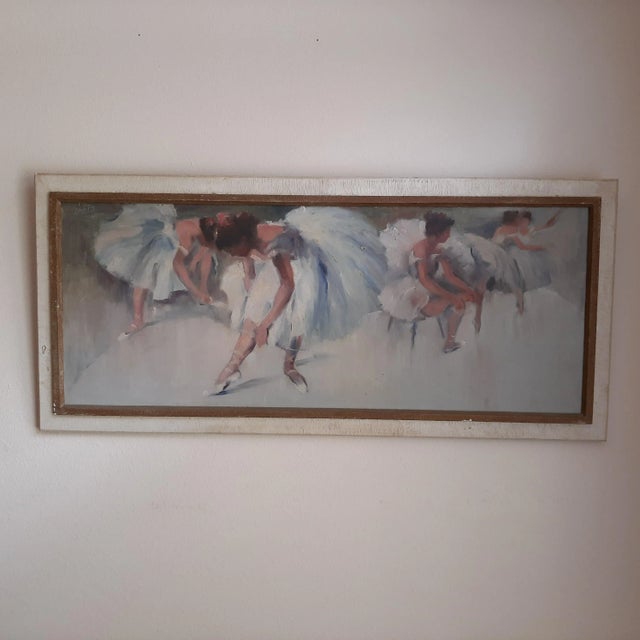
The Psychology Behind the Brush: Why Degas Embraced the “Ugly”
Degas’ fascination with the awkward extended beyond mere technique—it was a philosophical stance. In an era that prized beauty above all else, he sought to dismantle the illusion of perfection. His dancers were not performers on a stage but women in a studio, their bodies marked by fatigue, their expressions weary or distracted. This was a radical departure from the academic tradition, which demanded that art elevate its subjects to a state of idealized splendor. Degas, however, was drawn to the mundane, the overlooked, the unglamorous.
Consider his pastel drawings of dancers adjusting their hair or wiping their brows. These are not the grand, sweeping gestures of a prima ballerina’s solo. They are the small, private moments of exhaustion and self-care. By focusing on these details, Degas humanized his subjects, stripping away the myth of the ballerina as a distant, untouchable figure. Instead, he presented her as a worker, a body in motion, subject to the same physical laws as any other human being.
This psychological depth is what makes Degas’ work so compelling. He did not paint dancers to flatter them; he painted them to understand them. His awkward figures are not mistakes—they are revelations. They expose the labor behind the art, the sweat behind the sparkle, the reality behind the fantasy. In doing so, he invited viewers to see beyond the surface, to question the narratives we accept without scrutiny.
From Studio to Canvas: The Technical Mastery Behind the “Ugly”
Degas’ ability to capture the awkward with such precision was no accident—it was the result of meticulous observation and technical innovation. Unlike many of his contemporaries, who sketched dancers in idealized poses, Degas spent hours in the studio, watching his subjects from unusual angles. He crouched low to the ground, capturing dancers from below, or positioned himself at a distance to observe the way their bodies moved in unison. This immersive approach allowed him to document the nuances of posture and gesture that others might overlook.
His use of photography also played a crucial role. Degas was one of the first artists to experiment with the medium, using photographs as a reference for his compositions. The grainy, imperfect nature of early photography lent a sense of immediacy to his work, as if the dancers had been captured in a fleeting, unposed moment. This influence is evident in the way his figures often appear slightly blurred, their edges softened by the artist’s attempt to freeze a moment in time.
Moreover, Degas’ choice of medium—pastels, oils, and charcoal—allowed him to blend and smudge his lines, creating a sense of movement and spontaneity. In his pastel works, the colors bleed into one another, mimicking the way light dances across a dancer’s skin. The result is a visual rhythm that mirrors the physical rhythm of the dancers themselves. This technical mastery ensured that even his most awkward compositions felt alive, as if the figures were caught in the midst of a performance that had not yet ended.
The Legacy of Degas’ Awkward Aesthetic: A Challenge to Perfection
Degas’ willingness to embrace the awkward did not go unchallenged in his time. Critics of the era often dismissed his work as crude or unfinished, unable to reconcile the beauty of his technique with the perceived ugliness of his subjects. Yet, over time, his approach has come to be celebrated as a groundbreaking departure from tradition. Modern audiences, conditioned by the raw honesty of photography and cinema, recognize the power in Degas’ unflinching gaze.
Today, his influence can be seen in the works of contemporary artists who similarly reject idealized beauty in favor of authenticity. From the hyper-realistic sculptures of Ron Mueck to the candid photographs of Nan Goldin, the legacy of Degas’ awkward aesthetic lives on. These artists, like Degas, understand that true beauty often lies in the unvarnished, the unpolished, the real.

How to Engage with Degas’ Work: A Guide for the Modern Viewer
For those encountering Degas’ dancers for the first time, the initial reaction may be one of discomfort. The awkwardness can feel jarring, even unsettling. But this discomfort is precisely what makes the work so powerful. To truly engage with Degas’ art, one must adopt a mindset of curiosity and openness. Instead of seeking out the familiar beauty of a ballet poster, approach his paintings with the same analytical eye you would bring to a scientific study. Observe the way the light falls on the dancer’s skin, the way her muscles tense, the way her body bends under the weight of her own limbs.
Consider, too, the historical context. Degas was painting during a time of great social upheaval, when the rigid structures of the past were beginning to crumble. The ballerina, once a symbol of aristocratic refinement, was now a worker in a rapidly industrializing world. Degas’ work reflects this shift, capturing the tension between tradition and modernity, between idealism and reality.
Finally, don’t be afraid to embrace the awkwardness. In a world saturated with airbrushed images and curated perfection, Degas’ dancers offer a refreshing dose of honesty. They remind us that beauty is not a static ideal but a dynamic, ever-changing concept. And sometimes, the most beautiful things are the ones that make us pause, wrinkle our brows, and ask, “Why does this feel so real?”
As the final brushstroke dries and the dancers’ forms settle into the canvas, one thing becomes clear: Degas did not paint awkwardness for the sake of shock. He painted it because it was true. And in doing so, he gave us a gift—a glimpse into the unfiltered, unvarnished reality of the human body in motion. That, perhaps, is the most radical act of all.


Leave a Comment