

The rhythmic heartbeat of America’s dance floors didn’t begin with a polished waltz or a stately minuet—it was born in the hush-hush gatherings of the enslaved, where bodies moved in defiance, storytelling, and survival. Picture this: under the cloak of night, or in the shadowed corners of plantation quarters, enslaved Africans and their descendants crafted a dance so potent, so subversively joyful, that it would ripple through centuries, birthing jazz, tap, and the swagger of modern hip-hop. This was no mere entertainment; it was a language of resistance, a coded celebration, and the first true American vernacular dance—the cakewalk.
The cakewalk wasn’t just a dance; it was a sly wink to the oppressor, a performance so exaggerated in its elegance that it mocked the very idea of white supremacy. Enslaved people, forbidden from gathering freely, turned their stolen moments into a spectacle of parody, mimicking the stiff, pretentious ballroom dances of their enslavers with exaggerated high steps, sweeping bows, and a grin that said, “You want refinement? We’ll give you refinement—times ten.”
The Plantation as a Stage: Where Dance Became Defiance
Long before the cakewalk had a name, enslaved Africans brought with them a tapestry of rhythmic traditions—polyrhythms from the Congo, the fluid footwork of the Yoruba, the stamping dances of the Ashanti. These weren’t just dances; they were spiritual cartography, maps of memory and identity etched into the earth with bare feet. When the chains of slavery forced these traditions into the crucible of the Americas, something extraordinary happened: the dances evolved, fused, and birthed something entirely new.
The plantation wasn’t just a place of labor; it was an accidental theater. Sundays, holidays, and stolen nights became stages where enslaved people reenacted their stolen histories, their dreams of freedom, and their quiet triumphs. The ring shout, a circular dance where dancers moved counterclockwise in a trance-like state, was more than a ritual—it was a portal. Participants believed they could communicate with ancestors, that the dance itself was a form of prayer. The stomping, the clapping, the ecstatic shouts—these weren’t just movements; they were incantations, spells cast to ward off despair.
And then there was Ol’ Uncle Joe, the mythic figure who danced with such wild abandon that his name became shorthand for the unbridled joy of Black movement. Whether he was a real man or a composite of many, his spirit lived in the way enslaved people threw their bodies into the dance, their limbs loose, their spines undulating like reeds in a storm. This wasn’t ballet—this was bodies speaking in tongues, a language older than the plantations themselves.
The Cakewalk: A Dance That Outsmarted the Master
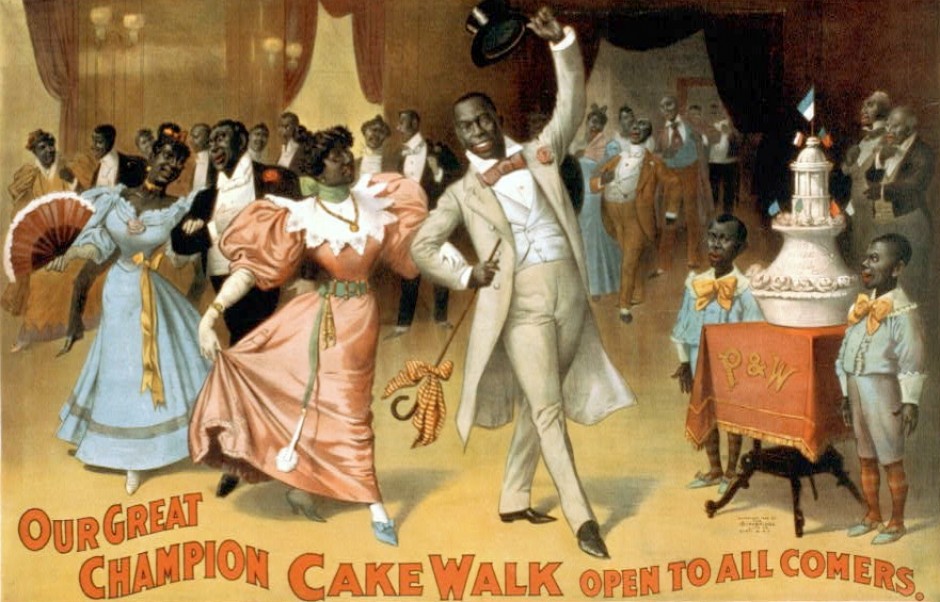
The cakewalk emerged in the mid-19th century, a time when the brutality of slavery was at its peak, and yet, somehow, joy still found a way to flourish. The dance was a paradox: it was both a celebration and a taunt, a performance of refinement that was, in reality, a masterclass in subversion. Enslaved people would line up in couples, strutting in exaggerated parodies of white ballroom etiquette—high kicks, sweeping bows, and the kind of prim posturing that made the enslavers’ jaws clench. The prize? A cake. A simple, symbolic cake, but one that carried the weight of stolen dignity.
What made the cakewalk so devilishly clever was its duality. To the enslavers, it looked like a quaint, almost comical imitation of their own dances. But to those who danced it, it was a secret handshake, a way to assert humanity in a world that denied it. The high-stepping, the prancing, the way dancers would freeze in dramatic poses—all of it was a wink, a nod, a “We see you, and we’re laughing.” The cakewalk wasn’t just a dance; it was a guerrilla tactic, a way to turn the master’s gaze into a mirror that reflected back only absurdity.

The Ripple Effect: How the Cakewalk Shaped American Dance
The cakewalk didn’t stay hidden for long. By the 1870s, it had exploded into the mainstream, first as a minstrel show spectacle and then as a sensation in ballrooms across America and Europe. White audiences, who had spent decades laughing at Black performers in blackface, were now paying good money to watch them dance the cakewalk—unaware that they were, in fact, applauding a dance that had once been a weapon of quiet defiance. The irony was delicious: the very thing that had been born in resistance was now being commodified, watered down, and sold back to the masses as “exotic entertainment.”
But the cakewalk’s DNA didn’t disappear—it mutated. The high-stepping strut evolved into the strut of ragtime, the shimmy of the 1920s, and the swing of the 1940s. The rhythmic footwork of the cakewalk laid the groundwork for tap dance, where the syncopated beats of the feet became a language of their own. Even the bounce of modern hip-hop can trace its lineage back to those plantation nights, where enslaved people turned the earth beneath their feet into a drum and their bodies into instruments.
Consider the Charleston, that frenetic, knee-slapping dance of the 1920s. Its roots are unmistakable: the cakewalk’s high energy, the ring shout’s circular motion, the way dancers would isolate different parts of their bodies in a rhythmic conversation. Or take the jitterbug, that wild, acrobatic partner dance of the 1940s—its frenetic spins and lifts were just the cakewalk on steroids, a celebration of freedom that refused to be contained.
The Unspoken Legacy: Dance as a Living Archive
What most people don’t realize is that the cakewalk wasn’t an isolated phenomenon—it was part of a continuum. The dances of the enslaved were living archives, repositories of history, resistance, and cultural memory. Every stomp, every shuffle, every rhythmic clap was a syllable in a story that refused to be silenced. When we watch a modern dancer move, whether in a ballet studio or on a street corner, we’re seeing echoes of those plantation nights, of Ol’ Uncle Joe’s wild abandon, of the cakewalk’s sly wit.
And yet, the full story of these dances is often erased. We celebrate jazz as America’s original art form, but we forget that jazz was born from the same rhythmic soil as the ring shout and the cakewalk. We marvel at the athleticism of tap, but we rarely acknowledge that its syncopated beats were a direct descendant of the footwork used to mock enslavers. This isn’t just history—it’s a lineage of defiance, a chain of creativity that stretches from the bowels of slavery to the stages of Broadway.

The next time you see someone dance with unbridled joy, with a swagger that feels like it’s rooted in something ancient and unshakable, remember: that movement didn’t come from nowhere. It came from the plantations, from the ring shouts, from the cakewalk’s sly grin. It came from bodies that refused to be broken, that turned oppression into art, and that danced so hard, so freely, that the world had no choice but to listen.
American vernacular dance isn’t just a collection of steps—it’s a testament to the power of the human spirit to create beauty in the face of brutality. From Ol’ Uncle Joe’s wild jigs to the cakewalk’s stinging satire, these dances were never just entertainment. They were survival. They were resistance. They were the first true voice of a nation finding its rhythm.


Leave a Comment