

The Guggenheim Abu Dhabi isn’t just another museum—it’s a cultural earthquake, a tectonic shift in how the world perceives art, architecture, and geopolitical ambition. When its doors swing open in 2026, it won’t merely unveil another collection of masterpieces; it will unfurl a new chapter in the global narrative of human creativity. For decades, the Solomon R. Guggenheim Foundation has been a beacon of avant-garde thought, but this iteration in the United Arab Emirates is something far more audacious: a fusion of desert ambition and cosmopolitan vision, where the sands of Arabia meet the avant-garde ethos of Frank Gehry’s architectural genius. The fascination isn’t just about the art—it’s about what this institution represents: a bold redefinition of cultural legacy in a region where tradition and innovation collide with breathtaking force.
What makes the Guggenheim Abu Dhabi so mesmerizing isn’t just its scale or its Frank Gehry-designed silhouette rising from the Arabian Gulf like a crystalline mirage. It’s the audacity of the vision itself. In a world where cultural institutions often play it safe, this project dares to ask: What happens when a museum isn’t just a repository of the past, but a living, breathing organism that shapes the future? The answer lies not in the marble floors or the climate-controlled galleries, but in the quiet revolution it quietly heralds—a revolution where art becomes a bridge between civilizations, where the Middle East stakes its claim as a new epicenter of global culture, and where the very idea of a “museum” is reimagined.
The Architecture: A Symphony of Light and Geometry
The Guggenheim Abu Dhabi isn’t just a building; it’s a manifesto in steel and glass. Designed by Frank Gehry, the structure is a masterclass in controlled chaos, where undulating curves and angular planes seem to defy gravity. But this isn’t mere aesthetic indulgence—it’s a deliberate dialogue with the environment. The building’s façade, clad in reflective titanium and glass, shimmers like a mirage under the Abu Dhabi sun, its surfaces shifting with the light. By day, it mirrors the sky and sea; by night, it glows like a lantern, casting an ethereal glow over Saadiyat Island.
Inside, the galleries spiral upward in a continuous loop, a nod to the Guggenheim’s New York predecessor but reimagined for the 21st century. The design isn’t just visually stunning—it’s experiential. Visitors won’t just walk through the museum; they’ll navigate a journey where architecture and art converge. The central atrium, a soaring void of space, acts as a gravitational pull, drawing eyes upward toward the skylight that punctuates the ceiling. It’s a space that demands contemplation, where the act of viewing art becomes a meditative act, a pause in the relentless march of time.
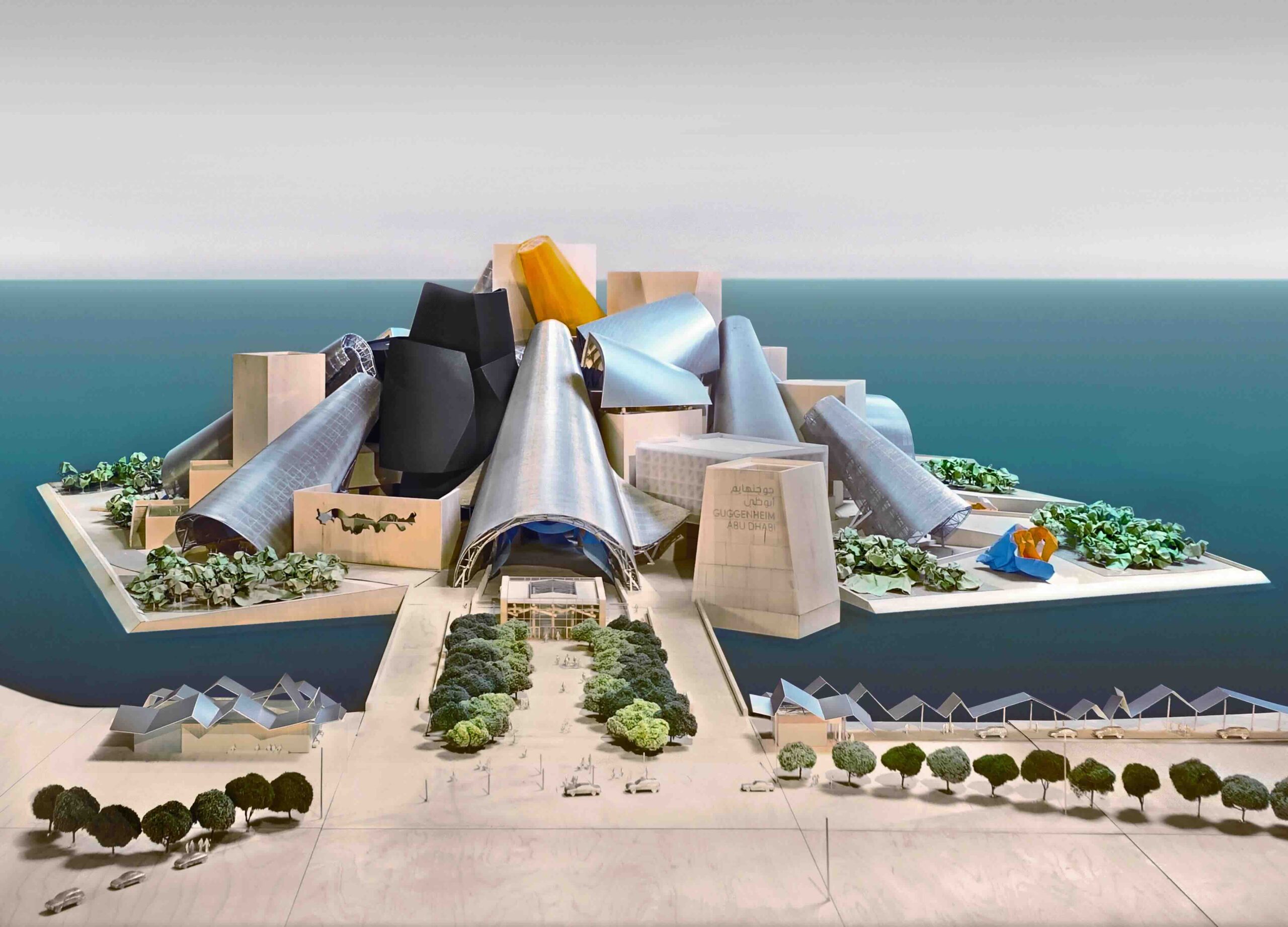
Yet, the true genius of Gehry’s design lies in its adaptability. The museum’s modular galleries can be reconfigured for exhibitions of any scale, from immersive installations to intimate retrospectives. This flexibility isn’t just practical—it’s philosophical. It suggests that art isn’t static; it’s a living conversation, one that evolves with each visitor’s perspective. In a region where tradition often dictates permanence, the Guggenheim Abu Dhabi embraces fluidity, proving that cultural institutions can be both rooted and revolutionary.
The Collection: A Tapestry of Global Dialogues
The Guggenheim Abu Dhabi’s collection isn’t just a curated selection of art—it’s a deliberate act of cultural diplomacy. With a focus on modern and contemporary works from the Middle East, Africa, South Asia, and beyond, the museum seeks to dismantle the Eurocentric narratives that have long dominated the art world. This isn’t about tokenism; it’s about redressing a historical imbalance. For too long, the stories of non-Western artists have been sidelined, their voices drowned out by the dominance of Western institutions. The Guggenheim Abu Dhabi changes that.
Imagine standing before a painting by an Emirati artist whose work explores the tension between tradition and modernity, then turning to see a sculpture by a Nigerian artist reimagining the human form through the lens of postcolonial identity. The collection isn’t just diverse—it’s a conversation, a collision of perspectives that challenges visitors to see the world differently. The Guggenheim’s curators have made a conscious effort to include works that grapple with pressing global issues: migration, climate change, identity, and the legacy of colonialism. These aren’t just aesthetic choices; they’re political statements, a quiet rebellion against the idea that art should exist in a vacuum.
But the collection’s power lies not just in its breadth, but in its depth. The museum has secured loans from some of the world’s most prestigious institutions, including the Solomon R. Guggenheim Museum in New York and the Centre Pompidou in Paris. Yet, it also shines a spotlight on emerging artists, providing a platform for voices that have historically been marginalized. This dual approach—balancing the canon with the contemporary—ensures that the Guggenheim Abu Dhabi isn’t just a museum of the past, but a laboratory for the future.
The Vision: A Cultural Oasis in the Desert
Abu Dhabi’s ambition to become a global cultural hub isn’t new. The emirate has long recognized that its future isn’t just about oil and skyscrapers—it’s about ideas. The Guggenheim Abu Dhabi is the crown jewel of this vision, a project that transcends the boundaries of what a museum can be. But why here? Why now?
The answer lies in the region’s shifting identity. The Middle East is no longer content to be a passive consumer of Western culture; it’s staking its claim as a creator, a thought leader, a disruptor. The Guggenheim Abu Dhabi is a physical manifestation of this shift. It’s a declaration that the Arab world isn’t just a destination for oil and tourism—it’s a destination for art, for dialogue, for intellectual exchange. The museum’s location on Saadiyat Island, a cultural district that also includes the Louvre Abu Dhabi and the Zayed National Museum, reinforces this message. Together, these institutions form a constellation of cultural power, a testament to the UAE’s commitment to fostering creativity and innovation.
Yet, the Guggenheim Abu Dhabi’s vision extends beyond its walls. The museum is designed to be a hub for education, research, and community engagement. Its residency programs will bring artists from around the world to Abu Dhabi, fostering cross-cultural collaborations that could redefine contemporary art. Its archives will preserve the region’s artistic heritage, ensuring that future generations have access to their own history. And its public programs—workshops, lectures, performances—will make art accessible to everyone, not just the elite.
This isn’t just about building a museum; it’s about building a movement. The Guggenheim Abu Dhabi is a challenge to the status quo, a provocation to rethink what culture can be. In a world where divisions often feel insurmountable, it offers a radical alternative: a space where differences aren’t erased, but celebrated; where the past isn’t ignored, but recontextualized; where the future isn’t feared, but embraced.
The Controversies: Navigating the Complexities
Of course, no grand vision comes without its detractors. The Guggenheim Abu Dhabi has faced criticism on multiple fronts—from concerns about labor practices during construction to debates about cultural appropriation. Some argue that a Western institution imposing its model on the Middle East risks diluting local traditions. Others question whether a museum of this scale is truly necessary in a region where art often takes a backseat to more immediate concerns.
These criticisms aren’t unfounded. The construction of the Guggenheim Abu Dhabi did raise labor rights issues, a reminder that even the most visionary projects can come at a human cost. The museum’s leadership has acknowledged these concerns, pledging to uphold ethical standards and ensure fair treatment of workers. But the conversation doesn’t end there. It extends to the very purpose of the institution: Can a museum truly be a force for good in a region where freedom of expression is often constrained? Can it foster genuine dialogue in a society where certain topics remain taboo?
The Guggenheim Abu Dhabi’s response to these challenges will be telling. If it succeeds, it could become a model for how cultural institutions can navigate complexity with integrity. If it stumbles, it risks becoming another example of how even the most well-intentioned projects can fall short. But one thing is clear: the debates surrounding the museum are as much a part of its story as the art on its walls. They remind us that culture isn’t just about beauty—it’s about power, ethics, and the messy, human realities that shape our world.
The Legacy: Beyond the Grand Opening
The Guggenheim Abu Dhabi’s true impact won’t be measured in its first year, but in the decades that follow. Will it redefine the role of museums in the 21st century? Will it inspire other institutions to take bold risks? Will it change how the world sees the Middle East—and how the Middle East sees itself?
What’s certain is that the Guggenheim Abu Dhabi will leave an indelible mark. It will challenge visitors to confront their own biases, to question the narratives they’ve been fed, to see the world through new eyes. It will push artists to innovate, to experiment, to break boundaries. And it will force the global art world to reckon with its own limitations.
But perhaps its most enduring legacy will be the way it redefines the very idea of a cultural institution. The Guggenheim Abu Dhabi isn’t just a museum; it’s a promise. A promise that art can bridge divides. A promise that the future can be shaped by those willing to dream big. A promise that even in a world divided by politics and ideology, there’s still room for wonder.
As the opening of the Guggenheim Abu Dhabi approaches, the anticipation is palpable. But the real magic won’t happen on opening day. It will happen in the quiet moments—the whispered conversations in the galleries, the unexpected connections between strangers, the way a single artwork can shift a visitor’s perspective forever. The Guggenheim Abu Dhabi isn’t just a building; it’s an invitation. An invitation to see the world differently. An invitation to be part of something greater than ourselves. And when the doors finally open in 2026, the world will be watching—not just to see what’s inside, but to witness the birth of a new cultural era.


Leave a Comment