

In an era marked by unprecedented architectural ambition and cultural expansion, the Gulf region stands as a beacon of innovation and vision. Its mega-museums—a fusion of artistry, technology, and history—have become epicenters of global fascination. Yet amidst all this grandeur, there lies an intriguing paradox: the palpable human interruption, the gentle yet profound reminder of humanity’s role, presence, and influence within these colossal spaces. This juxtaposition is not just an aesthetic observation but a gateway to deeper reflections on how human narratives intertwine with monumental constructs.
The Allure of Gigantic Cultural Edifices
Museums in the Gulf, towering and commanding, speak primarily through their enormity. These structures are often envisioned as modern-day fortresses of knowledge, meticulously designed to project cultural identity and progress. Their sweeping curves and futuristic facades are keen declarations of ambition, signaling a break from the past and a march towards global cultural prominence. Visitors are inevitably drawn to their scale, their commanding presence in the desert skyline, and the promise of immersive experiences inside.
The very scale of these mega-museums tends to dwarf the individual, creating a moment of awe and wonder. It’s almost primal—the human fascination with gigantism, not unlike standing beneath an ancient redwood or a towering cathedral. This encounter forces a recalibration of perspective, a realization of how small we are within the larger tapestry of civilization. Yet, paradoxically, this experience also kindles a yearning for human connection amid the grandiosity. It is as if these museums, in their silence and scale, beckon the visitor to inscribe their own presence within their halls.
Human Presence as a Narrative Device
The concept of human interruption in such monumental spaces is far from accidental. It functions as a deliberate narrative mechanism, designed to evoke empathy and personal reflection. The presence of individuals—captured on hand sculptures, candid photographs, or interactive exhibits—humanizes the seemingly impersonal grandeur of the structures. It draws attention to the individuals behind the culture: the artisans, the historians, the storytellers, and the everyday people who shape history’s undercurrent.
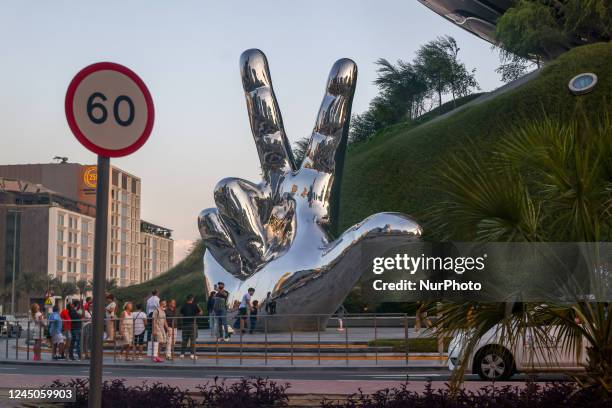
Take, for instance, the compelling imagery of a giant hand sculpture poised in front of a museum’s main entrance. The hand is a profound symbol: a universal marker of creation, touch, and human agency. It interrupts the cold precision of the architectural lines with a warmth that is tactile and immediate. Such an element functions as a bridge between the visitor’s experience and the building’s ideation, inviting the observer not just to admire but to interact, to contemplate their own role within the continuum of history and modernity.
The Psychological Magnetism of Interaction Amid Monumentality
Underneath the towering walls and futuristic aesthetics lies a psychological phenomenon: the crave for interaction and connection. When faced with vast expanses of polished stone and glass, people instinctively seek relational cues—sounds, textures, signs of life—that affirm their existence within that space. Human interruption, whether literal or symbolic, satisfies this craving. It answers the innate desire to be seen and to see oneself reflected in the broader narrative.
This response reveals a subtle human truth—the interplay between space and inhabitant defines meaning. It is not merely the spectacle of architecture that captivates, but the revelation that in these monumental spaces, human stories persist and thrive. The mega-museum thus becomes more than a repository of artifacts; it becomes a living organism shaped by the footsteps, voices, and shadows of those who traverse its halls.
Cultural Identity and the Human Dimension
Particularly in the Gulf, where rapid modernization is paired with deep reverence for history, mega-museums operate as cultural crossroads. They celebrate absolute heritage while broadcasting a cosmopolitan future. However, without the insertion of human elements, these institutions risk alienation. They could become sterile showcases—palaces of art and history devoid of emotional resonance.
To counter this, curators and architects emphasize the human dimension as a central pillar of experience. Exhibits highlight the everyday lives of ancient civilizations and contemporary locals alike. The architectural narrative often weaves human-centered stories into its very structure, ensuring that visitors do not just observe history—they inhabit it, feeling its pulse through interactive galleries and personalized storytelling.
Technology and the Transformation of Human Engagement
Technology plays an essential yet nuanced role in heightening human interruption in these sprawling venues. Sophisticated digital installations, augmented reality interfaces, and immersive audiovisual experiences amplify the visitor’s sense of presence and interaction. Instead of passive consumption, technology fosters active participation, letting visitors engage dynamically with exhibits.
For example, interactive screens can simulate ancient trade routes across the Persian Gulf or restore vanished architectural wonders through virtual reconstructions. These tools transform isolation into dialogue, allowing a shared human experience between the distant past and the digital present. In this way, technology does not diminish humanity—it accentuates it within the vastness of the mega-museum.
Challenges and Future Directions
Despite their monumental success, Gulf mega-museums face ongoing challenges in maintaining this balance between grandiosity and human intimacy. There is always a risk of becoming overly commercialized or detached from the very cultures they aim to depict. Striking an equilibrium where human interruption remains meaningful rather than tokenistic requires continual innovation and sensitivity.
Going forward, these institutions will likely explore more profound inclusion of tactile and participatory elements, inviting communities themselves to narrate their stories. The increasing focus on sustainability and accessibility also calls for designs that prioritize human comfort and engagement just as much as visual spectacle. The next wave of mega-museums may well redefine human interruption, transforming from occasional gestures into seamless, essential aspects of their identities.
Conclusion: Embracing the Human Mosaic in the Age of the Mega-Museum
The grandeur of Gulf mega-museums captivates with its monumental scale and futuristic brilliance. Yet it is the subtle human interruption—the interplay of hands, footsteps, stories, and technological interactions—that truly brings these spaces to life. This phenomenon transcends mere aesthetics. It reveals an intrinsic human yearning: to be part of something larger, to inscribe oneself within the continuum of time and culture.
In embracing this human mosaic, Gulf mega-museums not only celebrate civilization but also reaffirm humanity at their core. They stand not merely as edifices of stone and steel but as vibrant, living galleries of human existence—complex, interactive, and irresistibly compelling.


Leave a Comment