

The Circle of Fifths isn’t just a poster—it’s a Rosetta Stone for musicians, a compass for composers, and a secret key unlocking the hidden architecture of music itself. Hanging on studio walls or tucked into the corners of music theory textbooks, this deceptively simple diagram has been dismissed by many as a decorative tool, a beginner’s crutch, or worse, a wallflower in the garden of advanced musical knowledge. But peel back its layers, and you’ll discover a living, breathing entity—one that doesn’t just map chords, but reveals the emotional DNA of every key, the gravitational pull of tonal centers, and the alchemy of harmonic motion. This isn’t just about memorizing I-IV-V progressions or knowing which sharps and flats lurk in D major. It’s about seeing music not as a sequence of notes, but as a landscape where every step forward or backward carries weight, color, and intention. Whether you’re a songwriter searching for the perfect bridge, a jazz improviser navigating a sea of ii-V-Is, or a classical composer weaving a symphony, the Circle of Fifths is your silent partner—whispering the rules before you break them, guiding you through the fog of creative uncertainty, and revealing why some progressions feel inevitable while others feel like stumbling in the dark.
The Hidden Cartography of Sound: Why the Circle of Fifths Maps More Than Just Keys
At first glance, the Circle of Fifths appears as a neat, symmetrical wheel: twelve slices, each representing a key, arranged by the number of sharps or flats. But this is no mere inventory. It’s a topological map of tonal gravity, where each key is a node in a vast harmonic network. The magic begins with the fifth interval—the interval that defines the circle’s structure. When you move clockwise from C to G, you’re ascending by a perfect fifth; counterclockwise, from C to F, you descend by the same interval. This isn’t arbitrary. The fifth is the most stable interval after the octave, and its resonance is deeply embedded in the physics of sound. It’s the reason why dominant chords (built on the fifth degree) exert such a magnetic pull over tonic chords. The Circle of Fifths doesn’t just list keys—it encodes their relationships, their tensions, and their resolutions. It’s the difference between knowing that A minor has no sharps or flats and understanding why it feels like the emotional twin of C major, separated only by a single semitone shift in the third. This is the cartography of mood, where the circle becomes a palette, and every key a color with its own psychological weight.
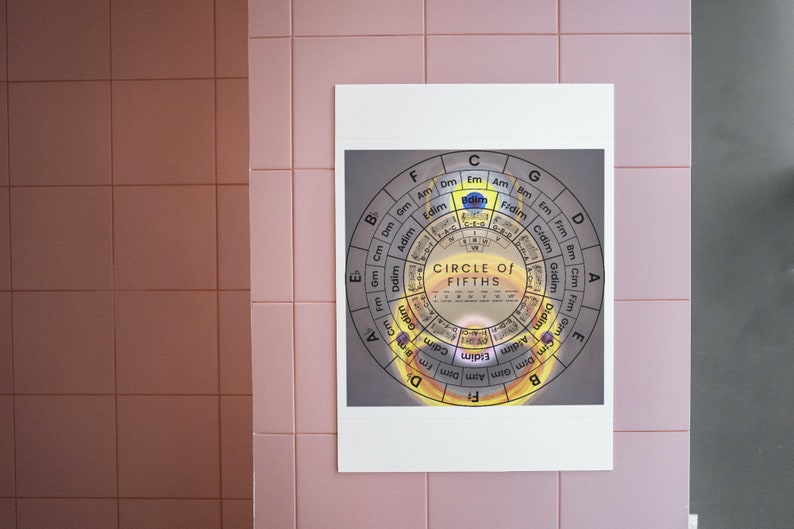
The Emotional Alchemy of Keys: How the Circle Reveals the Soul of Each Tonality
Every key has a personality, and the Circle of Fifths is the decoder ring that translates those personalities into something tangible. C major is often called the “white key” key—bright, open, unburdened by sharps or flats. But move one step counterclockwise to F major, and suddenly the air feels heavier, the shadows deeper. The addition of a B♭ softens the brightness, lending a pastoral, almost nostalgic quality. This isn’t just theory; it’s the reason why Beethoven’s Pastoral Symphony feels anchored in F major, or why Debussy’s Clair de Lune drifts through the same key with an ethereal glow. The Circle doesn’t just tell you which notes are sharp or flat—it tells you how those notes will color your emotions. G major, with its single sharp, is brash and triumphant, the key of folk anthems and rock choruses. D minor, its relative minor, is brooding and introspective, the key of heartbreak and cinematic drama. The Circle of Fifths doesn’t just categorize keys—it reveals their emotional DNA, turning abstract theory into a visceral experience. It’s the reason why a pop song in A major feels uplifting, while the same melody in A minor feels melancholic. The circle is a mood ring for music, and its colors are written in sound.
Harmonic Choreography: The Circle as a Blueprint for Movement and Tension
Music isn’t static—it breathes, shifts, and evolves. The Circle of Fifths is the choreographer of this movement, dictating how chords progress with a logic that feels both inevitable and exhilarating. Consider the ubiquitous ii-V-I progression, the backbone of jazz and classical harmony. In the key of C major, that’s D minor 7 → G7 → C major 7. Follow the circle clockwise, and you’re tracing the path of harmonic tension and release. The V chord (G7) is a magnet, pulling back to the I chord (C major) with a gravitational force that feels satisfying, almost cathartic. But the circle doesn’t just dictate forward motion—it allows for detours. A iii-VI-ii-V-I sequence in G major (B minor → E minor → A minor → D7 → G major) is a harmonic road trip, visiting distant tonal cousins before returning home. The Circle of Fifths doesn’t just map the destination—it maps the journey, revealing why some progressions feel like a stroll through a familiar neighborhood while others feel like an expedition into uncharted territory. It’s the reason why a blues progression feels raw and earthy (rooted in the circle’s raw, unadorned intervals) and why a jazz standard feels sophisticated (layered with substitutions and chromatic detours). The circle is the skeleton; the music is the flesh that moves over it.
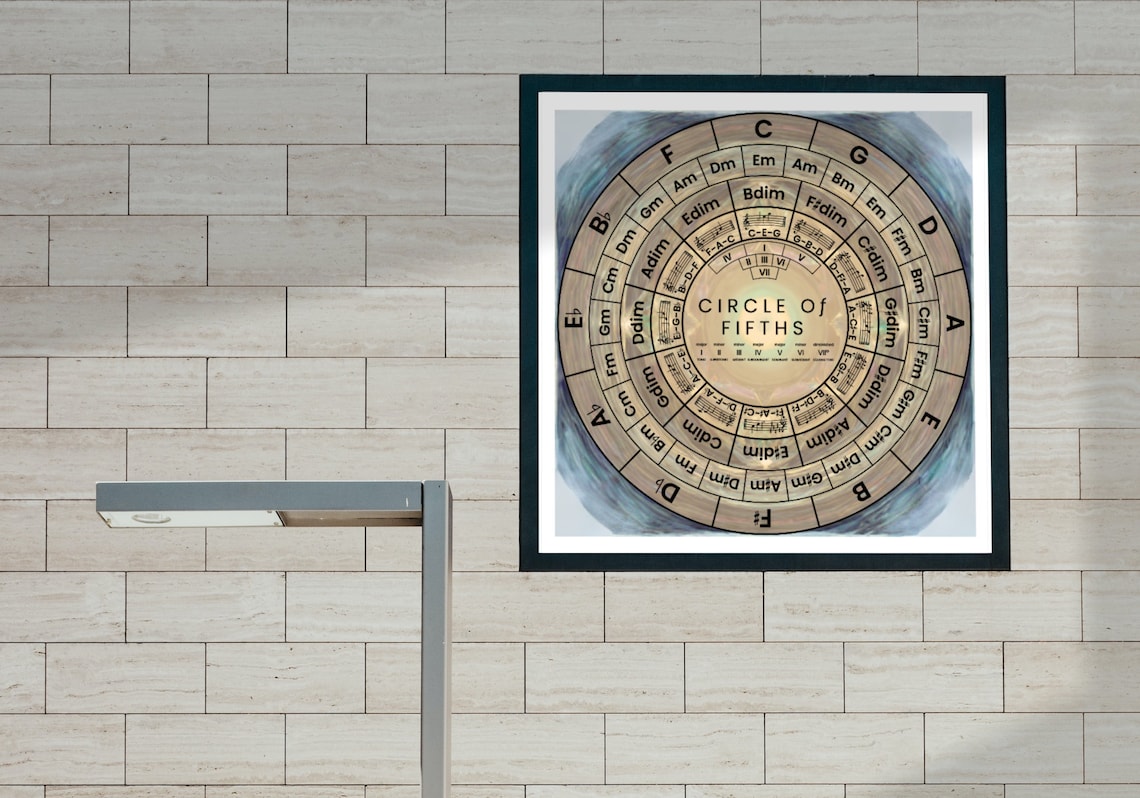
Breaking the Rules with the Circle’s Blessing: How to Use It to Innovate, Not Just Imitate
Here’s the paradox: the Circle of Fifths is both a rulebook and a rebellion manual. It teaches the conventions so you can subvert them. Jazz musicians use it to navigate complex reharmonizations, slipping in tritone substitutions or modal interchange with the confidence of someone who knows the terrain. Classical composers like Bach and Mozart used it to weave fugues and sonatas with a sense of inevitability, even as they bent the rules to create surprise. The key is to treat the circle not as a cage, but as a playground. Want to write a hauntingly ambiguous piece? Start in C major but pivot to its parallel minor (C minor) via the circle’s outer rim. Craving a sense of disorientation? Use the circle to modulate abruptly to a distant key, like jumping from C major to F# major in a single bar. The Circle of Fifths doesn’t stifle creativity—it amplifies it by giving you a map of where the dragons lie, where the safe paths are, and where the unexplored territories begin. It’s the reason why a pop song can feel fresh despite using the same chords as a thousand others—because the arrangement, the rhythm, and the emotional delivery transform the familiar into the extraordinary. The circle is your co-conspirator in crime, the silent partner in your creative heist.
The Circle in the Wild: Real-World Examples of Its Invisible Influence
To see the Circle of Fifths in action, look no further than the songs that have shaped generations. The opening chords of Let It Be by The Beatles—C, G, A minor, F—trace a path straight through the circle’s inner ring. The verse of Sweet Child O’ Mine by Guns N’ Roses hinges on a ii-V-I in D major, a progression that feels like a musical sigh. Even in film scores, the circle’s influence is omnipresent. John Williams’ Star Wars theme relies on the heroic lift of a V chord resolving to I, while Hans Zimmer’s Time from *Inception* uses chromatic movement through the circle to create a sense of descent into the subconscious. The Circle of Fifths isn’t just a teaching tool—it’s the invisible hand guiding some of the most iconic moments in music history. It’s the reason why a simple chord progression can feel timeless, why a modulation can send shivers down your spine, and why some songs stick in your head like aural Velcro. It’s not just a diagram; it’s the DNA of musical storytelling.
The Circle of Fifths isn’t a poster to hang on your wall and forget. It’s a living, breathing entity—a Rosetta Stone, a compass, a secret language whispered between notes. It doesn’t just tell you which keys exist; it reveals how they feel, how they move, and how they can be bent to your will. Whether you’re a songwriter searching for the perfect emotional palette, a jazz musician navigating a sea of substitutions, or a composer weaving a symphony, the circle is your silent guide, your trusted ally in the alchemy of sound. It doesn’t just map the territory—it invites you to explore it, to break it, to reinvent it. So the next time you see the Circle of Fifths, don’t just glance at it. Listen. Because the real magic isn’t in the diagram—it’s in the music it helps you create.


Leave a Comment