

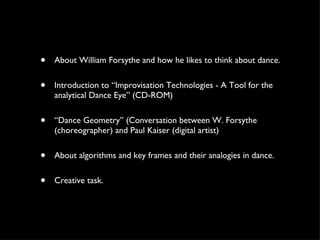
In the vast, uncharted territory of human movement, where the body becomes both instrument and canvas, William Forsythe’s *Improvisation Technologies* emerges as a radical manifesto—a silent revolution whispered through the language of geometry. This isn’t merely a dance manual; it’s a cartographic odyssey, a way to map the invisible forces that shape our physical existence. Imagine standing at the precipice of a blank page, not with a pencil, but with your entire being, ready to inscribe the first line of a new kind of choreographic poetry. Forsythe’s system doesn’t just teach you to move; it teaches you to *see* movement as a living, breathing equation, where every gesture is a vector, every shift a sine wave, and every pause a deliberate fractal in the grand design of kinetic artistry.
At its core, *Improvisation Technologies* is a toolkit for the mind’s eye, a set of principles that transform the dancer’s body into a dynamic sketchpad. It’s as if Forsythe has handed you a compass that doesn’t point north, but toward the ephemeral intersections of intention and gravity, where the body’s architecture bends to the will of an unseen draftsman. The promise here is not just technical mastery, but a perceptual metamorphosis—a shift so profound it redefines what it means to *be* in motion. For those willing to surrender to its logic, the system offers a gateway to a world where the body doesn’t just perform; it *constructs*, line by line, a fugue of flesh and geometry.

The Body as a Living Compass: Navigating the Geometry of Motion
Forsythe’s system begins with a radical premise: the body is not a vessel for movement, but a *generator* of it. Every joint, every muscle, every micro-adjustment of weight becomes a node in a vast, invisible lattice. The dancer doesn’t just execute steps; they *trace* them, as if pulling invisible threads through the air, leaving behind a trail of spatial intention. This is where the magic lies—not in the replication of forms, but in the discovery of them. The body, when viewed through this lens, becomes a living compass, its needles pointing not to cardinal directions, but to the latent geometries buried within the act of moving.
Consider the humble plié. In traditional dance, it’s a preparatory step, a mere prelude to the real action. But in Forsythe’s world, it’s a *vector field*—a constellation of potential trajectories that ripple outward from the dancer’s center. The depth of the bend, the alignment of the spine, the distribution of weight across the feet—all of these are variables in an equation that could spiral into a pirouette, a fall, or a sudden stillness. The system teaches you to read these variables not as static positions, but as dynamic forces, each one capable of reshaping the entire choreographic landscape in an instant.
This is where the first shift in perspective occurs. The dancer stops seeing movement as a sequence of shapes and starts seeing it as a *topography*—a terrain where every gesture carves a new path, every shift in weight redefines the horizon. It’s a way of thinking that turns the body into a cartographer, mapping the invisible currents of space and time with nothing but flesh and breath. And once you begin to see it this way, the world of dance is never the same.
The Alchemy of Constraints: Turning Limitations into Creative Fuel
One of the most counterintuitive—and liberating—aspects of Forsythe’s system is its embrace of constraints. In a culture obsessed with freedom, with boundless possibility, the idea that limitations could be the key to unlocking creativity feels almost heretical. Yet, *Improvisation Technologies* thrives on this paradox. Constraints, in this context, are not shackles; they are the scaffolding upon which new forms of expression are built. They force the dancer to interrogate the most fundamental questions: What does it mean to move? What happens when a joint is locked, or a limb is extended beyond its usual reach? How does gravity become a collaborator rather than an adversary?
Take, for example, the principle of *alignment*. In classical dance, alignment is often taught as a rigid ideal—a straight spine, squared hips, a perfectly vertical axis. But Forsythe flips this on its head. Alignment, in his system, is not a fixed target but a *dialogue*—a negotiation between the body’s internal architecture and the external forces acting upon it. What happens when you deliberately misalign a joint? What new pathways open up when you allow the spine to curve not as a flaw, but as a deliberate choice? The system encourages the dancer to treat these moments not as errors, but as *emergent properties*, where the body’s imperfections become the raw material for new choreographic possibilities.
This alchemy of constraints extends beyond the physical. Forsythe’s system also introduces *temporal constraints*—rhythmic patterns, asymmetrical phrasing, or even the deliberate suspension of motion. These are not arbitrary rules; they are the sparks that ignite the imagination. When you’re forced to move within a confined rhythmic structure, the body begins to *invent* ways to fill the silence, to stretch the moment, to make the constraint itself a source of surprise. It’s a reminder that creativity doesn’t thrive in the absence of rules, but in the tension between what is allowed and what is possible.
The Choreographic Eye: Seeing Movement as a Living Blueprint
Perhaps the most transformative aspect of *Improvisation Technologies* is its insistence on developing what Forsythe calls the *choreographic eye*—a way of seeing movement not as a series of isolated gestures, but as a continuous, evolving blueprint. This is not the passive observation of a spectator, but the active perception of a creator. The choreographic eye doesn’t just watch; it *interrogates*. It asks: What forces are at play here? What lines of tension are being drawn? How does this movement relate to the one that came before, and the one that will come after?
This way of seeing is not innate; it must be cultivated. Forsythe’s system provides the tools to do so, training the dancer to recognize the underlying structures of movement—the invisible scaffolding that holds a gesture together. It’s a way of parsing motion into its constituent parts: the *initiation* (where the movement begins), the *path* (the trajectory it follows), and the *termination* (where it ends, or where it might begin anew). But it’s also about seeing the *relationships* between these parts—the way a shift in the pelvis can ripple through the spine, or how a sudden change in direction can alter the entire spatial composition.
The choreographic eye also demands a shift in how we perceive time. In traditional dance, time is often treated as a linear conveyor belt, a steady march from one beat to the next. But Forsythe’s system reveals time as a *fluid*, malleable substance—something that can be stretched, compressed, or even fractured. A single gesture might linger, expanding into a vast, slow-motion landscape, while the next could erupt in a staccato burst of energy. This is not just a technical trick; it’s a way of experiencing time as a collaborator in the act of creation, a partner that can be wooed, teased, or even defied.
To develop the choreographic eye is to become a detective of the ephemeral—to uncover the hidden narratives in every movement, every pause, every breath. It’s a way of seeing the world not as a series of static images, but as a dynamic, ever-shifting tapestry of potential. And once you begin to see it this way, the act of dancing becomes something far greater than performance. It becomes a form of *active perception*, a way of engaging with the world that is as much about discovery as it is about expression.
From Theory to Practice: The Laboratory of the Body
The true test of any system lies not in its theory, but in its application. *Improvisation Technologies* is no exception. The principles it espouses are not meant to be memorized; they are meant to be *lived*. This is where the rubber meets the road, where the abstract becomes concrete, and where the dancer’s body becomes the ultimate laboratory. The system encourages a process of relentless experimentation—where every session is an opportunity to push boundaries, to fail spectacularly, and to stumble upon the unexpected.
One of the most powerful exercises in the system is the *score*—a set of instructions or constraints that guide the improvisation. A score might ask the dancer to move only in straight lines, or to initiate every gesture from the sternum, or to maintain a constant dialogue between two points in space. These scores are not rigid formulas; they are invitations to play, to explore the edges of what the body can do. And because they are rooted in the dancer’s own physicality, they ensure that every improvisation is a unique, unrepeatable event.
But the laboratory of the body is not just a place of experimentation; it’s also a place of *listening*. Forsythe’s system teaches the dancer to attune themselves not just to the external forces of space and gravity, but to the internal rhythms of breath, heartbeat, and muscular tension. It’s a way of moving that is as much about *receiving* as it is about *doing*—a reminder that the body is not a machine, but a living, responsive organism. When you begin to listen in this way, every movement becomes a conversation, a dialogue between the dancer and the invisible forces that shape their world.
This is where the system’s promise of a perceptual shift becomes most apparent. As the dancer engages with these principles, they begin to notice things they never saw before—the way a slight tilt of the head can alter the entire spatial composition, or how a change in breath can transform the quality of a movement. It’s a way of seeing that doesn’t just apply to dance, but to the world at large. Suddenly, the act of walking down the street becomes an improvisation, the way you hold a cup of coffee a choreographic study. The body, once a tool for performance, becomes a way of *engaging* with reality itself.
The Ripple Effect: How Forsythe’s Vision Transforms Beyond the Studio
The influence of *Improvisation Technologies* extends far beyond the confines of the dance studio. In a world where the body is often reduced to a mere instrument—whether for labor, sport, or entertainment—Forsythe’s system offers a radical alternative. It’s a way of reclaiming the body not as a vessel for external demands, but as a site of infinite creative potential. This is a vision that resonates with artists, athletes, therapists, and even engineers, all of whom are beginning to recognize the body as a complex, adaptive system capable of generating its own solutions.
For artists, the system provides a new language for composition, one that is not bound by tradition but rooted in the body’s inherent intelligence. For athletes, it offers a way to break free from the rigid structures of training, to rediscover movement as a dynamic, responsive process. For therapists, it presents a tool for re-educating the body, for helping individuals reconnect with their physical selves in a world that often treats the body as a machine to be optimized. And for engineers, it inspires new ways of thinking about robotics, biomechanics, and the intersection of human and machine intelligence.
But perhaps the most profound ripple effect of Forsythe’s vision is its challenge to the very notion of what it means to be *human*. In a culture that often prioritizes efficiency, productivity, and control, *Improvisation Technologies* reminds us that the body is not a machine to be programmed, but a living, breathing entity capable of infinite adaptation and surprise. It’s a call to embrace the unpredictable, to find beauty in the flawed, and to see the world not as a series of fixed points, but as a vast, ever-shifting landscape of potential.

To engage with *Improvisation Technologies* is to embark on a journey—not just of the body, but of the mind and spirit. It’s a way of seeing that transforms the act of moving from a mere performance into a form of active perception, a dialogue between the dancer and the invisible forces that shape their world. And once you’ve experienced this shift, once you’ve felt the body become a compass, a laboratory, and a living blueprint all at once, there’s no going back. The world will never look the same.
So step into the space. Let your body become the first line. And begin to draw.


Leave a Comment