

The Surrealist’s Guide to Reality is not a map, but a labyrinth—one that twists logic into poetry and bends the mundane into the extraordinary. It is a journey for those who see the world not as it is, but as it could be: a flickering hologram of dreams, quantum whispers, and parallel selves. Whether you’re a philosopher with a penchant for paradox, an artist chasing the uncanny, or simply a wanderer in the fog of everyday existence, this guide will illuminate the hidden corridors of reality. Prepare to step beyond the veil of the ordinary and into a realm where logic dissolves into lucidity, and the surreal becomes the only truth worth chasing.
The Quantum Mirage: Books That Unravel the Fabric of Existence
Imagine waking up one morning to find that the laws of physics are merely suggestions, flickering like candle flames in a draft. Quantum physics doesn’t just describe reality—it dismantles it, reassembles it, and leaves you questioning whether you’re the observer or the observed. For those who crave to peer behind the curtain of the cosmos, Three Simple Books on Quantum Physics, Parallel Universes, and Simulation Theory serve as your Rosetta Stone to the enigma of existence.
These aren’t dry textbooks filled with equations that dance like hieroglyphs. Instead, they are portals—each page a wormhole into the mind-bending possibilities of multiverses where every choice spawns a new timeline, and the universe itself might be a cosmic simulation rendered by an advanced civilization. Picture this: you’re reading a chapter on Schrödinger’s cat, and suddenly, you’re the cat—simultaneously alive and dead, suspended in a state of quantum limbo until an unseen force (perhaps your own curiosity) collapses the wave function. The surreal isn’t just a style here; it’s the operating system of reality.
Dive into Simulated Worlds, Parallel Realities, and you’ll find yourself questioning whether your morning coffee was brewed by your own hands or by a rogue AI experimenting with human behavior. These books don’t just inform—they transform. They turn the act of reading into a séance, where the spirits of possibility whisper through the pages, urging you to consider that your reality might be one of countless simulations, each a fleeting dream in the mind of a greater intelligence.

The Art of Dissolving Boundaries: Surrealist Masterpieces That Defy Definition
Surrealism isn’t just an art movement—it’s a rebellion against the tyranny of the rational. It’s the act of taking the mundane (a melting clock, a floating apple, a bowler-hatted man with a fish for a face) and twisting it into something that feels like a dream you can’t quite remember upon waking. The surrealist artist doesn’t depict reality; they dissect it, rearrange its organs, and present it back to you as a grotesque yet beautiful corpse of logic.
Take, for example, the works of Salvador Dalí, whose The Persistence of Memory transforms time itself into a puddle of Camembert cheese, oozing across a Catalan landscape. Or René Magritte’s The Son of Man, where an apple obscures a man’s face, leaving us to wonder: is the apple the man, or is the man the apple? These aren’t just paintings—they’re riddles wrapped in enigmas, draped in the velvet of the subconscious.
But surrealism isn’t confined to the canvases of the early 20th century. Modern artists continue to push the boundaries, crafting visual paradoxes that linger in the mind like half-remembered dreams. Imagine a cityscape where gravity flows upward, where buildings are made of liquid light, where the sky is a mirror reflecting a world that doesn’t exist. These aren’t just images; they’re experiences, invitations to suspend disbelief and wander through the corridors of the impossible.
For those who seek to immerse themselves in this visual rebellion, seek out galleries and digital collections that specialize in the uncanny. Let your eyes feast on the grotesque beauty of surrealist perspectives, where every stroke is a rebellion against the mundane, and every color is a whisper from the subconscious.

The Puzzle of the Self: Solving the Labyrinth of Identity
Who are you, really? The answer isn’t a name or a job title—it’s a mosaic of fragments, a collage of memories, desires, and illusions. The surrealist doesn’t just ask this question; they play with it, turning the act of self-discovery into a game of hide-and-seek with the ego. What if you’re not one person, but many? What if your memories are fabrications, stitched together by a mind that thrives on chaos? What if the “you” you know is merely a character in a story written by a stranger?
Enter the world of surrealist puzzles, where the act of solving becomes a metaphor for the act of existing. These aren’t your average jigsaw puzzles with clear edges and predictable images. Instead, they’re mind-benders, designed to fracture your perception of reality. Take, for instance, a puzzle where the pieces don’t fit together in any logical way—where the image only reveals itself when you abandon the rules of conventional assembly. This isn’t just a game; it’s a lesson in surrendering to the unknown.
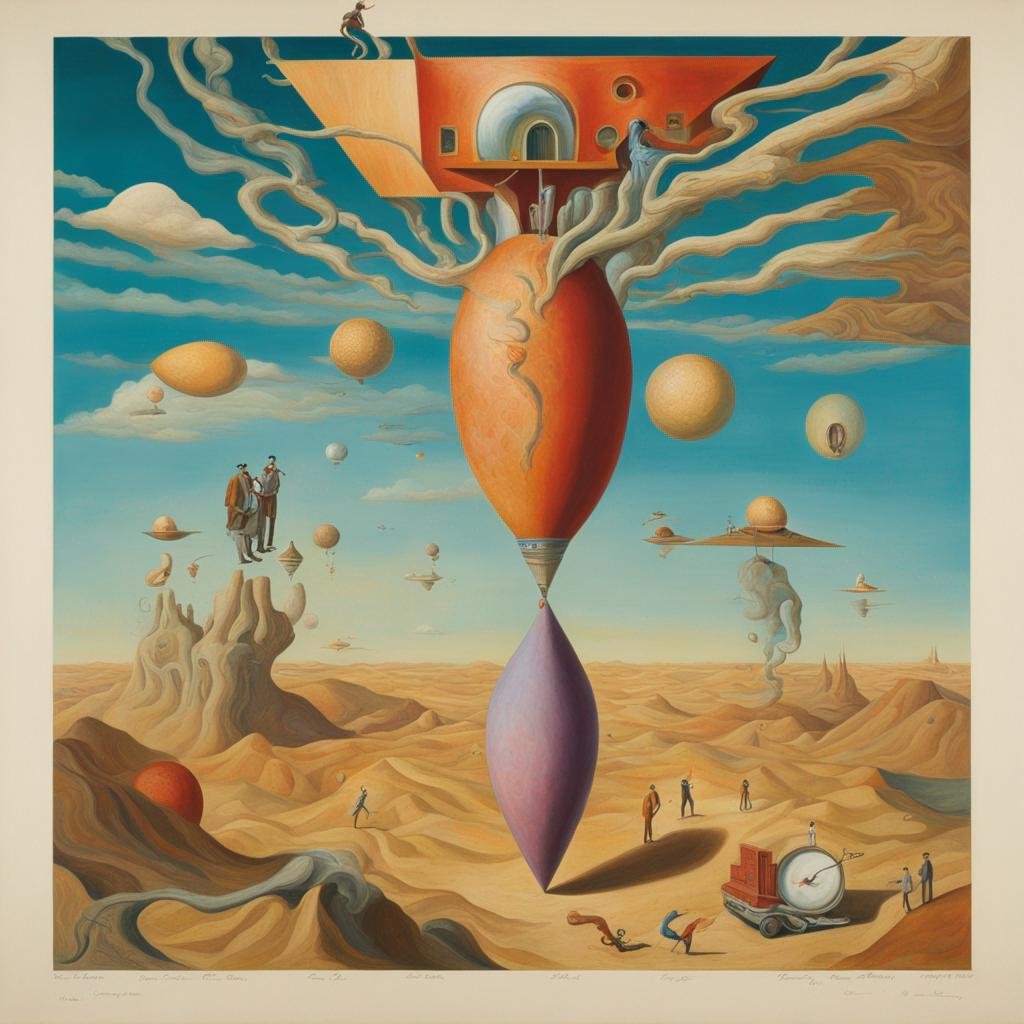
One such puzzle, escaping_reality__surrealist_perspectives_by_gerousia59_dhdsvl3, presents a challenge that feels like a descent into a surrealist dreamscape. The pieces are abstract, the colors clash like clashing realities, and the final image—when it emerges—is a kaleidoscope of shifting identities. As you assemble it, you’re not just putting together a picture; you’re reconstructing your own sense of self. Who are you in this puzzle? Are you the artist, the observer, or the subject? The answer, like the puzzle itself, is fluid.
These puzzles are more than distractions; they’re meditations on the fluidity of identity. They remind us that the self is not a fixed point but a constellation of possibilities, each one a star in the galaxy of the psyche. Solve enough of them, and you might just find that the boundaries between “you” and “the world” have dissolved entirely.
The Alchemy of Perception: Turning the Mundane into the Miraculous
Reality is a canvas, and you are the artist. But what if the paint isn’t applied with a brush, but with the flicker of a candle, the hum of a refrigerator, the scent of rain on pavement? Surrealism teaches us that the miraculous isn’t hidden in distant galaxies or alternate dimensions—it’s woven into the fabric of the everyday, if only we know how to look.
Start by practicing defamiliarization. Take an object—a spoon, a shoe, a lamp—and examine it as if you’ve never seen it before. What if the spoon were a key to another world? What if the shoe were a portal to a realm where time moves backward? What if the lamp were a sentient being, watching you with ancient, knowing eyes? The surrealist doesn’t just see; they re-see.
Next, embrace the power of automatic writing. Set a timer for five minutes and write without stopping, without editing, without judgment. Let the words flow like ink from a broken pen, splattering across the page in a chaotic dance of thought. What emerges might be gibberish—or it might be a revelation. The surrealist doesn’t censor the subconscious; they let it speak, even if its voice is a whisper from the void.
Finally, seek out the uncanny in the ordinary. Take a walk through your neighborhood and look for the strange—the mannequin in the store window with a face that’s almost human, the shadow that moves when no one is there, the sound of laughter in an empty room. These aren’t just coincidences; they’re signals from the surreal, nudges from a reality that refuses to be tamed.
The Surrealist’s Guide to Reality isn’t a destination—it’s an invitation. It’s a call to arms for those who refuse to accept the world as it is, who demand to see it as it could be. Whether through the lens of quantum physics, the strokes of a surrealist masterpiece, the challenge of a mind-bending puzzle, or the alchemy of perception, the surreal is always waiting, just beyond the edge of the rational.
So step forward. Let the boundaries blur. Embrace the chaos. And remember: the most surreal thing about reality is that it’s yours to reshape, one dream at a time.


Leave a Comment