

The theme park, as a cultural artifact, has long been a vessel for escapism—a glittering mirage of joy where reality dissolves into cotton candy clouds and adrenaline-fueled loops. It’s a place where families pose for photographs beneath the benevolent gaze of Mickey Mouse, where children’s laughter mingles with the mechanical symphony of roller coasters. Yet, in the summer of 2015, a shadow crept over this idyllic facade. Banksy, the elusive street artist whose work dissects societal hypocrisies with surgical precision, unveiled Dismaland—a theme park that didn’t just mock the conventions of fun, but exposed the rot beneath the glitter. It wasn’t just a park; it was a mirror held up to the modern world, reflecting our collective disillusionment in a carnival of controlled chaos.
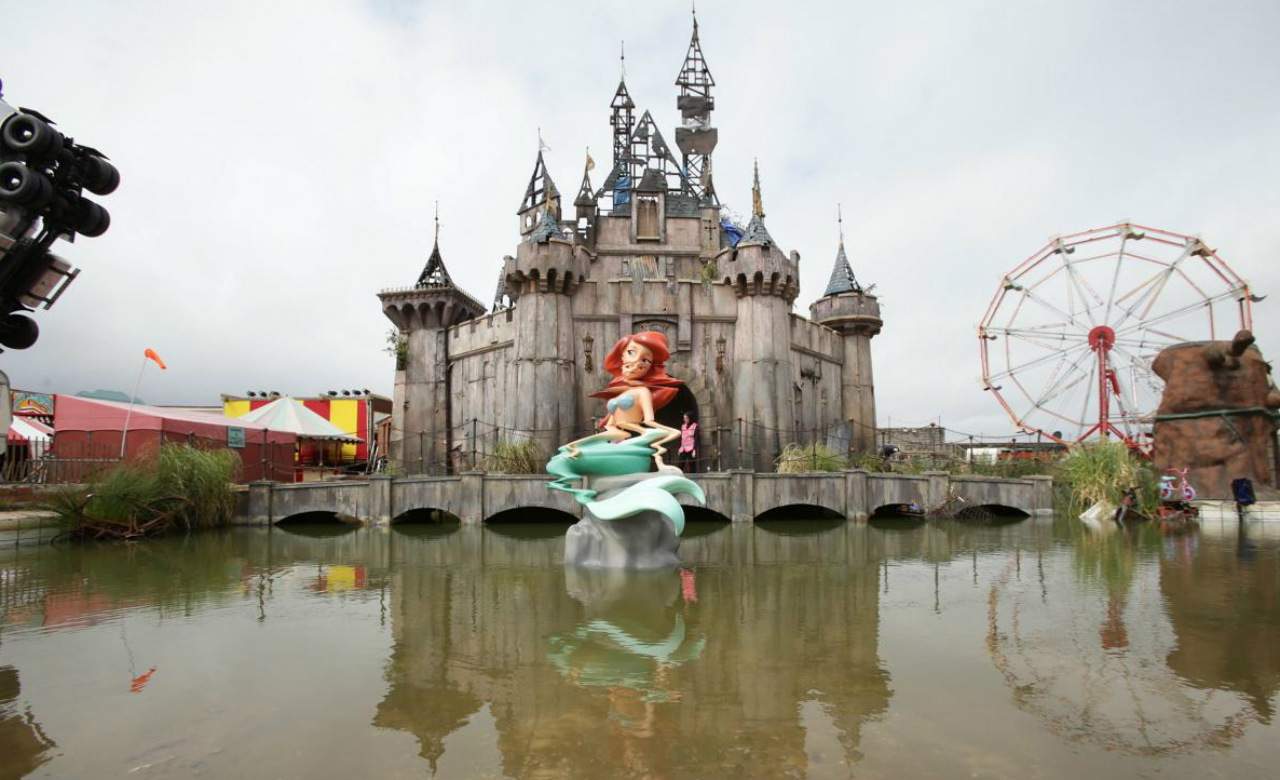
At first glance, Dismaland appeared to be a conventional theme park, complete with turrets, ticket booths, and the promise of entertainment. But the moment visitors stepped inside, the illusion shattered. The roller coaster, far from thrilling, was a dilapidated relic, its tracks rusted and incomplete. The carousel, usually a whirl of vibrant horses, featured emaciated, skeletal figures frozen in grotesque poses. Even the entrance sign, a parody of Disney’s iconic script, read: “Welcome to Dismaland, the most disappointing place on Earth.” It was a theme park designed to fail, a carnival of disenchantment where the only thrill was the realization of how hollow the original promise had become.
The Illusion of Happiness and the Tyranny of Perfection
Theme parks are, at their core, temples of manufactured joy. They peddle an idealized version of happiness—one where every ride is exhilarating, every meal is delicious, and every guest is delighted. But this perfection is a lie, a carefully constructed facade that obscures the reality of labor exploitation, environmental degradation, and the commodification of human emotion. Dismaland ripped away this veil, exposing the machinery behind the magic. Its attractions weren’t just ugly; they were honest. The “Haunted Mansion” wasn’t haunted by ghosts, but by the specter of capitalism’s relentless pursuit of profit at any cost. The “Cinderella’s Castle” wasn’t a fairy tale; it was a crumbling monument to broken promises.
Banksy’s genius lay in his ability to weaponize the theme park’s own language against itself. By mimicking the aesthetics of Disney and other corporate juggernauts, he forced visitors to confront the cognitive dissonance between the park’s cheerful veneer and its dystopian reality. It was a masterclass in subversion, a reminder that the most potent critiques often come from within the systems they seek to dismantle. In a world where social media demands constant happiness, Dismaland was a rebellion—a place where sadness was not just allowed, but celebrated.
The Politics of Disappointment: A Mirror to Society’s Failures
Dismaland wasn’t just a critique of theme parks; it was a searing indictment of modern society. Each attraction served as a metaphor for a different societal ill. The “Aquatic Amusements” section featured a sinking ship, a nod to the refugee crisis and the global indifference to human suffering. The “Bank Job” ride, a parody of bank heists, lampooned the financial system’s role in perpetuating inequality. Even the “Court of Justice,” a courtroom where visitors could put on trial a puppet of a corrupt politician, was a scathing commentary on the erosion of trust in institutions.

The park’s most chilling exhibit was perhaps the “Dismal Future” installation, a series of dystopian dioramas depicting a world ravaged by climate change, war, and technological dystopia. It wasn’t just a warning; it was a prophecy. In an era where optimism is often conflated with naivety, Dismaland dared to ask: What if the future isn’t bright? What if the systems we’ve built are irreparably broken? The park’s existence was a challenge to its visitors: confront the darkness, or continue pretending it doesn’t exist.
The Paradox of Participation: Why We Can’t Look Away
One of the most fascinating aspects of Dismaland was its paradoxical appeal. Despite its bleakness, people flocked to it in droves. Why? Because discomfort, when framed as art, becomes a form of engagement. The park wasn’t just a place to visit; it was an experience to endure, a test of one’s willingness to stare into the abyss. Visitors weren’t passive consumers of joy; they were active participants in a collective reckoning. The act of walking through Dismaland was, in itself, a political statement—a rejection of the passive consumption of happiness in favor of an unflinching gaze at reality.
This paradox speaks to a deeper truth about human nature: we are drawn to that which challenges us, even when it unsettles us. Theme parks, by their very nature, are designed to provide easy thrills, but Dismaland offered something far more valuable—a raw, unfiltered confrontation with the world’s injustices. It was a reminder that art, at its best, doesn’t just entertain; it provokes. It doesn’t just distract; it demands. And in doing so, it forces us to ask ourselves: What are we willing to tolerate in the name of fun?
The Legacy of Dismaland: A Blueprint for Honest Art
The impact of Dismaland extended far beyond its temporary existence. It proved that art could be both a mirror and a weapon—a way to hold up a distorted reflection of society while simultaneously wielding that reflection as a tool for change. Banksy didn’t just create a theme park; he created a blueprint for what art could be in an age of disillusionment. Dismaland was a call to arms, a reminder that the most powerful critiques are those that force us to confront the uncomfortable truths we’d rather ignore.
In the years since its closure, the spirit of Dismaland has lived on in other works of art and activism. It challenged the notion that art must be beautiful or uplifting to be meaningful. Instead, it embraced the messy, the uncomfortable, and the downright ugly as valid forms of expression. It was a testament to the power of honesty in a world that often prioritizes illusion over truth. And perhaps most importantly, it was a reminder that even in the darkest of places, there is value in staring directly into the abyss—because sometimes, the abyss is the only thing that can show us the light.
The theme park, as an institution, will likely never be the same. Banksy’s Dismaland didn’t just critique a genre; it redefined it. It took the familiar trappings of joy and turned them into a hall of mirrors, reflecting not just the faces of its visitors, but the fractured state of the world itself. In doing so, it didn’t just create a theme park—it created a moment of reckoning. And in a world that often prefers distraction to reflection, that might just be the most honest thing a theme park has ever done.


Leave a Comment