

Why does Beethoven’s Fifth Symphony feel like a musical fortress—unyielding, inevitable, and impossible to ignore? It’s not just the thunderous opening bars, though they certainly command attention. No, the real magic lies in a single, four-note motif that Beethoven wields like a composer’s Swiss Army knife. This isn’t just a tune; it’s a sonic skeleton key that unlocks entire movements, a harmonic Swiss watch where every gear clicks into place with terrifying precision. But here’s the playful challenge: could you, as a composer, take this same motif and stretch it across an entire symphony without it ever feeling repetitive or predictable? Beethoven did it effortlessly. Let’s dissect how.

The Motif as a Musical DNA Strand
Imagine a single strand of DNA, coiled and compact, yet capable of replicating into an entire organism. Beethoven’s opening motif—three short notes followed by a long one, often rendered as “dit-dit-dit-dah”—is that DNA. It’s a rhythmic fingerprint, a melodic seed so potent that it contains multitudes within its four-note structure. This motif isn’t just a motif; it’s a germinal cell, a generative force that Beethoven manipulates with surgical precision across the symphony’s four movements.
Consider the motif’s intervallic structure: a minor third descent followed by a perfect fourth ascent. This intervalic DNA is the harmonic backbone. The minor third introduces tension, a yearning that demands resolution, while the perfect fourth offers a fleeting sense of stability. Together, they create a push-and-pull dynamic that Beethoven exploits relentlessly. The motif isn’t static; it’s a living entity that mutates, inverts, and expands as the symphony unfolds. In the first movement, it’s a declaration of war. In the second, it’s a shadowy specter haunting the strings. By the finale, it’s a triumphant anthem, its DNA now fully expressed in radiant major tonality.
The Rhythmic Chisel: Carving Time Itself
Rhythm is the sculptor’s chisel in Beethoven’s hands. The motif’s rhythmic profile—short-short-short-long—is a temporal blueprint that Beethoven bends to his will. He doesn’t just repeat it; he stretches it, compresses it, and inverts it, playing with our perception of time like a puppeteer pulling strings.
In the first movement, the motif’s rhythm is hammered out in the strings, each note a hammer blow. But listen closely to the development section, where Beethoven takes the motif’s rhythm and fragments it across the orchestra. The oboes might play the first two notes, the horns the last two, creating a kaleidoscopic effect where the motif is never quite whole but always recognizable. This rhythmic sleight of hand keeps the listener off-balance, ensuring the motif never feels like a crutch but rather a compass guiding us through the symphony’s labyrinth.
Even the motif’s cadence—the long final note—is a rhythmic trap. It lingers, unresolved, teasing the listener with the promise of closure that only arrives in the finale. Beethoven turns rhythm into a narrative device, a way to manipulate our emotional timeline. The motif isn’t just a sound; it’s a ticking clock, counting down to its own apotheosis.

Harmonic Alchemy: Turning a Motif into a Key Signature
If rhythm is the chisel, harmony is the crucible where the motif is transformed. Beethoven doesn’t just repeat the motif in the same key; he subjects it to harmonic alchemy, transmuting its emotional DNA through a series of tonal experiments. The motif’s journey from C minor to C major is a harmonic odyssey, a testament to Beethoven’s ability to turn a simple idea into a grand philosophical statement.
In the first movement, the motif is locked in C minor, a key associated with struggle and defiance. But Beethoven doesn’t let it stagnate. He modulates it, first to E-flat major in the second movement, where the motif takes on a more lyrical, almost pastoral quality. Then, in the third movement, he traps it in a fugal labyrinth, each entrance of the motif a new harmonic twist. By the finale, the motif is reborn in C major, its minor-key shadows burned away by the light of triumph. This harmonic evolution isn’t just clever composition; it’s a narrative arc, a musical Bildungsroman where the motif grows from a seed into a tree.
The genius lies in how Beethoven uses the motif’s harmonic potential to create tension and release. The motif’s opening notes outline a C minor triad, but the long final note creates a dissonance—a suspended seventh—that demands resolution. Beethoven exploits this harmonic ambiguity, using the motif as a pivot point between stability and chaos. It’s as if the motif is a question, and the harmony is the answer, a dialogue that unfolds over the course of the symphony.
The Orchestral Kaleidoscope: A Motif in a Thousand Colors
Beethoven doesn’t just repeat the motif; he paints it in a thousand orchestral colors. The motif’s four notes are a blank canvas, and the orchestra is his palette. In the first movement, the motif is a thunderous declaration in the low strings and brass. In the second movement, it’s a ghostly whisper in the violins, its rhythm stretched and blurred. In the third movement, it’s a fugal puzzle, each instrument taking a turn to solve its harmonic riddle. By the finale, the motif is a blazing fanfare, its notes ringing out in every corner of the orchestra.
This orchestral kaleidoscope isn’t just about variety; it’s about perspective. Beethoven forces the listener to hear the motif anew with each iteration, as if seeing it through a different lens. The motif becomes a musical Rorschach test, its meaning shifting with each orchestral color. It’s a masterclass in orchestration, where the motif’s simplicity allows Beethoven to explore the full spectrum of the orchestra’s emotional range.
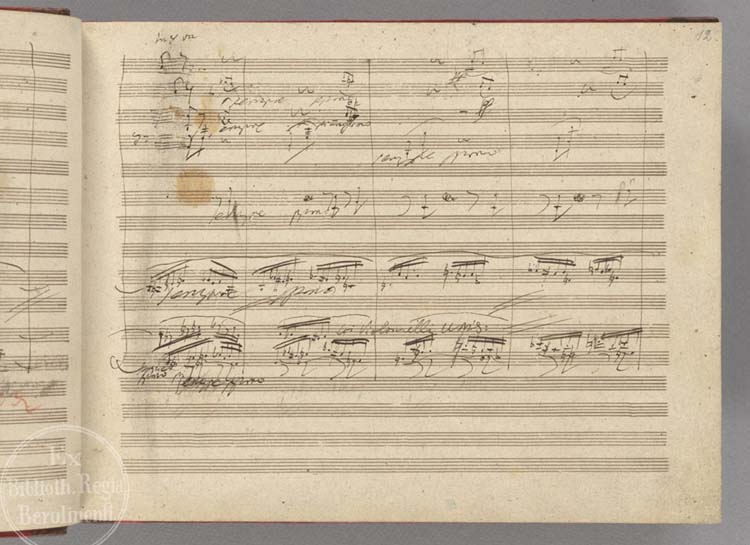
The Psychological Hook: Why the Motif Haunts Us
There’s something almost supernatural about the way the motif lingers in the mind. It’s not just memorable; it’s inescapable. Beethoven taps into a psychological phenomenon known as the Zeigarnik effect, where uncompleted tasks—or in this case, unresolved musical phrases—create a mental itch that demands scratching. The motif’s unresolved final note is that itch, a sonic cliffhanger that Beethoven exploits to keep the listener engaged.
But the motif’s psychological power goes deeper. It’s aural shorthand for struggle and triumph, a sonic archetype that resonates across cultures and centuries. The “dit-dit-dit-dah” pattern is instantly recognizable, a musical fingerprint that transcends language and time. Beethoven doesn’t just write a symphony; he composes an emotional experience, one that taps into universal human themes of conflict and resolution. The motif becomes a metaphor, a sonic stand-in for the human spirit’s indomitable will.
The Composer’s Dilemma: Can You Do It Too?
So, here’s the challenge: could you, as a composer, take a single motif and stretch it across an entire symphony without it ever feeling repetitive or predictable? It’s a test of both creativity and discipline. The motif must be simple enough to be memorable but complex enough to sustain interest. It must be flexible enough to adapt to different moods and keys, yet strong enough to hold the entire structure together.
Beethoven’s Fifth is a masterclass in this art, but it’s not the only example. Bach’s Art of Fugue takes a single subject and weaves it into a tapestry of counterpoint. Wagner’s leitmotifs in The Ring Cycle are motifs that evolve and intertwine across decades of music. Even modern composers like Philip Glass have used repetitive motifs to create hypnotic, immersive experiences. The key is to treat the motif like a living thing, something that can grow, mutate, and adapt without losing its essence.
The lesson here is clear: simplicity is not the enemy of complexity. A single motif, when treated with enough ingenuity, can become the backbone of an entire musical universe. Beethoven didn’t need a hundred themes to write a symphony; he needed one motif and the audacity to let it speak for itself.
So the next time you hear those four notes—three short, one long—pause for a moment. Listen not just to the music, but to the story it tells. It’s a story of struggle, of transformation, of a single idea that refuses to be ignored. And it all starts with a motif, a humble four-note seed that grows into something eternal.


Leave a Comment