

Picture a world where liquids behave like overcooked oatmeal—thick, sluggish, and reluctant to flow. Now imagine the opposite: a liquid so fluid it slips through your fingers like whispers through a crowded room. This is the paradox of viscosity and surface tension, the invisible hands sculpting how liquids move, cling, and defy gravity. Whether you’re simulating water cascading down a digital cliff or oil inching through a virtual engine, these properties dictate whether your creation feels alive or gelatinous—like jelly in a wind tunnel.
Viscosity and surface tension are the unsung choreographers of fluid dynamics. They don’t just influence how a liquid pours; they define its personality. A high-viscosity fluid behaves like treacle in winter—slow, deliberate, and resistant to change. A low-viscosity one dances like champagne bubbles, effervescent and untamed. Surface tension, meanwhile, is the liquid’s stubborn pride, holding its shape against the world’s chaos. Together, they transform flat, lifeless simulations into something that breathes.

The Thickness of Time: What Viscosity Really Measures
Viscosity isn’t just about how “thick” a liquid feels—it’s a measure of internal friction, the molecular handshake that slows down flow. Think of it as the liquid’s reluctance to let go of itself. Honey, for instance, has a viscosity so high it could double as a construction adhesive. Water, by contrast, is a sprinter, darting through pipes with the grace of a figure skater. But viscosity isn’t static. It’s a shape-shifter, influenced by temperature, pressure, and even the liquid’s own history.
In simulations, nailing viscosity means understanding its two faces: dynamic and kinematic. Dynamic viscosity (often denoted by the Greek letter mu) is the resistance to flow under an applied force. Kinematic viscosity (nu) is dynamic viscosity divided by density—essentially, how the liquid flows under its own weight. A syrup-thick fluid might have a high dynamic viscosity but a low kinematic viscosity if it’s also dense, like molasses in January. Simulators must juggle these values carefully, or risk turning a cascading waterfall into a wobbly blob of jelly.
Consider the difference between pouring warm maple syrup and cold motor oil. The syrup flows smoothly, its molecules sliding past each other with relative ease. The oil, chilled to near-solidity, resists movement like a reluctant dancer. In a simulation, replicating this behavior requires more than just slapping a “thickness” slider. It demands an understanding of how viscosity changes with shear rate—the faster you stir, the thinner the liquid becomes. This phenomenon, known as shear-thinning, is why ketchup flows out of a bottle only after a vigorous shake.

The Skin of the Liquid: Surface Tension’s Invisible Armor
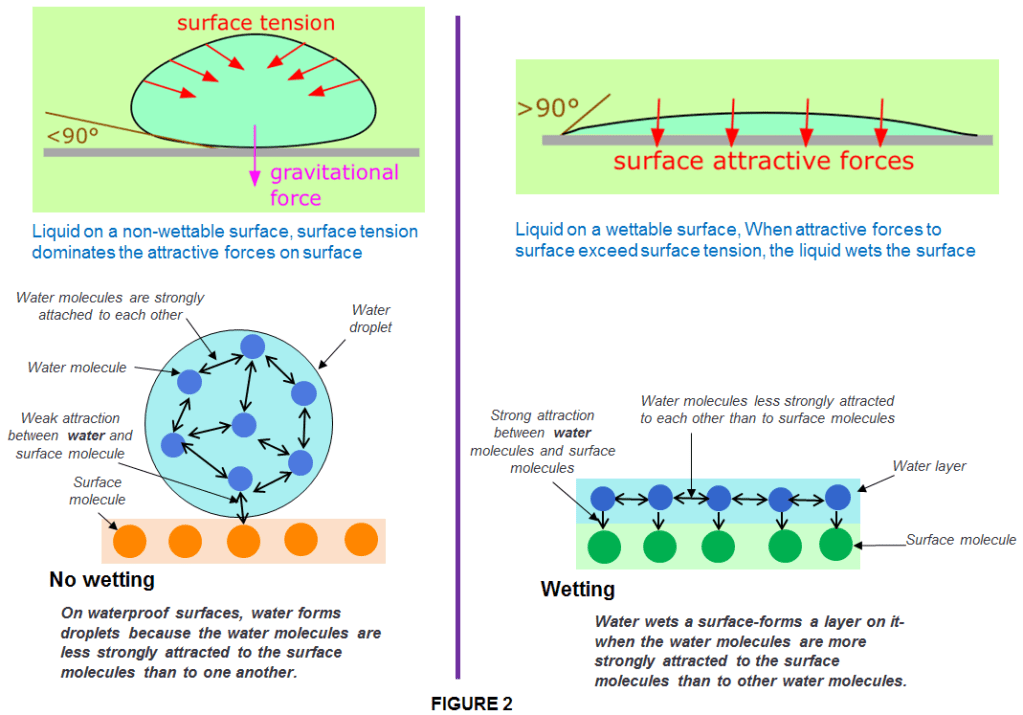
If viscosity is the liquid’s internal struggle, surface tension is its external armor—a molecular force field that holds the surface taut and unbroken. It’s the reason water droplets bead up like tiny, iridescent marbles and why insects can skate across ponds without sinking. Surface tension arises from the imbalance of cohesive forces at the liquid’s surface, where molecules are pulled inward by their neighbors, creating a kind of elastic skin.
This “skin” isn’t just a curiosity; it’s a critical player in how liquids interact with their surroundings. In simulations, surface tension can mean the difference between a droplet that splashes realistically and one that collapses into a puddle of digital goo. It’s what makes a raindrop cling to a windowpane or a soap bubble hold its shape against the breeze. But surface tension isn’t always a friend to animators. Too much, and your liquid behaves like a stretched rubber sheet, resisting deformation. Too little, and it disintegrates into a mist of particles.
Surface tension is also a shape-shifter, influenced by temperature, impurities, and even the presence of other liquids. Hot water, for instance, has lower surface tension than cold, which is why it spreads more easily. Add soap, and the tension plummets, allowing water to penetrate fabrics or create those satisfying suds in a sink. In simulations, replicating these nuances requires a delicate balance. Too much surface tension, and your liquid looks like it’s wrapped in plastic. Too little, and it’s a shapeless puddle, devoid of character.

When Simulations Go Jelly: The Pitfalls of Ignoring Physics
There’s a fine line between a liquid that feels real and one that looks like it was animated by a jellyfish. The culprit? Often, it’s the neglect of viscosity and surface tension—or worse, their misrepresentation. A common mistake is treating all liquids as if they’re water, with the same viscosity and surface tension. But water is an outlier, a fluid so well-behaved it’s almost boring. Real-world liquids are a menagerie of behaviors, from the syrupy drag of glycerin to the near-invisible surface tension of mercury.
Another pitfall is oversimplifying the math. Many simulations use the Navier-Stokes equations, a set of partial differential equations that describe fluid motion. But these equations are a double-edged sword. They’re powerful, but they’re also sensitive. A slight miscalculation in viscosity or surface tension can turn a convincing simulation into a wobbling, gelatinous mess. It’s like trying to conduct an orchestra where half the musicians are playing a different tempo. The result is cacophony, not harmony.
Surface tension, in particular, is tricky to simulate accurately. Traditional methods like the Volume-of-Fluid (VOF) approach can struggle with thin films or complex interfaces. Newer techniques, such as the Level Set method or Smoothed Particle Hydrodynamics (SPH), offer more flexibility but require careful tuning. Even then, artifacts can creep in—droplets that refuse to detach, or surfaces that look like they’re made of rubber. The key is to experiment, to tweak, and to remember that physics is not a suggestion but a law.
Consider the case of a digital fountain. If the viscosity is too high, the water will drip like syrup. If the surface tension is too low, the droplets will dissolve into mist before they even form. But get it right, and the fountain becomes a spectacle—a shimmering, dynamic display that feels alive. The difference isn’t just technical; it’s emotional. A well-simulated liquid doesn’t just look real; it feels real, as if it could spill onto your desk and soak your papers.
The Alchemy of Balance: Crafting Realistic Liquid Simulations
So how do you avoid the jelly trap? The answer lies in balance—balancing physics with artistry, realism with stylization, and computation with intuition. Start with the basics: research your liquid. Is it water, oil, or something more exotic like liquid nitrogen? Each has its own viscosity and surface tension profile. Water at room temperature has a dynamic viscosity of about 1.002 mPa·s and a surface tension of 72 mN/m. Honey, by contrast, can have a viscosity of 2,000–10,000 mPa·s and a surface tension of around 50 mN/m. These numbers aren’t just trivia; they’re the foundation of your simulation.
Next, consider the environment. Temperature, pressure, and even the presence of other substances can alter a liquid’s behavior. A hot liquid will have lower viscosity and surface tension, while a cold one will be more sluggish. Add salt to water, and its surface tension changes slightly. Mix oil and water, and you create a whole new set of interactions. Simulations must account for these variables, or risk feeling sterile and unnatural.
Finally, don’t be afraid to cheat. Not in the sense of lying to the audience, but in the sense of using artistic license to enhance realism. If a droplet looks too spherical, tweak the surface tension slightly to make it more dynamic. If a liquid feels too thick, adjust the viscosity to match the desired mood. The goal isn’t to replicate reality pixel-for-pixel; it’s to evoke the essence of reality, to make the audience believe in the illusion.
Remember, the most convincing liquids aren’t the ones that obey physics perfectly—they’re the ones that feel right. A stylized animation might exaggerate viscosity or surface tension for dramatic effect, and that’s okay. The key is intention. Every choice should serve the story, whether it’s the slow, deliberate pour of aged whiskey or the frantic splashing of a breaking wave.
In the end, mastering viscosity and surface tension is about more than just technical skill. It’s about understanding the poetry of liquids—the way they cling, flow, and defy. It’s about turning a digital blob into a character, a simulation into a story. So the next time your liquid simulation looks like jelly, don’t blame the software. Look deeper. Adjust the viscosity. Tweak the surface tension. And most importantly, listen to the liquid. It’s trying to tell you something.


Leave a Comment