

The moment you step into a Parisian apartment, your gaze is inevitably drawn to the mirror. Not just any mirror, but one that seems to command the room with an almost regal presence. It’s not merely a functional object; it’s a statement, a silent storyteller that whispers tales of elegance, history, and architectural finesse. Why, then, does every Parisian apartment seem to have that specific mirror placement? What alchemy of design and purpose makes it so ubiquitous? Let’s unravel the mystery behind this captivating phenomenon.
At first glance, the placement of mirrors in Parisian apartments appears effortless, almost accidental. Yet, nothing in Parisian design is left to chance. The mirror, often positioned opposite a window or a fireplace, serves as a masterful tool to amplify light and space. In a city where natural light is a prized commodity, this strategic placement ensures that even the smallest apartment feels airy and expansive. The mirror doesn’t just reflect light; it transforms it, scattering it across the room in a dance of luminosity that softens shadows and highlights the room’s best features. It’s a subtle yet powerful trick that makes the space feel larger than its physical confines.
But the mirror’s role extends beyond mere functionality. It’s a cultural artifact, a nod to the Parisian obsession with symmetry and balance. The French have long revered the principles of classical architecture, where every element has its place and purpose. A mirror placed above a fireplace, for instance, isn’t just a decorative choice—it’s a deliberate act of creating harmony. The fireplace, a symbol of warmth and conviviality, is mirrored in the reflective surface, doubling its presence and reinforcing the room’s focal point. This symmetry isn’t just aesthetically pleasing; it’s a visual metaphor for the Parisian way of life, where every detail is considered and nothing is superfluous.


There’s also a psychological dimension to this mirror placement. In a city as bustling and crowded as Paris, the home becomes a sanctuary, a private retreat from the chaos outside. The mirror, with its reflective surface, acts as a portal—it connects the interior with the exterior, blurring the lines between the private and the public. When placed opposite a window, it doesn’t just reflect the sky or the neighboring buildings; it invites the outside world into the apartment, creating a sense of openness and connection. This is especially poignant in a city where the boundaries between the personal and the communal are often blurred. The mirror becomes a silent companion, a witness to the daily rituals of life, from morning coffee to evening reflections.
Moreover, the mirror’s placement often aligns with the principles of *feng shui*, a practice that has subtly influenced Parisian design. In *feng shui*, mirrors are used to enhance the flow of energy, or *qi*, within a space. A mirror placed in a way that reflects a beautiful view or a source of natural light is believed to invite positive energy into the home. In Parisian apartments, where space is at a premium, this practice takes on added significance. The mirror doesn’t just reflect light; it reflects life itself, infusing the space with a sense of vitality and movement. It’s no wonder that Parisians, who are known for their reverence for both tradition and innovation, have embraced this practice so wholeheartedly.
The mirror also serves as a canvas for personal expression. In a city that celebrates individuality within the framework of collective elegance, the mirror becomes a stage for self-expression. Whether it’s an ornate, gilded frame that speaks to a love of Baroque opulence or a sleek, modern design that nods to contemporary minimalism, the mirror’s placement often reflects the personality of its owner. It’s not just a decorative element; it’s a conversation starter, a piece of art that invites admiration and curiosity. In a Parisian apartment, where every object tells a story, the mirror is no exception. It’s a silent narrator, revealing fragments of its owner’s taste, history, and aspirations.
But let’s not forget the practicalities. In a city where real estate is a luxury, the mirror’s ability to create the illusion of space is invaluable. A small apartment in the Marais or Montmartre can feel cramped and confining, but a strategically placed mirror can transform it into a light-filled haven. The mirror’s reflective surface tricks the eye, making the room appear larger and more open. It’s a design hack that’s as clever as it is beautiful, a testament to the Parisian knack for making the most of limited resources. This isn’t just about aesthetics; it’s about survival in a city where space is a precious commodity.
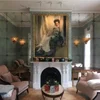
There’s also a historical context to consider. Parisian apartments, especially those in the historic center, often feature high ceilings and large windows. The mirror, placed above a fireplace or opposite a window, capitalizes on these architectural features, creating a sense of grandeur and verticality. This placement isn’t just about light and space; it’s about paying homage to the city’s architectural heritage. The mirror becomes a bridge between the past and the present, a way to honor the elegance of bygone eras while embracing modern sensibilities. It’s a subtle yet powerful way to connect with history without being overtly nostalgic.
And then there’s the matter of vanity. Parisian women, in particular, have long been celebrated for their effortless chic, and the mirror plays a starring role in this narrative. A well-placed mirror isn’t just a functional object; it’s a tool for self-care and self-expression. Whether it’s a vanity mirror in the bedroom or a full-length mirror in the hallway, the placement of the mirror is often designed to flatter and enhance. It’s a way to celebrate the body, to play with light and shadow, and to create a space that feels both intimate and aspirational. In a city that worships beauty and elegance, the mirror is more than a decorative element—it’s a ritual object, a daily reminder of the importance of self-care and self-expression.
The mirror’s placement in a Parisian apartment is also a nod to the city’s love affair with romance and drama. Paris is, after all, the city of love, and the mirror is a silent participant in this narrative. Whether it’s reflecting the flicker of candlelight in a dimly lit salon or capturing the soft glow of a chandelier in a grand apartment, the mirror adds a layer of romance and intrigue to the space. It’s a way to create a sense of intimacy and mystery, to invite the viewer to imagine the stories that unfold within the room. The mirror doesn’t just reflect the present; it hints at the past and the future, making the space feel alive with possibility.
In the end, the mirror’s ubiquitous presence in Parisian apartments is a testament to the city’s multifaceted identity. It’s a blend of practicality and poetry, of tradition and innovation, of light and shadow. It’s a way to create space where there is none, to connect with the outside world while remaining cocooned in privacy, to honor history while embracing the present. The mirror isn’t just a decorative element; it’s a philosophy, a way of life. It’s why every Parisian apartment feels like a sanctuary, a stage, and a story all at once.
So the next time you find yourself in a Parisian apartment, take a moment to appreciate the mirror. It’s not just a reflection of the room—it’s a reflection of the city itself, a silent witness to the elegance, the history, and the unspoken magic that defines Parisian living.


Leave a Comment