

The Hong Kong diaspora is not just a scattering of people across the globe—it is a vibrant, pulsating network of artists, thinkers, and creators who are reshaping the very definition of “Chinese art.” As the city’s identity fractures and reforms under political and social pressures, its artists are taking their stories, struggles, and dreams beyond borders, infusing new life into a cultural narrative that has long been dominated by rigid traditions or reductive stereotypes. From the neon-lit streets of London to the gritty galleries of Berlin, these diasporic voices are crafting a visual language that is unapologetically hybrid, painfully personal, and defiantly contemporary. They are not merely exporting Hong Kong’s culture; they are reimagining it, piece by piece, in the diaspora’s own image.
What does it mean to be a Hongkonger abroad? For many, it is a constant negotiation between memory and reinvention. The artists featured in this exploration—whether through photography, illustration, or immersive installations—are not just documenting displacement; they are weaponizing it. Their work becomes a bridge between the familiar and the foreign, a way to hold onto a homeland that is both tangible and elusive. In their hands, “Chinese art” is no longer a monolith but a living, breathing ecosystem of influences, where ink wash meets digital glitch, where protest slogans morph into abstract poetry, and where the collective trauma of 1997 lingers in the margins of every brushstroke. This is the art of the in-between, where identity is not a fixed point but a journey—and the canvas is the entire world.
The Visual Diaries of Displacement: Photography as a Medium of Memory
Photography, with its unflinching gaze, has become one of the most potent tools for diasporic artists to archive their fractured realities. The lens does not just capture images; it freezes moments of transition, of hesitation, of quiet rebellion. Consider the way a Hongkonger photographer might frame the skyline of their new city—not as a backdrop, but as a character in their personal epic. The towering glass structures of Canary Wharf or the crumbling tenements of Berlin’s Kreuzberg district become more than locations; they are silent witnesses to the artist’s own metamorphosis.
In these visual diaries, the camera lingers on the small, overlooked details: a teacup from home left on a windowsill in Vancouver, the way sunlight filters through a bamboo blind in a London flat, the graffiti of protest slogans translated into a foreign tongue. Each photograph is a palimpsest, layering the old over the new, the familiar over the alien. The images are not just about loss; they are about the stubborn act of claiming space. A Hongkonger artist in Toronto might photograph the city’s Chinatown not as a nostalgic replica of home, but as a site of negotiation—where the past and present collide in a neon haze of dumpling steam and subway grime.
 The camera becomes an extension of the artist’s psyche, a way to externalize the internal chaos of belonging to two (or more) worlds. In these works, the act of taking a photograph is not passive documentation but an active reclamation—a way to say, “This is where I am, and this is where I come from.” The resulting images are not just beautiful; they are acts of defiance against the erasure of diasporic experiences.
Illustration as Rebellion: The Nib’s Subversive Take on Identity
While photography captures the tangible, illustration distills the intangible—the emotions, the contradictions, the unspoken tensions of being Hongkonger abroad. The Nib, a platform known for its biting political satire, has become a haven for diasporic artists who use ink and wit to dissect the complexities of Chinese identity in a global context. Here, the cartoonist’s pen is mightier than the sword, slicing through stereotypes with a single, deft stroke.
The illustrations in this space are not mere caricatures; they are visual manifestos. A comic might depict a Hongkonger immigrant in New York, their face half-hidden behind a protest mask, the other half obscured by a surgical mask—symbolizing the duality of their existence. Another might play with the iconography of Chinese opera masks, reimagining them as contemporary emojis, their exaggerated expressions a commentary on the performative nature of cultural identity. The humor is sharp, the critique is unflinching, and the art is undeniably political.
 What makes this work so compelling is its refusal to be boxed in. These artists are not just illustrating their own experiences; they are holding up a mirror to the broader diaspora, forcing viewers to confront the absurdities and hypocrisies of cultural assimilation. The result is a body of work that is as funny as it is poignant—a reminder that laughter can be a form of resistance.
Installations of the In-Between: Where Space Becomes Story
For some diasporic artists, the gallery itself is not just a space to display art but a site to construct it. Installations become immersive narratives, where the physical environment mirrors the psychological landscape of displacement. These works are not passive; they demand participation, forcing viewers to navigate the same disorientation that the artist once felt.
Imagine stepping into a room where the walls are lined with translucent panels, each etched with the faint outlines of Hong Kong’s skyline—fading in and out like a memory. The floor is scattered with objects: a child’s schoolbag, a protest flyer, a half-empty bottle of Tsingtao beer. The air hums with the sound of Cantonese pop songs playing backward. This is not just an installation; it is an emotional topography, a way to physically experience the weight of leaving home.
Another artist might create a site-specific work in a Berlin gallery, using the building’s architecture to evoke the claustrophobia of Hong Kong’s urban density. The installation could feature a maze of mirrored corridors, reflecting the artist’s face back at them in fragments—each shard representing a different version of themselves, a different version of their identity. The viewer, too, becomes part of the piece, their movements distorting the reflections, blurring the lines between observer and participant.
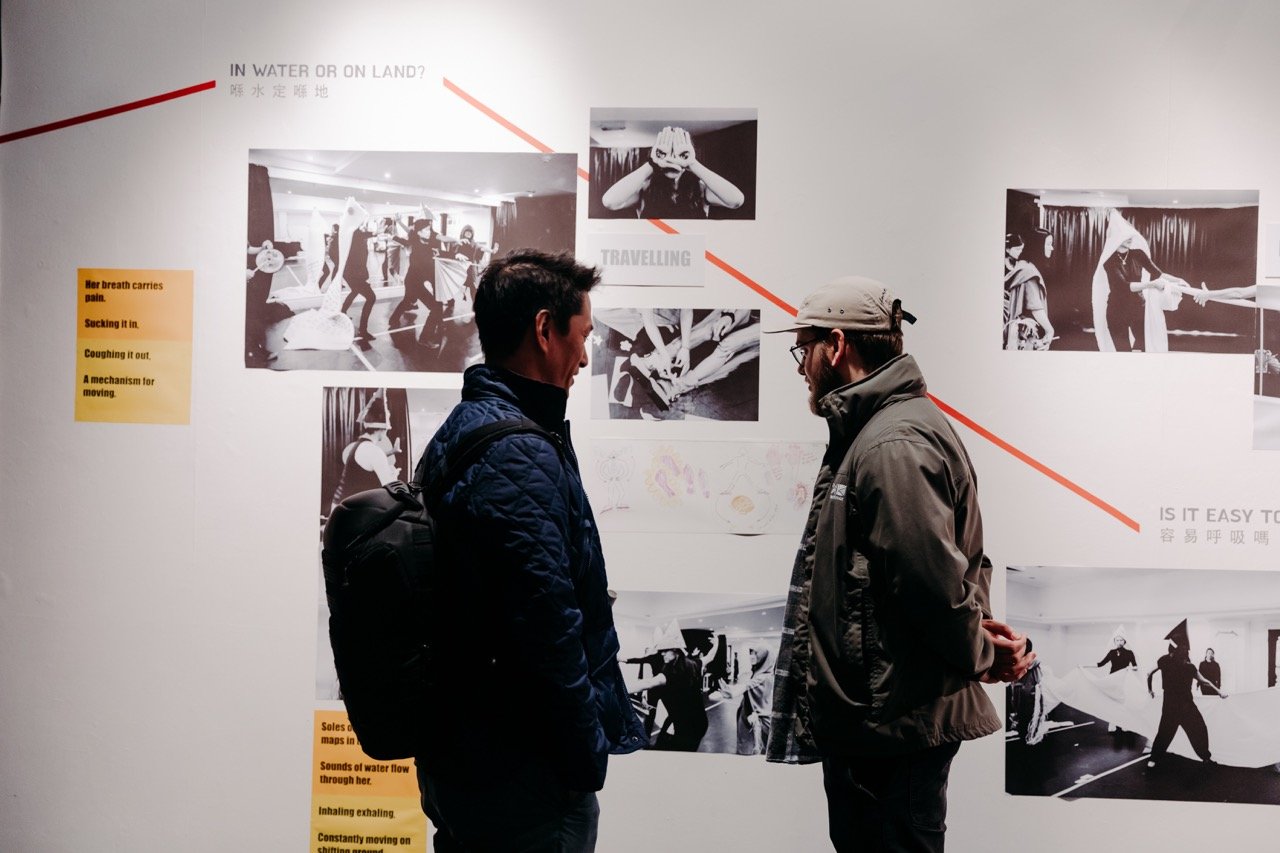 These installations are not just about the past; they are about the present tense of diaspora—the constant push and pull between here and there, now and then. They are spaces where the artist’s identity is not just represented but performed, where the act of creation becomes an act of survival.
The Diaspora’s New Canon: Redefining “Chinese Art” for the 21st Century
The art emerging from the Hong Kong diaspora is not just a footnote in the larger story of Chinese art; it is rewriting the entire narrative. For too long, “Chinese art” has been synonymous with ink paintings, calligraphy, and the rigid aesthetics of the imperial court. But the diaspora’s artists are tearing down these walls, replacing them with something far more dynamic and inclusive. Their work is not bound by tradition; it is fueled by it, remixing centuries-old techniques with digital innovation, political urgency, and personal myth-making.
This is art that refuses to be categorized. A photograph might incorporate elements of Chinese ink wash; an illustration might borrow from Western comic styles; an installation might blend soundscapes from both Cantonese and German cultures. The result is a new visual language, one that speaks to the hybridity of the diasporic experience. It is art that does not ask for permission to exist; it simply does.
Moreover, this art is not just for the diaspora. It is for anyone who has ever felt the ache of belonging to more than one place, who has ever stood at the edge of two cultures and wondered where they fit. It is art that challenges the viewer to see beyond the surface—to recognize that “Chinese art” is not a monolith but a vast, ever-evolving conversation. And in that conversation, the voices of the diaspora are not just heard; they are leading the way.
The Hong Kong diaspora’s artists are not just creating art; they are forging a new cultural identity, one brushstroke, one frame, one installation at a time. Their work is a testament to the power of art as both a weapon and a balm—a way to remember, to resist, and to reimagine. In a world that often seeks to box identities into neat little categories, these artists are proving that the most vibrant art is the kind that refuses to be contained.


Leave a Comment