

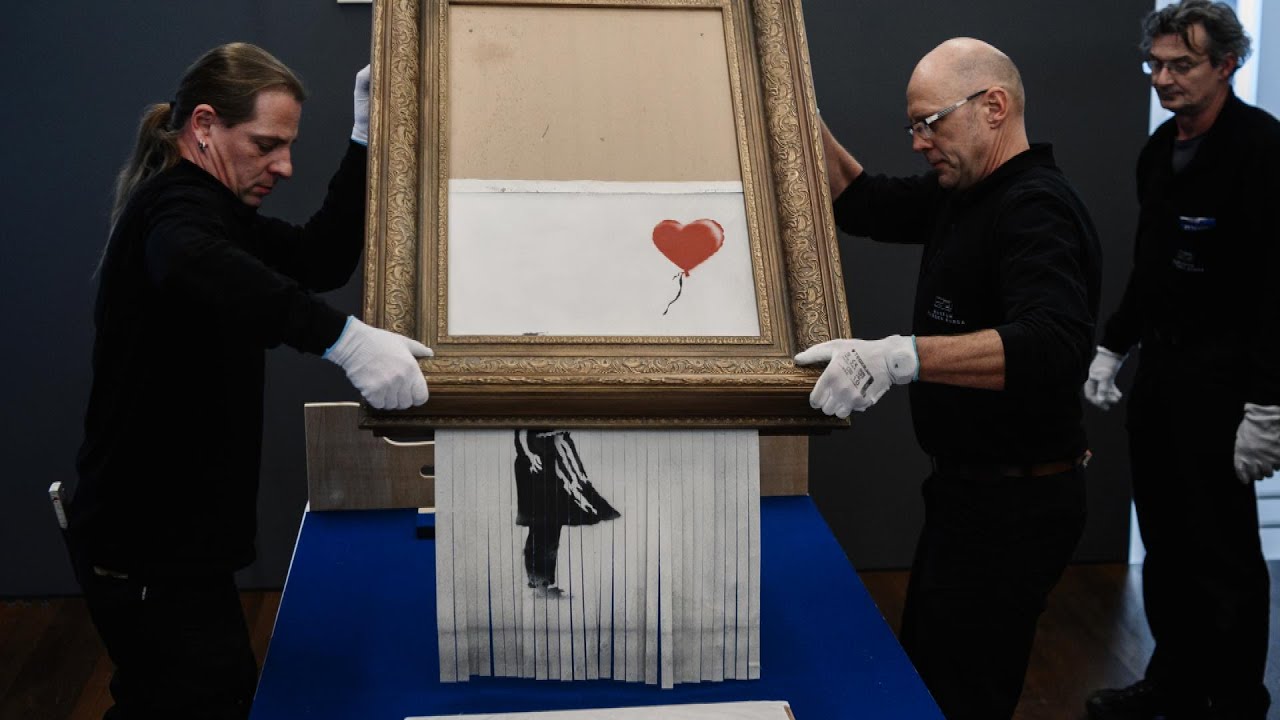
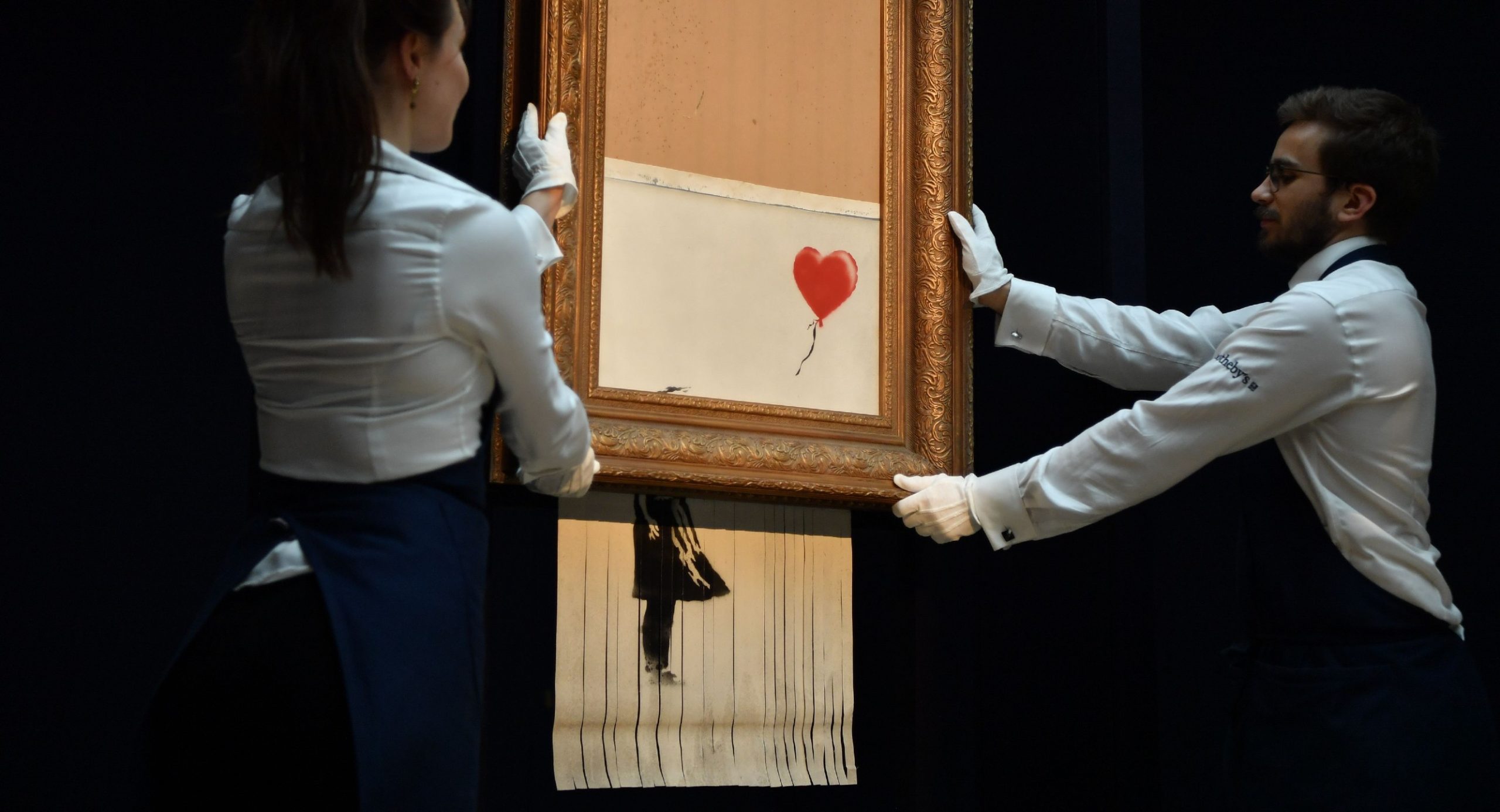
In the annals of art history, few moments have sparked as much intrigue, debate, and sheer astonishment as Banksy’s *Girl with Balloon* shredding itself mid-auction. The 2018 Sotheby’s sale in London saw the artwork transform from a $1.4 million masterpiece into a $25.4 million spectacle—all within the span of a few breathless seconds. Yet, what if the real performance wasn’t the shredding itself, but the way it forced us to confront our own complicity in the spectacle? What if the most audacious act wasn’t Banksy’s, but ours?
The moment the frame’s hidden mechanism activated, the art world held its collective breath. The shredded canvas dangled like a tongue-in-cheek wink from the artist, a sly commentary on the commodification of art. But here’s the twist: the performance wasn’t just Banksy’s. It was ours. Every gasp, every tweet, every headline that followed was part of the act. The real magic wasn’t in the shredding—it was in the way we, the audience, became the unwitting co-conspirators in a grand illusion.
The Illusion of Control: Who Really Owns the Art?
Art has always been a game of perception. Galleries, auction houses, and collectors play by rules they’ve written themselves—rules that dictate what’s valuable, what’s worthy, and what’s worthless. But Banksy’s stunt exposed the fragility of those rules. The shredding wasn’t just a destruction of the painting; it was a demolition of the illusion that art’s value is inherent. Suddenly, the emperor had no clothes, and the crowd couldn’t look away.
Consider the irony: the buyer, who paid millions for a half-shredded canvas, now owns a piece that’s arguably more valuable precisely because it’s incomplete. The shredding didn’t diminish the artwork—it amplified its narrative. It forced us to ask: Is art valuable because of what it is, or because of what it represents? The answer, Banksy seemed to suggest, is in the eye of the beholder—and the beholder, in this case, was us.
This isn’t just about Banksy. It’s about the power we give to institutions. Auction houses thrive on the drama of the sale, the tension of the bid, the spectacle of the hammer dropping. But when the spectacle turns against them, when the artwork itself rebels, the illusion shatters. The real performance wasn’t the shredding—it was the way we, the audience, clung to the narrative that the shredding created. We needed it to mean something. We needed it to be profound. And in doing so, we became part of the act.
The Audience as the Unwitting Protagonist
Every great performance requires an audience. Shakespeare knew it. Hitchcock knew it. Banksy, it turns out, knew it too. The shredding wasn’t just a stunt—it was an invitation. An invitation to participate, to react, to debate. And we did. We dissected it, analyzed it, memed it, and ultimately, we mythologized it. The real magic wasn’t in the canvas tearing apart; it was in the way we stitched our own stories onto the remnants.

Think about it: without our reactions, the shredding would have been just another oddity in the annals of art history. But because we engaged with it—because we argued over its meaning, because we questioned its authenticity, because we turned it into a cultural touchstone—it became something more. It became a mirror. A mirror that reflected back not just Banksy’s genius, but our own hunger for meaning in a world that often feels devoid of it.
This is the power of performance art. It doesn’t just exist in the moment; it exists in the aftermath. It’s not just the artist’s creation—it’s the audience’s interpretation. The shredding was a catalyst, but the real alchemy happened in the conversations that followed. We became the artists, the critics, the philosophers. We turned a single event into a cultural phenomenon. And in doing so, we proved that the most powerful performances aren’t the ones we watch—they’re the ones we live.
The Commodification of Rebellion
There’s a delicious irony in the fact that Banksy’s anti-establishment stunt was, in the end, co-opted by the very establishment it sought to undermine. The shredded painting sold for $25.4 million. The buyer, presumably, was thrilled. The auction house, undoubtedly, was delighted. And Banksy? Well, Banksy got exactly what he wanted: attention.
But here’s the question we’ve been avoiding: Is rebellion still rebellion if it’s profitable? If the system that Banksy sought to critique ends up profiting from his critique, does the critique lose its power? Or does it gain something even more insidious—a kind of twisted legitimacy?
This isn’t just about Banksy. It’s about all of us. We live in an age where rebellion is commodified. Where dissent is monetized. Where even the most radical acts are absorbed into the machine, repackaged, and sold back to us as edgy content. The shredding was a masterclass in this phenomenon. It was a rebellion that was, in the end, a performance—a performance designed to make us question the nature of value, only to have those questions neatly packaged and sold back to us.
But perhaps that’s the point. Perhaps the real rebellion isn’t in tearing down the system, but in recognizing our own complicity in it. Perhaps the most radical act isn’t to reject the machine, but to understand how deeply we’re all entangled in its gears.
The Spectacle of Participation
We’ve entered an era where participation is the new currency. Social media has turned us all into performers, our lives curated like reality TV shows. We post, we share, we react—and in doing so, we become part of the spectacle. Banksy’s shredding was a masterstroke because it forced us to confront this reality. It wasn’t just an artwork shredding itself; it was an invitation to participate in the performance of meaning-making.
And we took the bait. We debated. We theorized. We memed. We turned the shredding into a cultural Rorschach test, seeing in it whatever we wanted to see. Some called it genius. Others called it gimmicky. Some saw a commentary on capitalism. Others saw a clever marketing ploy. The beauty of it was that it didn’t matter what we saw—because the act of seeing was the performance.
This is the power of modern art. It doesn’t just hang on a wall—it lives in the conversations it sparks. It doesn’t just exist in a gallery—it exists in the zeitgeist. And the zeitgeist, as Banksy so deftly demonstrated, is shaped by all of us. We are the curators of meaning. We are the arbiters of value. We are the performers in this grand, chaotic, beautiful spectacle.
The Real Performance Was You
So here’s the truth: Banksy’s shredded painting wasn’t the performance. It was the setup. The real performance was us. The way we reacted. The way we engaged. The way we turned a single moment into a cultural phenomenon. The shredding was just the catalyst—the spark that ignited a wildfire of meaning, debate, and interpretation.
And that’s the genius of it. Because in the end, Banksy didn’t just create a piece of art. He created an experience. An experience that required us to bring our own stories, our own biases, our own desires to the table. He turned the passive observer into the active participant. He made us complicit in the act of creation.
So the next time you see a piece of art that challenges you, that provokes you, that forces you to question the world around you—remember this. The real performance isn’t in the artwork. It’s in you. It’s in the way you engage with it. It’s in the meaning you choose to see. And in that moment, you become the artist. You become the rebel. You become the storyteller.
Banksy’s shredded painting sold for $25.4 million. But the real value? It was priceless. Because it reminded us that the most powerful art isn’t the one we hang on a wall—it’s the one we carry in our hearts.


Leave a Comment