

Picture this: the clock ticks past midnight, the caffeine in your veins has long since curdled into a metallic sludge, and the script for tomorrow’s festival performance sits in your hands like an unsolved riddle wrapped in a mystery. You’ve never read it. You don’t know the characters, the plot, or even the genre. Yet, by sunrise, the stage must breathe with life, the lights must cast their spell, and the audience must feel the pulse of a world that exists only in ink and imagination. This is not a design challenge—it’s a midnight heist against the tyranny of the blank canvas, a 24-hour festival nightmare where creativity is the only currency that doesn’t devalue under pressure.
Designing a set for a show you’ve never read is like assembling a puzzle with half the pieces missing and the box lid facing the wrong way. You’re not just building a world; you’re conjuring one from whispers, from the faintest echoes of mood and tone that drift through the script’s periphery. The director’s vision is a flickering candle in a hurricane, and your job is to sculpt the wind itself into something tangible. It’s a high-wire act where every misstep could plunge the production into the abyss of irrelevance—or worse, into the purgatory of forgettable design. Yet, in that precarious dance between chaos and control, lies the thrill of the unknown, the seductive allure of the uncharted.
The Script as a Ghost: Reading Between the Lines of the Unseen
You don’t have the luxury of time to dissect every subtext or parse every metaphor. Instead, you must become a literary archaeologist, sifting through the script’s detritus for clues like a detective in a noir film. The stage directions are sparse, the dialogue cryptic. A single mention of “a flickering streetlamp” becomes a beacon, guiding your hand toward a world steeped in chiaroscuro shadows. A character’s offhand remark about “the weight of memory” might translate into a set piece that feels like a crumbling archive, its walls lined with fragments of forgotten stories.
This is where intuition becomes your most trusted ally. You’re not designing for the text you’ve read; you’re designing for the text you *feel*. The script is a ghost haunting your studio, its presence felt in the hum of the printer, the scent of coffee gone cold, the way your pencil hesitates over the page. Every choice you make is an act of divination, a gamble that the unseen world you’re building will resonate with the unseen world the playwright intended. It’s a thrilling game of telephone, where the message gets distorted with every retelling—but in the distortion, something new and unexpected is born.

The Language of Shadows: Lighting as the Invisible Architect
In the absence of a fully realized script, lighting becomes your most eloquent collaborator. It doesn’t just illuminate—it *interprets*. A single shaft of light slicing through the darkness can suggest a character’s isolation, while a slow, creeping wash of color might foreshadow an impending storm. Lighting is the alchemy that transforms static wood and metal into a living, breathing entity. It’s the difference between a set that merely *exists* and one that *haunts*.
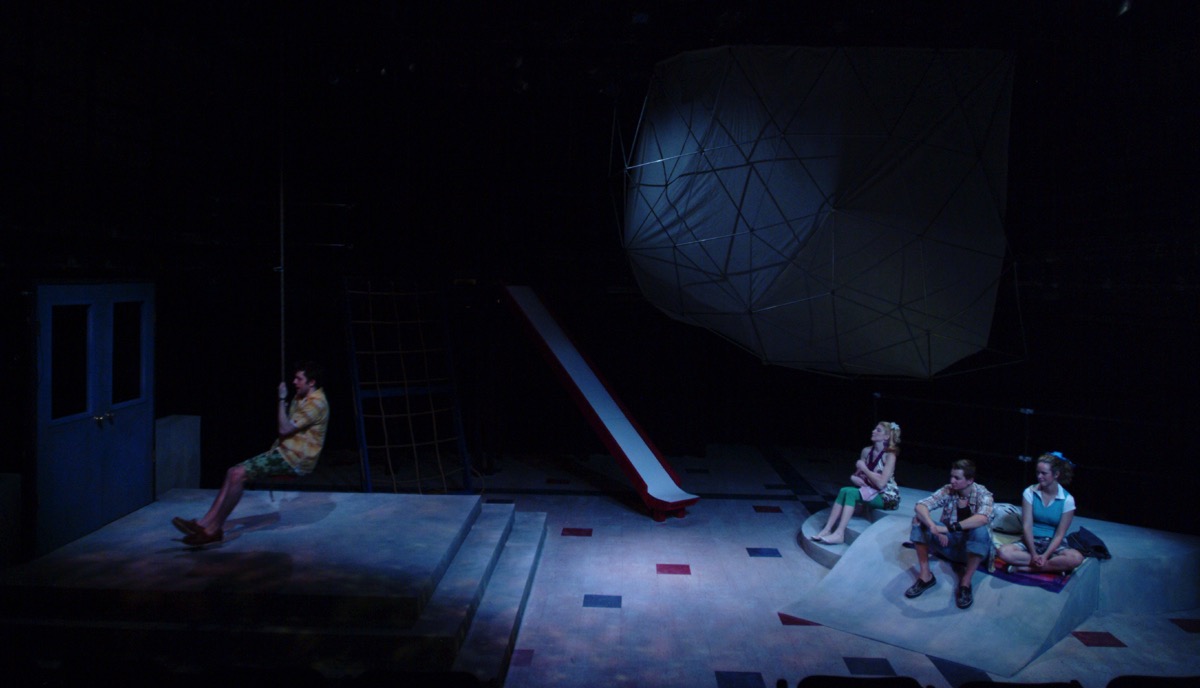
Consider the festival stage as a canvas for chiaroscuro, where the interplay of light and shadow isn’t just aesthetic—it’s narrative. A character’s entrance might be heralded not by a cue, but by the gradual brightening of a single spotlight, as if the stage itself is recognizing their presence. The absence of light can be just as powerful; a blackout isn’t a void, but a moment of suspension, a breath held before the plunge into revelation. In this way, lighting becomes the invisible hand that guides the audience’s gaze, their emotions, their very understanding of the world unfolding before them.
But beware the trap of overcomplication. The best lighting designs are those that serve the story, not obscure it. A wash of deep indigo might evoke a sense of melancholy, but if the script’s tone is one of frenetic energy, that same color could feel like a misstep. Trust your instincts, but let the script’s emotional core be your compass. Lighting is the language of the unseen, and in the silence between cues, it speaks volumes.
Material Alchemy: Turning Constraints into Creative Gold
Limited time. Limited resources. Limited knowledge. These aren’t obstacles—they’re the crucible in which true creativity is forged. When the script is a locked room and the deadline is a ticking bomb, the materials at your disposal become the keys to unlocking something extraordinary. A pile of scaffolding becomes a towering cityscape. A stack of crates transforms into a shifting labyrinth. Even the most mundane objects can be repurposed into something magical when viewed through the lens of necessity.
Think of the stage as a foundry, where raw materials are melted down and recast into something entirely new. A sheet of plywood isn’t just a surface—it’s a potential cliff face, a rooftop, a prison wall. A length of chain isn’t just hardware—it’s a metaphor for entrapment, a visual echo of the script’s themes. The constraints of the 24-hour festival nightmare aren’t shackles; they’re the scaffolding upon which your imagination can climb.
But material alchemy requires a certain audacity. You must be willing to take risks, to embrace the imperfect, to see beauty in the rough edges. A hastily painted backdrop might lack the polish of a commissioned artwork, but it could possess a raw, visceral energy that resonates with the audience. The patina of age on a prop might not be intentional, but it could lend an air of authenticity to a world that feels lived-in and real. In the end, the materials you choose aren’t just building blocks—they’re the DNA of the world you’re creating, and every imperfection is a genetic mutation that makes it uniquely yours.
The Festival as a Living Organism: Adapting to the Unpredictable
A festival isn’t a static performance—it’s a living, breathing entity, pulsing with the energy of thousands of attendees, each with their own expectations, emotions, and interpretations. Your set isn’t just a backdrop; it’s a participant in this collective experience. It must be flexible enough to adapt to the ebb and flow of the festival’s rhythm, whether that means adjusting for a sudden change in weather, accommodating an unexpected technical glitch, or responding to the spontaneous energy of the crowd.
This is where modular design becomes your secret weapon. A set that can be reconfigured on the fly isn’t just practical—it’s a statement. It says to the audience that the world you’ve created is dynamic, that it can shift and change in response to the moment. A series of movable panels might transform a serene garden into a battleground in minutes. A platform that can be raised or lowered could turn a simple stage into a multi-level dreamscape. The festival isn’t a place for static perfection; it’s a place for evolution.
But adaptability requires foresight. You must anticipate the unpredictable, not just react to it. A sudden downpour might mean that certain materials are off-limits, or that the set needs to be waterproofed. A last-minute change in the lineup might require a redesign that can accommodate a different performance style. The best festival sets aren’t those that are flawless—they’re those that are resilient, that can bend without breaking, that can surprise and delight even when the script is a mystery.
The Aftermath: When the Curtain Falls on the Unknown
When the final notes of the performance fade and the audience disperses into the night, the set you’ve created doesn’t simply vanish. It lingers in the memories of those who experienced it, a ghost of the world you built in the dark. Some will love it. Some will hate it. Some will see things in it that you never intended. And that’s the beauty of it—your set wasn’t just a reflection of the script; it was a collaboration between you, the unseen playwright, and the collective imagination of the audience.
The 24-hour festival nightmare isn’t just a test of skill; it’s a test of courage. It asks you to embrace the unknown, to trust your instincts, and to create something from nothing. It’s a reminder that true art isn’t born from certainty, but from the willingness to leap into the void and trust that the wings will appear. And when the sun rises on the morning after, and the stage is bare once more, you’ll know that you didn’t just design a set—you conjured a moment, a memory, a spark in the dark that will outlast the festival itself.
So the next time you’re handed a script you’ve never read, don’t panic. Don’t despair. Instead, lean into the chaos. Let the unknown be your guide. Because in the end, the most unforgettable sets aren’t those that perfectly match the script—they’re those that dare to rewrite it in their own image.


Leave a Comment