

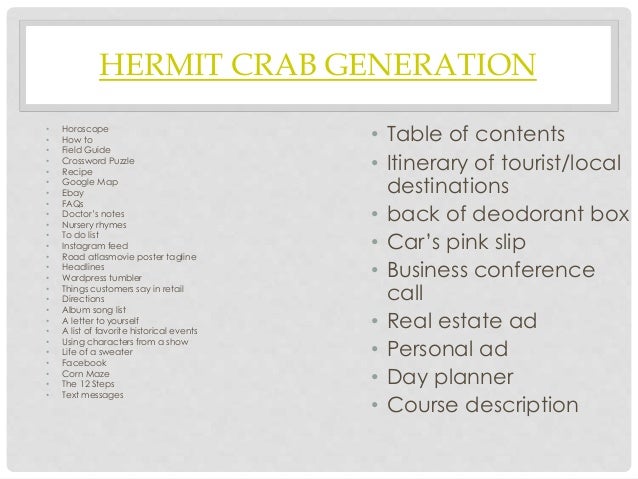
In the vast, untamed savanna of essay writing, where the lions of five-paragraph structures prowl and the hyenas of formulaic prose cackle, there exists a creature both peculiar and profound: the hermit crab essay. Unlike its shell-dwelling namesake, this literary mollusk doesn’t carry its home on its back—it wears the discarded exoskeletons of other genres as its own. Recipes, obituaries, grocery lists, even instruction manuals—all these and more can become the scaffolding for an essay that is as unexpected as it is illuminating. If you’ve ever felt stifled by the rigid confines of traditional academic writing, the hermit crab essay is your liberation, your invitation to dance with form and function in ways that surprise, delight, and provoke thought.
Imagine crafting an essay not by building from scratch, but by repurposing the architecture of a recipe card, a eulogy, or a tax form. The result? A piece that feels alive, conversational, and deeply human. This isn’t just writing—it’s alchemy. You take the mundane and transmute it into the profound. You take the rigid and make it fluid. You take the expected and render it extraordinary. Let’s embark on a journey through the many guises of the hermit crab essay, exploring the forms it can take, the readers it can enchant, and the ideas it can illuminate.

The Recipe as Essay: A Feast of Metaphor and Method
There’s something almost sacred about a recipe. It’s a promise: follow these steps, and something nourishing will emerge. But what if that recipe became the skeleton of an essay? What if the ingredients weren’t flour and sugar, but memories and metaphors? A recipe essay doesn’t just list components—it dissects them, savors them, and weaves them into a narrative tapestry.
Consider a recipe for chocolate chip cookies. The flour is tradition. The butter is comfort. The chocolate chips are the unexpected joys of life. Each ingredient becomes a metaphor for a personal experience, a cultural touchstone, or a philosophical musing. The instructions, meanwhile, become the structure of your argument: preheat the oven (set the stage), mix the dry ingredients (establish your thesis), fold in the chocolate (introduce your climax). The result? An essay that reads like a love letter to baking—and to life.
Readers drawn to recipe essays are often those who crave warmth, nostalgia, and sensory detail. They want to be fed not just intellectually, but emotionally. They’re the kind of people who linger over the smell of cinnamon in a kitchen or who can recite their grandmother’s pie recipe from memory. For them, an essay structured like a recipe isn’t just a piece of writing—it’s an experience, a ritual, a shared meal of words.

The Obituary as Essay: Eulogizing Ideas, Not Just People
Obituaries are, at their core, essays in miniature. They distill a life into a few hundred words, highlighting virtues, quirks, and legacies. But what if we applied that precision not to a person, but to an idea? An ideology? A cultural phenomenon? The obituary essay is a meditation on endings, a eulogy for things that have died—or perhaps things that should.
Imagine writing an obituary for nostalgia in the digital age. You’d begin with the deceased: “Nostalgia, beloved by generations of vinyl collectors and mixtape enthusiasts, passed away peacefully in 2023, survived by its cousin, selective memory.” The cause of death? “The relentless march of algorithmic curation and the erasure of analog artifacts.” The survivors? “Those who still believe a Polaroid captures more than pixels.” The tone is solemn, yet wry. The structure is familiar, yet subversive. The reader is drawn in by the gravitas of the form, only to find themselves questioning what else might be worthy of an obituary.
This form appeals to readers who appreciate irony, satire, and the power of brevity. It’s for those who enjoy the juxtaposition of the formal and the irreverent. The obituary essay invites us to mourn, celebrate, and interrogate—all at once. It’s a reminder that every idea, no matter how abstract, has a lifespan, and that writing can be both a eulogy and a resurrection.
The Grocery List as Essay: The Poetry of the Mundane
Grocery lists are the unsung heroes of daily life. They’re practical, utilitarian, and often forgotten the moment the milk is purchased. But what if we treated them like poetry? What if each item on the list became a symbol, a memory, a fragment of a larger story? The grocery list essay is a celebration of the overlooked, a testament to the idea that even the most ordinary moments can be profound when viewed through the right lens.
Consider a list that reads: “eggs (for breakfast with my son), coffee (to survive the 5 a.m. commute), almond milk (because the cows deserve a break), red wine (for when the kids are finally asleep).” Each item is a doorway into a memory, a relationship, a ritual. The essay unfolds not as a linear narrative, but as a collage of moments, each as vivid as the last. The reader is invited to piece together the story, to fill in the blanks with their own experiences.
This form resonates with readers who find beauty in the everyday. It’s for the poets who see metaphors in supermarket aisles and the philosophers who ponder the existential weight of a loaf of bread. The grocery list essay is a love letter to the unremarkable, a reminder that life is made up of small, sacred details.
The Instruction Manual as Essay: How-To as Heart-To
Instruction manuals are the dry, technical cousins of poetry. They’re meant to be followed, not admired. But what if we treated them like confessions? What if the steps of assembling a bookshelf became a metaphor for building a relationship, or the instructions for programming a thermostat became a meditation on control and surrender? The instruction manual essay is a playful yet profound exploration of process, precision, and the human need for guidance.
Imagine writing an instruction manual for grief. Step 1: “Acknowledge the loss. Do not skip this step.” Step 2: “Allow the tears. They are not a malfunction.” Step 3: “Reassemble your life, one drawer at a time.” The tone is clinical, yet deeply empathetic. The form is familiar, yet deeply personal. The reader is both the student and the teacher, learning and unlearning in equal measure.
This form appeals to readers who enjoy the tension between structure and spontaneity. It’s for those who see the world as a series of systems, each with its own logic and beauty. The instruction manual essay invites us to question the instructions we’ve been given—and to write our own.
The Diary Entry as Essay: The Raw and the Unfiltered
Diary entries are the purest form of self-expression. They’re unfiltered, unpolished, and often unread by anyone but their author. But what if we shared them? What if a diary entry became the framework for an essay that explores vulnerability, intimacy, and the rawness of human experience? The diary entry essay is a window into the soul, a confession without the safety net of revision.
Consider a diary entry written in the aftermath of a breakup: “Today, I ate cereal for dinner because I couldn’t be bothered to cook. I cried in the shower where the water could drown out the sound. I Googled ‘how to know if you’re depressed’ and then closed the tab because I already knew the answer.” The language is unadorned, the emotions laid bare. The essay doesn’t just tell a story—it invites the reader into the writer’s most private moments.
This form resonates with readers who crave authenticity. It’s for those who believe that truth is more powerful than polish. The diary entry essay is a reminder that writing doesn’t always have to be perfect—sometimes, it just has to be real.
The Weather Report as Essay: Forecasting the Human Condition
Weather reports are the most ephemeral of genres. They’re meant to be glanced at and forgotten. But what if we treated them like literature? What if the forecast for a storm became a metaphor for emotional turmoil, or the description of a heatwave became a meditation on climate change and human resilience? The weather report essay is a fusion of science and sentiment, a way to explore the external world as a reflection of our inner lives.
Imagine writing a weather report for a city in the midst of gentrification: “Today’s forecast: rising rents, falling community. Wind speeds: 15 mph, carrying the echoes of long-time residents being priced out. Humidity: 90%, the oppressive weight of displacement. Visibility: poor, obscured by the haze of development.” The language is clinical, yet deeply evocative. The form is familiar, yet deeply subversive. The reader is invited to see the world—and themselves—differently.
This form appeals to readers who enjoy the interplay between the natural and the human-made. It’s for those who see poetry in meteorology and metaphor in meteorological data. The weather report essay is a reminder that even the most objective of genres can be a canvas for emotion.

The hermit crab essay is more than a stylistic flourish—it’s a rebellion against the tyranny of the blank page. It’s an invitation to play, to experiment, to find joy in the unexpected. Whether you’re crafting a recipe that doubles as a memoir, an obituary for an idea, or a grocery list that reads like poetry, you’re not just writing an essay. You’re reinventing what an essay can be.
For the reader, these essays are a breath of fresh air in a world of predictable prose. They’re the literary equivalent of stumbling upon a hidden café in a city you’ve walked a hundred times before—unexpected, delightful, and impossible to forget. They remind us that writing isn’t about adhering to rules; it’s about breaking them, bending them, and sometimes, wearing them like a second skin.
So the next time you sit down to write, ask yourself: what discarded shell lies nearby? What genre, what form, what mundane artifact could become the vessel for your next great idea? The hermit crab essay isn’t just a trick of the trade—it’s a testament to the boundless creativity of the human mind. And that, truly, is something to celebrate.


Leave a Comment