


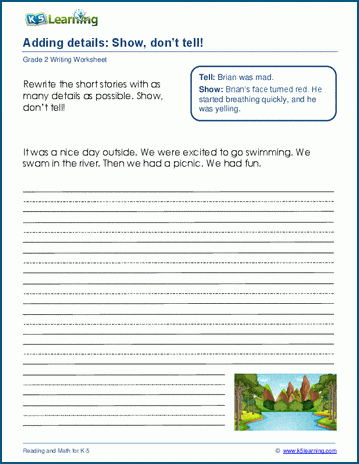
The adage “Show, don’t tell” has been drilled into writers like a mantra, a sacred commandment etched into the stone tablets of creative writing. It’s the gospel preached by every MFA program, every bestselling author, every well-meaning English teacher. But what if I told you that “Show, don’t tell” is a lie? Not a malicious one, perhaps, but a half-truth so ingrained that it blinds us to the real power of storytelling. The truth is far more nuanced, far more liberating. It’s not about choosing one over the other—it’s about knowing when to wield each with surgical precision. So, buckle up. We’re about to shatter a myth and rebuild your narrative instincts from the ground up.
The Myth of the Binary: Why “Show, Don’t Tell” is a Half-Truth
At its core, “Show, don’t tell” is a reaction against the lazy, the vague, the emotionally inert. It’s a call to arms against prose that reads like a grocery list: “She was sad. He was angry. The room was dark.” But here’s the catch—it’s not a universal law. It’s a tool, and like any tool, it’s only as good as the hand that wields it. The problem arises when writers treat it as an absolute, as if “showing” is always superior and “telling” is the literary equivalent of cheating.
Consider the difference between these two passages:
Passage A (Showing): “The rain drummed against the window like a thousand impatient fingers tapping a Morse code message only she could decipher. Her breath hitched, and the weight in her chest pressed down until she thought her ribs might crack.”
Passage B (Telling): “She was devastated. The news had gutted her.”
Passage A is undeniably vivid. It immerses the reader in sensory detail, in the raw physicality of emotion. But Passage B? It’s efficient. It’s direct. It cuts through the clutter and lands the emotional blow with precision. Which is better? Neither. It depends on the moment, the pacing, the rhythm of the story. The myth of “Show, don’t tell” forces writers into a false dichotomy, as if creativity is a zero-sum game where one technique must always triumph over the other.
The real artistry lies in the interplay between the two. A story that “shows” exclusively risks exhausting the reader with relentless detail, while a story that “tells” exclusively risks feeling flat, like a painting with no texture, no depth. The magic happens in the balance—the judicious use of telling to accelerate the narrative, and the strategic deployment of showing to slow it down, to linger, to make the reader feel.
The Power of Telling: When Less Is More
Telling isn’t the enemy. It’s the scalpel in the surgeon’s toolkit—precision over pageantry. There are moments when telling isn’t just acceptable; it’s essential. Think of the opening of a thriller, where the protagonist’s backstory is condensed into a single, devastating line: “By the time he reached the door, he’d already lost three men that year.” No need for a flashback, no need for a drawn-out explanation. The telling here is a narrative shortcut, a way to convey years of history in a heartbeat.
Telling shines in transitions. Imagine a character traveling from New York to Tokyo. You could spend three paragraphs describing the cramped airplane seat, the stale pretzels, the crying baby in 17B. Or you could tell it in one line: “The flight was a blur of turbulence and jet lag, and by the time he landed, his soul felt like it had been run through a paper shredder.” The latter is efficient. It keeps the story moving. It respects the reader’s time.
Telling is also the unsung hero of thematic resonance. A story about grief doesn’t need to wallow in every tear-stained pillowcase. Sometimes, a single line—”Grief, she learned, was just love with nowhere to go”—can echo in the reader’s mind long after the last page. Telling can distill complex emotions into aphorisms, into truths that linger like the aftertaste of a fine wine.
But here’s the key: telling must be intentional. It must serve a purpose. A lazy “tell” is just as damaging as a lazy “show.” The difference between a clunky exposition dump and a masterful tell is the difference between a hammer and a scalpel—both are tools, but one is wielded with purpose.
The Art of Showing: When to Paint in Vivid Strokes
If telling is the scalpel, showing is the paintbrush—the tool that brings the canvas to life. Showing is about immersing the reader in the world, making them feel the heat of the desert sun, the sting of the betrayal, the quiet hum of a library at midnight. It’s about making the abstract tangible. But even here, there are pitfalls to avoid.
First, showing must be selective. Not every emotion, not every detail, deserves the full treatment. Over-showing is like a chef drowning a dish in sauce—eventually, you can’t taste the meat. A character’s fear doesn’t need a paragraph-long description of their trembling hands and racing heart. Sometimes, a single, specific detail will do: “Her fingers dug into the armrests hard enough to leave crescent moons in her palms.”
Showing thrives in moments of high emotional stakes. When a character is on the verge of a breakthrough, when a secret is about to be revealed, when a relationship is hanging by a thread—these are the times to slow down, to let the reader feel every tremor, every glance, every unspoken word. But even then, showing must be purposeful. A character staring out a window for three paragraphs isn’t showing; it’s navel-gazing. Showing is about revealing character through action, through subtext, through the unspoken.
Consider the difference between these two approaches to a breakup scene:
Passage A (Over-showing): “She sat on the edge of the bed, her knees pulled to her chest. The room was too quiet. The clock on the wall ticked like a metronome counting down to doom. Her eyes burned, but she refused to cry. The sheets smelled like him—cedar and old books—and she wanted to scream.”
Passage B (Strategic showing): “She didn’t look up when the door clicked shut. The scent of his cologne lingered, a ghost she couldn’t exorcise. On the nightstand, his watch still lay where he’d left it, its hands frozen at 3:17. She picked it up, turned it over in her fingers, and hurled it across the room.”
Passage A is exhausting. It’s repetitive, self-indulgent. Passage B is sharp. It cuts to the emotional core with surgical precision. The showing here isn’t about piling on details; it’s about choosing the right ones—the ones that carry the weight of the moment.
The Alchemy of Balance: When to Mix Show and Tell
The most compelling stories aren’t those that rigidly adhere to “show” or “tell.” They’re the ones that know when to switch gears, when to accelerate and when to linger. The alchemy of balance is what separates the good from the great.
Think of a heist movie. The planning phase is often told—quick cuts of blueprints, briefings, tense exchanges—because the audience doesn’t need to sit through every minute of the characters’ strategizing. But the moment the heist goes wrong? That’s when the camera lingers. That’s when the showing takes over, as the protagonist sprints down a hallway, bullets ricocheting off the walls, the soundtrack pounding in the viewer’s ears. The telling sets the stage; the showing makes the audience feel the chaos.
In literary fiction, balance is equally crucial. A novel like Gone Girl by Gillian Flynn is a masterclass in this interplay. Flynn tells us early on that Nick’s wife is missing, and we’re told he’s a suspect. But the real power comes from the showing—the diary entries, the unreliable narrators, the slow unraveling of truth. The telling gives us the framework; the showing makes us question everything.
Even in nonfiction, balance is key. A memoir about addiction might open with a harrowing scene of a relapse—showing the raw, unfiltered reality. But then it might pivot to telling, summarizing months of recovery in a few sentences, before diving back into showing the small, quiet moments of progress. The telling provides the scaffolding; the showing fills in the gaps with humanity.
The key is to ask yourself: What does the reader need to feel right now? If they need to be immersed in a moment, show. If they need to move forward, tell. If they need to understand a character’s motivation in a heartbeat, tell. If they need to experience the weight of that motivation, show.
The Reader’s Role: Trusting the Audience
Here’s the secret no one tells you: readers are smarter than you think. They don’t need every emotion spelled out for them. They don’t need every detail described in excruciating detail. In fact, the best stories leave room for the reader to fill in the blanks, to make the story their own.
Telling, when done well, invites the reader to participate. It says, “I trust you to understand this.” It’s an act of faith in the reader’s intelligence. Showing, on the other hand, is an act of generosity—it gives the reader the gift of experience. But both require the reader to meet the writer halfway.
Consider the opening of Lolita by Vladimir Nabokov: “Lolita, light of my life, fire of my loins.” It’s telling in the most audacious way—it doesn’t show us Humbert’s obsession; it tells us it’s consuming, it’s inescapable. And yet, the line is so vivid, so charged with meaning, that it feels like a showing. The reader doesn’t need a paragraph-long description of Humbert’s lust; the line itself is the experience.
This is the paradox of storytelling: the most effective techniques often feel like their opposites. The best telling feels like showing. The best showing feels like telling. The line between the two is thinner than we think, and the magic happens when we stop worrying about the rules and start focusing on the effect.
Breaking the Rules: When to Ignore the Gospel
Every rule in writing exists to be broken—eventually. The key is knowing when to break it and why. There are moments when “Show, don’t tell” is not just unhelpful; it’s actively harmful.
Consider a story set in a dystopian future where the government controls all media. The protagonist, a journalist, is trying to expose the truth. If you strictly adhere to “Show, don’t tell,” you might spend pages describing the protagonist’s frantic typing, the flickering lights of the apartment, the distant sound of sirens. But what if you told the reader directly: “The government had eyes everywhere, and every word she wrote could be the last.” The telling here isn’t lazy; it’s a rebellion against the very system the story is critiquing. It’s a way to mirror the protagonist’s defiance in the prose itself.
Or take a romance novel where the love interest is a quiet, stoic rancher. You could spend paragraphs describing his calloused hands, the way his jaw tightens when he’s angry, the scent of leather and hay that clings to him. But what if you told the reader: “He wasn’t the type to say ‘I love you,’ but when he looked at her, his eyes did the talking.” The telling here is more intimate, more revealing of the character’s nature than any amount of showing could achieve.
The point is this: rules are guidelines, not commandments. The best writers know when to follow them and when to cast them aside. The best stories are the ones that feel inevitable, as if they couldn’t have been written any other way. And sometimes, that means breaking the gospel of “Show, don’t tell” with a flourish.
The Future of Storytelling: Beyond the Binary
We’re living in an era where storytelling is evolving at a breakneck pace. The rise of interactive media, of video games and virtual reality, is forcing writers to rethink the very nature of narrative. In these new formats, the line between “show” and “tell” blurs even further. A video game might “show” a character’s grief through their slumped posture and tear-streaked face, but it might “tell” the player about their backstory through environmental details—a half-finished letter on a desk, a photograph tucked into a mirror.
Even in traditional prose, the future lies in hybridity. The most exciting writers today are those who refuse to be boxed in by old adages. They’re the ones who blend showing and telling seamlessly, who use each technique not as a rule but as a color on their palette. They’re the ones who understand that the goal isn’t to follow the gospel of “Show, don’t tell”—it’s to create an experience that lingers, that haunts, that changes the reader.
So, the next time someone tells you to “show, don’t tell,” smile and nod. Then go ahead and do the opposite—if it serves the story. Write the scene that needs to be shown in vivid detail. Write the line that needs to be told with brutal efficiency. Trust your instincts. Trust your reader. And most of all, trust the story.
The myth of “Show, don’t tell” is dead. Long live the art of storytelling.
The next time you sit down to write, ask yourself not whether to show or tell, but what the story demands. Sometimes, the answer will surprise you. Sometimes, it will set you free.


Leave a Comment