

The 3/1 Twill Scarf That Reverses the Rainbow is not merely an accessory—it is a sartorial paradox, a garment that bends light into color and folds time into texture. Imagine a scarf that doesn’t just drape but *reverses*: where the indigo of dusk meets the crimson of dawn in a single, unbroken weave. This is the magic of the 3/1 twill structure, a weaving technique so deft it turns the rainbow inside out, allowing the wearer to step through the spectrum rather than merely admire it. It’s as if the scarf itself is a Möbius strip of chromatic possibility, where every glance reveals a new hue, a new story, a new beginning.
What makes this scarf so mesmerizing isn’t just its visual allure—though that is undeniable—but its ability to embody contradiction. It is both delicate and robust, a whisper of silk against the neck and a declaration of craftsmanship in its weave. The 3/1 twill, with its three warp threads passing over one weft thread in a staggered rhythm, creates a diagonal rib that catches the light like a prism. This isn’t flat color; it’s a topography of hue, where shadows and highlights dance in perpetual motion. When draped, the scarf doesn’t just sit—it *breathes*, shifting from emerald to violet as the wearer moves, as if the very air is being filtered through a kaleidoscope.
The Alchemy of the Twill: Weaving Light into Fabric
The 3/1 twill is no ordinary weave. It is an ancient technique refined by time, a dance of tension and release that gives birth to a fabric both supple and structured. In this scarf, the twill’s signature diagonal lines aren’t just decorative—they are the spine of its identity. Each thread is a note in a symphony, and the 3/1 ratio is the conductor, ensuring harmony between warp and weft. The result? A surface that doesn’t just reflect light but *interprets* it, bending rays into a spectrum that seems to reverse the natural order of the rainbow.
Picture the scarf in a deep cobalt, the kind of blue that feels like the first breath of twilight. When light strikes it, the twill’s ridges catch the illumination, splitting it into flecks of turquoise and sapphire. Tilt your head, and the hues invert—what was once a cool blue becomes a warm teal, as if the scarf is a living thing, adapting to its environment. This isn’t mere color theory; it’s a tactile illusion, a fabric that refuses to be static. The 3/1 twill doesn’t just hold dye—it *converses* with it, coaxing out depths and nuances that flat weaves can only dream of.
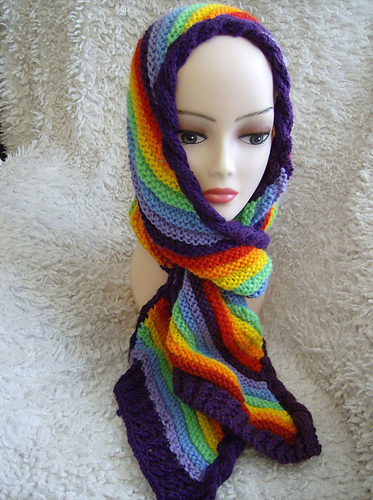
The Rainbow Reversed: A Palette That Defies Expectation
The rainbow, as we know it, unfurls in a predictable arc—red, orange, yellow, green, blue, indigo, violet—each color a step in a linear progression. But the 3/1 twill scarf doesn’t follow the rules. It inverts them. Instead of a smooth gradient, the colors collide, overlap, and reverse, creating a visual echo that feels both familiar and alien. The red doesn’t fade into orange; it *bleeds* into violet, as if the spectrum has been folded in half and stitched back together.
This reversal isn’t arbitrary. It’s a deliberate subversion of expectation, a way to make the wearer question what they see. Is that streak of crimson really red, or is it the ghost of a sunset? Is the band of gold actually yellow, or is it the afterglow of dawn? The scarf becomes a Rorschach test for the eyes, a canvas where perception is as fluid as the weave itself. And because the twill’s diagonal lines guide the eye along its path, the colors aren’t just seen—they’re *experienced*, as if the wearer is walking backward through a prism.

The Sensory Symphony: Touch, Movement, and Memory
A scarf is more than its appearance—it is an extension of the body, a second skin that moves with the wearer. The 3/1 twill scarf understands this. Its fabric is a study in contrast: smooth where the twill’s ridges catch the light, soft where the threads relax into a gentle drape. When wrapped around the neck, it doesn’t cling—it *embraces*, its weight a reassuring presence against the skin. The diagonal ribs add a tactile dimension, a subtle texture that invites touch, as if the scarf is whispering secrets to the fingertips.
And then there’s the movement. A scarf is never static; it shifts with every step, every gesture. The 3/1 twill’s structure ensures that it doesn’t just hang—it *flows*, its colors rippling like water over stone. As the wearer walks, the scarf catches the light from different angles, and the reversed rainbow seems to chase itself, a perpetual motion of hue. It’s hypnotic, almost meditative. Some might call it a conversation piece; others, a wearable work of art. But to wear it is to become part of its rhythm—to move through the world with a fragment of the spectrum wrapped around you.
The Art of Wearing: Styling a Twill Scarf That Reverses Time
How does one style a scarf that seems to exist outside of time? The answer lies in embracing its contradictions. Pair it with a monochrome ensemble—a crisp white shirt and black trousers—and the scarf becomes the sole source of color, a burst of chromatic rebellion. Or drape it over a deep navy coat, letting the reversed rainbow peek out like a secret. The key is contrast: the scarf’s complexity demands a backdrop that lets it shine without competing.
For a more daring look, let the scarf take center stage. Wear it loosely around the neck, letting the ends cascade like a waterfall of color, or knot it at the front for a structured yet fluid silhouette. The twill’s diagonal lines add a dynamic element, guiding the eye and creating visual interest even from a distance. And because the scarf reverses the rainbow, it pairs beautifully with unexpected hues—try a mustard yellow or a dusty rose, and watch as the colors converse in ways they never could in nature.
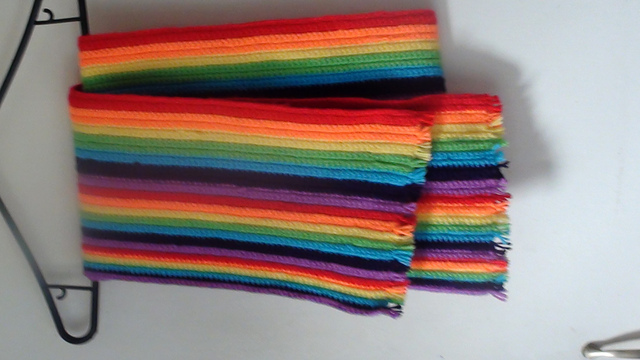
The 3/1 Twill Scarf That Reverses the Rainbow is more than a garment—it is a manifesto of craftsmanship, a rebellion against the ordinary, and a celebration of the unexpected. It challenges the wearer to see color not as a linear progression but as a cyclical dance, where every hue is both a beginning and an end. To own one is to carry a piece of the sky in your hands, to wrap yourself in the paradox of light and shadow, of past and future woven into a single, seamless thread. It is, in every sense, a scarf that doesn’t just adorn—it *transforms*.


Leave a Comment