

In the grand ballet of consumerism, where products pirouette off assembly lines and into our lives with dizzying speed, Dieter Rams’ Ten Principles of Good Design stand as an unshakable waltz of restraint. Like a masterful haiku, each principle distills the essence of utility into crystalline clarity, proving that elegance is not the absence of complexity, but the mastery of it. Half a century after their inception, these principles remain a lodestar for designers, a manifesto for those who believe that the most profound solutions are often the simplest. They are the architectural blueprints for objects that don’t just function—they resonate.
Imagine, if you will, a world where every object hums with purpose, where buttons don’t beg for attention, and where the passage of time only polishes the surface of a thing’s perfection. This is the world Dieter Rams envisioned—a world where design is not a veneer of style, but a silent symphony of necessity and beauty. His principles are not mere rules; they are the DNA of objects that refuse to become obsolete, not because they are trendy, but because they are timeless. Let’s embark on a journey through these ten commandments of design, where each principle is a thread in a larger tapestry of thoughtfulness.
The Good Design Is Innovative: A Dance with the Possible
Innovation is not the flashy gimmick of a tech demo; it is the quiet alchemy of turning constraints into opportunities. Rams understood that innovation thrives not in the absence of limitations, but in their embrace. A chair, for instance, is not just a seat—it is a study in ergonomics, material science, and human anatomy. The best designs don’t just solve problems; they redefine what a problem can be. Consider the humble zipper: once a clunky contraption, it became an elegant solution through relentless refinement. Innovation, in Rams’ philosophy, is not about reinventing the wheel—it’s about making the wheel spin smoother, quieter, and with fewer squeaks.
The Good Design Makes a Product Useful: The Silent Servant
Usefulness is the unsung hero of design. A product’s value is not measured in its flashiness, but in its ability to dissolve into the background of daily life. A well-designed kettle doesn’t demand admiration; it quietly boils water without drama. The principle here is one of humility—design should serve, not dominate. Think of the Swiss Army knife: a tool so intuitive that its complexity feels like second nature. Usefulness is the art of making the extraordinary feel ordinary, the complex feel effortless. When a product is truly useful, it becomes invisible, like a well-tailored suit that lets the wearer forget they’re wearing anything at all.
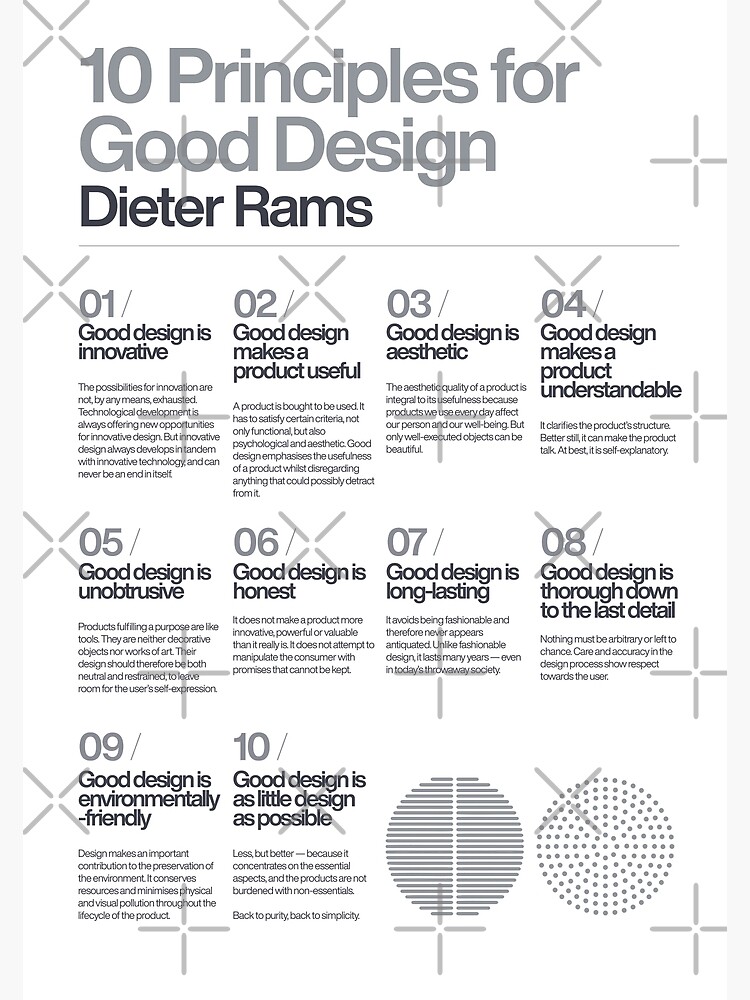
The Good Design Is Aesthetic: Beauty as a Byproduct of Purpose
Aesthetics, in Rams’ view, are not an afterthought but the inevitable result of a design done right. Beauty is not a coat of paint slapped onto a product; it is the visible harmony of form and function. The curves of a Braun coffee maker are not decorative—they are the physical manifestation of heat dissipation and ergonomic grip. Aesthetic appeal, then, is not about embellishment; it is about revealing the poetry in utility. When a product is beautiful, it doesn’t just catch the eye—it invites touch, trust, and even affection. It is the difference between a room filled with objects and a room that breathes with them.
The Good Design Makes a Product Understandable: The Language of Clarity
Confusion is the enemy of good design. A product should not require a manual to operate; it should speak for itself. The best designs are those that communicate their purpose through their very shape and structure. A door handle should imply “pull,” a switch should suggest “press,” and a chair should scream “sit.” Rams’ principle of understandability is a rebellion against the tyranny of complexity. It is the difference between a remote control cluttered with buttons and one that whispers, “This is all you need.” Clarity is not a feature—it is the foundation upon which all other virtues are built.
The Good Design Is Unobtrusive: The Art of Invisibility
Great design does not shout; it murmurs. It does not impose; it integrates. Unobtrusiveness is the principle that reminds us that the best objects are those we take for granted—until they are gone. A well-designed lamp does not demand to be the centerpiece of a room; it illuminates without fanfare. This principle is a call to humility in a world obsessed with spectacle. It is the difference between a flashy sports car and a bicycle that has carried generations of commuters without complaint. Unobtrusive design is the quiet confidence of a thing that knows its place—and excels in it.
The Good Design Is Honest: The Truth in Materials
Honesty in design is the refusal to deceive. A product should not pretend to be something it is not. If a material is plastic, let it look like plastic. If a mechanism is mechanical, let it reveal its workings. The principle of honesty is a stand against the superficial allure of faux luxury or misleading simplicity. It is the difference between a faux-wooden cabinet and one that proudly displays the grain of real oak. Honest design builds trust. It says, “This is what I am, and I am good at it.” In a world of smoke and mirrors, honesty is the rarest and most valuable currency.
The Good Design Is Long-lasting: The Antidote to Obsolescence
In an era of planned obsolescence, Rams’ principle of longevity is a radical act of defiance. A product should not be designed to break, but to endure. It should be timeless, not trendy. The best designs are those that age like fine wine, growing more desirable with time. Think of a Le Corbusier chair or a Moleskine notebook—objects that transcend their era without trying. Long-lasting design is not about durability alone; it is about creating something that future generations will not want to replace. It is the difference between a disposable razor and a straight razor that can be passed down as an heirloom.

The Good Design Is Thorough Down to the Last Detail: The Obsession with Perfection
Perfection is not a destination; it is a journey. The principle of thoroughness is the relentless pursuit of excellence in every screw, seam, and surface finish. It is the difference between a product that is “good enough” and one that is flawless. Rams’ designs are often scrutinized under a magnifying glass—not because they are flashy, but because they are meticulous. Every curve, every joint, every material choice is considered. This principle is a reminder that greatness is not found in grand gestures, but in the accumulation of small, deliberate choices. It is the art of making the invisible visible.
The Good Design Is Environmentally Friendly: The Silent Stewardship
Long before “sustainability” became a buzzword, Rams understood that good design must respect the planet. Environmental friendliness is not a feature to be bolted on; it is a fundamental requirement. It is the difference between a product that depletes resources and one that replenishes them—metaphorically or literally. This principle is about more than just recycling; it is about designing with the entire lifecycle in mind. A product should be repairable, upgradable, and ultimately recyclable. It should leave the earth no worse than it found it. In this way, good design is not just about the present—it is about the future.
The Good Design Is as Little Design as Possible: The Zen of Minimalism
Less, but better—that is the essence of Rams’ final principle. It is not about stripping away all ornamentation, but about distilling a product down to its purest, most essential form. It is the difference between a cluttered desk and one that holds only what is necessary. This principle is a rebellion against excess, a celebration of restraint. It is the difference between a symphony and a cacophony. When design is pared down to its essence, it becomes a conduit for human experience, not a distraction from it. It is the art of making space for what truly matters.
To walk through the world with Rams’ principles in mind is to see objects not as mere things, but as silent partners in our daily lives. They are the chairs we sink into after a long day, the lamps that cast a warm glow over a quiet evening, the tools that help us build, create, and connect. They are the antidote to the noise of modern life—a reminder that beauty and utility are not mutually exclusive, but the twin pillars of a life well-lived.
In an age where we are bombarded with stimuli, where products clamor for our attention like overzealous street vendors, Rams’ principles offer a sanctuary of simplicity. They teach us that the most profound designs are not those that scream for admiration, but those that whisper, “I am here to serve.” They are the quiet revolutionaries in a world of noise, the unsung heroes of a life well-designed.
So the next time you pick up an object, ask yourself: Does it innovate without gimmicks? Does it serve without demanding? Does it endure without trying? If the answer is yes, then you are holding a piece of Rams’ legacy in your hands—a testament to the enduring power of less, done right.


Leave a Comment