

In the age of digital ubiquity, where screens flicker with the relentless pulse of information, Jenny Holzer’s Truisms—those razor-sharp aphorisms that once adorned gallery walls like silent provocations—have found an unexpected sanctuary. No longer confined to the static hush of a museum, these distilled nuggets of wisdom, cynicism, and revelation now shimmer across pixels, their impact magnified by the very medium they were never designed for. There’s a peculiar alchemy at play when Holzer’s words meet the digital canvas: the glow of a screen transforms her statements from mere text into something almost alive, pulsing with the rhythm of the internet’s breath. It’s as if the Truisms were always meant to be seen this way—floating in the ether, untethered from the weight of physicality, their edges sharpened by the glare of modernity.
The allure isn’t just in the format, though. It’s in the way the screen becomes a mirror, reflecting not just the words but the chaos of the world that swirls around them. A Truism like “Money creates taste.” feels different when it flickers in the corner of your phone, nestled between a meme and a breaking news alert. The juxtaposition isn’t just visual; it’s existential. The digital realm doesn’t just display Holzer’s work—it interrogates it, challenges it, and, in doing so, makes it more potent than ever.
The Screen as a Canvas of Unfiltered Honesty
There’s a rawness to digital spaces that physical galleries can’t replicate. A museum demands reverence; a screen demands nothing but attention. When Holzer’s Truisms appear in the wilds of the internet—on social media feeds, in digital art archives, or even as intrusive pop-ups—they lose the sterile neutrality of a gallery and gain the electric unpredictability of the real world. The screen doesn’t just display; it amplifies. A Truism like “A little knowledge can be a dangerous thing.” isn’t just a statement when it’s sandwiched between a viral video and a political rant. It becomes a gut-punch, a reminder that knowledge, no matter how small, is a weapon in the digital arena.
Consider the way these words interact with the user’s gaze. In a gallery, you might linger, contemplating a Truism’s meaning. On a screen, you’re often scrolling, distracted, bombarded. The Truisms don’t just sit there—they insist. They hijack your attention, forcing you to confront them in the midst of life’s digital cacophony. It’s a form of guerrilla art, sneaking into your consciousness when you least expect it. The screen, then, isn’t just a medium; it’s a collaborator, turning passive observation into an active confrontation.
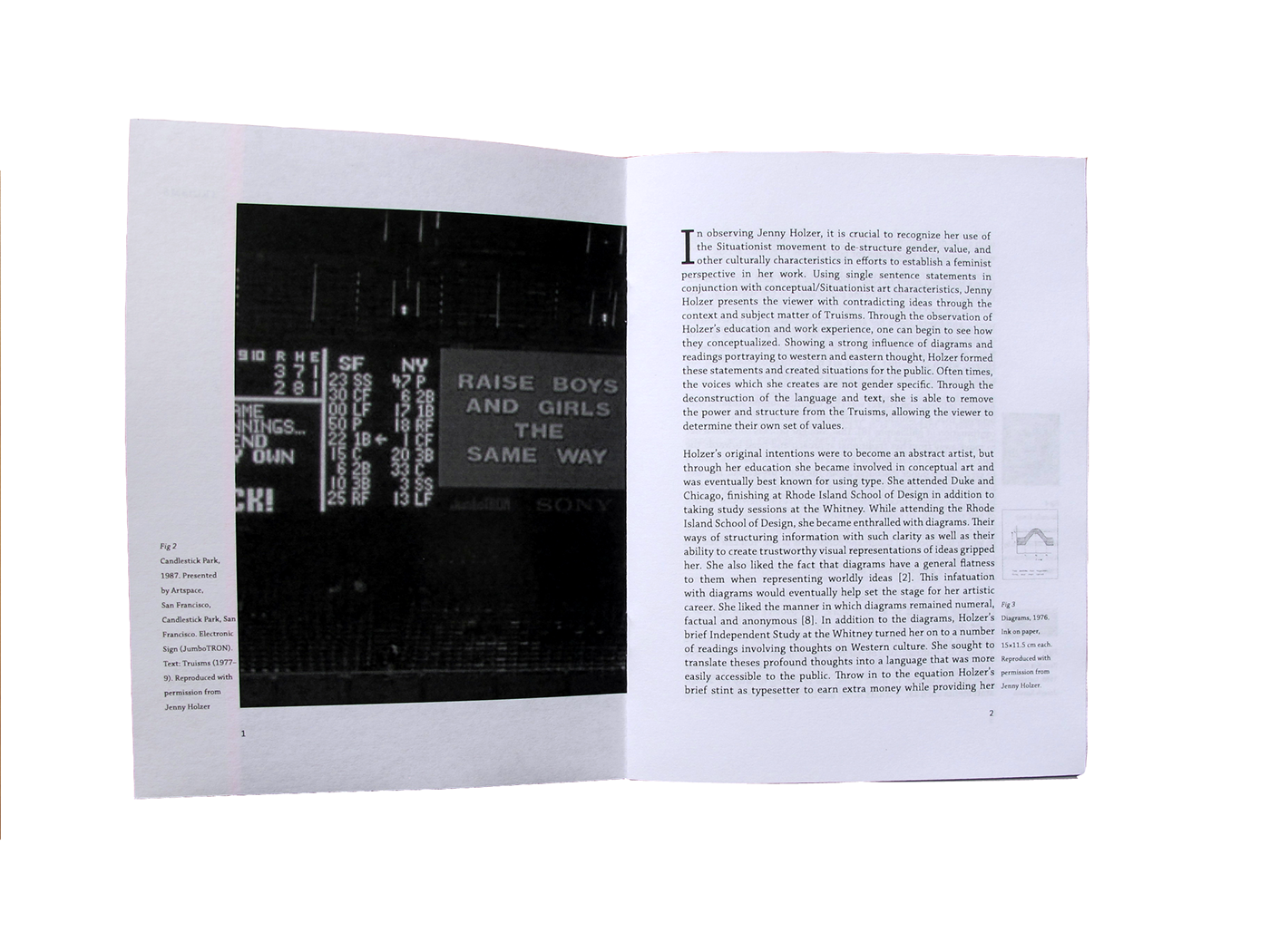
The Glow of Ephemeral Truths
Digital screens have a peculiar temporality. They flicker, refresh, and vanish—nothing is permanent, yet everything is immediate. This impermanence lends Holzer’s Truisms a haunting quality. A Truism like “Protect me from what I want.” isn’t just a statement; it’s a fleeting revelation, a whisper in the dark that disappears as quickly as it appears. The screen’s glow is both comforting and unsettling, a paradox that mirrors the Truisms themselves. They’re truths that feel eternal, yet they’re delivered in a format that’s inherently transient.
This ephemerality also democratizes the experience. In a gallery, access to art is often gated by location, cost, or exclusivity. On a screen, Holzer’s work is available to anyone with an internet connection. The Truisms become a shared language, a collective murmur in the digital ether. They’re no longer the preserve of the art elite; they’re part of the cultural lexicon, popping up in unexpected places, sparking conversations, and provoking reactions in real time. The screen, in this sense, is a great equalizer—a place where art isn’t just observed but lived.
The Digital Hive Mind and the Power of Repetition
The internet thrives on repetition. Memes, quotes, and viral phrases are endlessly recycled, their meanings shifting with each iteration. Holzer’s Truisms, when unleashed into this ecosystem, become part of this endless loop. A Truism like “Abuse of power comes as no surprise.” isn’t just read once; it’s shared, recontextualized, and repurposed. The screen amplifies its reach, turning a single statement into a cultural touchstone. It’s a form of digital folklore, where the Truisms evolve beyond their original intent, taking on new meanings with each retelling.
This repetition also strips away the artifice of originality. In a world where everything is curated, endlessly filtered, and algorithmically optimized, Holzer’s Truisms feel brutally honest. They don’t pretend to be profound or original; they’re blunt, unvarnished truths that cut through the noise. The screen, with its endless scroll of content, becomes the perfect vessel for this honesty. It’s a reminder that some things don’t need embellishment—they just need to be seen, again and again, until they seep into the collective consciousness.
The Screen as a Mirror of Modern Anxiety
There’s a deep unease that permeates the digital age. The screen is both a window to the world and a barrier between us and it. It’s a place of connection and isolation, of enlightenment and misinformation. Holzer’s Truisms, when viewed through this lens, become a reflection of our own anxieties. A Truism like “You are a victim of the rules you choose to obey.” isn’t just a statement; it’s a mirror held up to the digital age, forcing us to confront the rules we’ve internalized—the algorithms we obey, the platforms we trust, the truths we accept without question.
The screen, then, isn’t just a passive display; it’s an active participant in the Truisms’ power. It magnifies their impact, turns them into cultural artifacts, and forces us to engage with them in ways we never would in a gallery. The digital realm doesn’t just show us Holzer’s work—it interrogates us, challenges us, and, ultimately, changes us. The Truisms feel even more true on a screen because the screen itself is a microcosm of the world that Holzer’s words critique.

The Alchemy of Light and Language
There’s a tactile quality to Holzer’s Truisms when they appear on a screen. The glow of the pixels lends the words a physicality they lack on paper or in a gallery. They’re no longer static; they’re alive, pulsing with the energy of the digital world. A Truism like “Your oldest fears are the worst ones.” isn’t just a sentence; it’s a presence, a flicker in the corner of your eye that demands attention. The screen’s light transforms the words into something almost tangible, as if they could be plucked from the pixels and held in your hand.
This alchemy of light and language also speaks to the way we consume information in the digital age. We don’t just read words on a screen; we experience them. The glow of the screen, the flicker of the pixels, the way the text seems to hover in the air—all of it contributes to a sensory experience that’s uniquely digital. Holzer’s Truisms, when viewed this way, become more than just statements; they become sensations. They’re felt as much as they’re read, their impact heightened by the medium that delivers them.
The Uncanny Resonance of Digital Truths
There’s something uncanny about seeing Holzer’s Truisms on a screen. They feel both timeless and hyper-contemporary, as if they were written for this exact moment in history. The digital realm, with its endless stream of information, its echo chambers, and its algorithmic biases, is the perfect stage for these words. They resonate in a way they never could in a gallery, not because the gallery is less powerful, but because the screen is a mirror of the world that Holzer’s work critiques.
A Truism like “There’s no such thing as free will.” feels different when it’s delivered via a screen, where every click, every scroll, every algorithmic suggestion is a reminder of the forces that shape our choices. The screen doesn’t just display the Truisms; it embodies them. It’s a physical manifestation of the ideas they represent—a place where free will is both asserted and undermined, where truth is both sought and obscured.
The resonance is uncanny because it’s inevitable. Holzer’s Truisms were always about the human condition, and the digital age is the human condition distilled into pixels and code. The screen, then, isn’t just a medium; it’s a collaborator, a partner in the Truisms’ enduring relevance. It’s as if the words were waiting for this moment, for this medium, for this audience—ready to leap off the page and into the digital ether, where they belong.

The screen is more than a vessel for Jenny Holzer’s Truisms—it’s a catalyst. It transforms static words into living, breathing entities, pulsing with the rhythm of the digital age. The glow of the pixels, the flicker of the text, the way the words seem to hover in the air—all of it contributes to a sensory experience that’s uniquely suited to the Truisms’ power. They’re no longer just statements; they’re sensations, felt as much as they’re read. The screen doesn’t just display Holzer’s work; it interrogates it, challenges it, and, in doing so, makes it more potent than ever. In the digital realm, the Truisms aren’t just seen—they’re experienced. And in that experience, they find their truest form.


Leave a Comment