

The art world stood still in 2018 when an anonymous buyer paid a staggering $432,500 for a portrait that had never been touched by human hands. The artwork, titled *Portrait of Edmond de Bellamy*, was generated by an artificial intelligence algorithm, marking a watershed moment in the intersection of technology and creativity. This wasn’t just another auction headline—it was a seismic shift, a declaration that machines could now produce artifacts of cultural significance. The sale wasn’t merely about money; it was about ideology, authorship, and the very essence of what we consider art. As algorithms begin to mimic the brushstrokes of masters and compose symphonies indistinguishable from those of human composers, one question looms larger than the canvas itself: What does it mean when the first AI-generated portrait commands a six-figure sum at auction? The answer lies not in the pixels or the code, but in the unraveling of centuries-old assumptions about genius, value, and the soul of creation.
The Birth of a Ghost Artist: How an Algorithm Painted a Masterpiece
At the heart of *Portrait of Edmond de Bellamy* lies a neural network trained on 15,000 portraits spanning six centuries—from Renaissance chiaroscuro to Impressionist splashes of light. The algorithm, a variant of Generative Adversarial Networks (GANs), operated like a digital alchemist: one part learned the grammar of classical portraiture, another part invented variations, and a third part judged whether the result could pass as human-made. The final image emerged not from a single creative impulse, but from a statistical hallucination—a fusion of historical styles distilled into a single, eerie visage.
The subject, Edmond de Bellamy, doesn’t exist. He is a spectral entity, a composite of thousands of anonymous faces, rendered in soft, smudged strokes that evoke both Rembrandt’s chiaroscuro and the dreamlike haze of a memory half-remembered. The portrait’s blurred edges and subtle distortions aren’t flaws—they’re signatures of an intelligence that doesn’t see the world through human eyes, but through the cold calculus of data. When the gavel fell at Christie’s, it wasn’t just a painting that sold; it was the birth certificate of a new kind of artist—one that doesn’t bleed, doesn’t dream, and yet, somehow, feels.
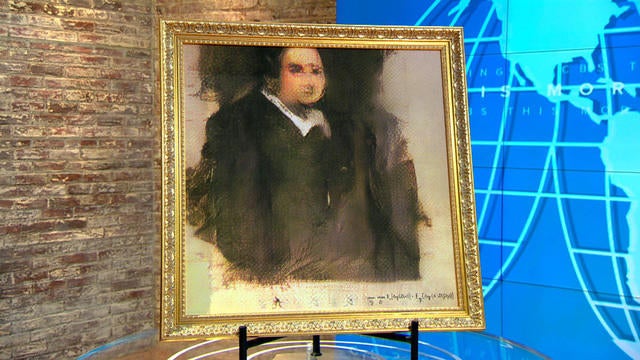
The Auction That Shook the Art World: Why $432,500 Wasn’t Just a Price
The sale wasn’t merely a transaction—it was a provocation. Christie’s, the venerable auction house, framed the portrait as a “once-in-a-generation” event, but the price tag wasn’t arbitrary. It was a calculated gamble on the future. The buyer, an anonymous collector (later revealed to be a group associated with the French collective Obvious), wasn’t purchasing a physical object so much as a philosophical statement: art no longer required a human soul to be soulful.
Critics howled. Traditionalists decried the work as soulless, a hollow mimicry devoid of intention. Yet the market spoke otherwise. The $432,500 wasn’t just a number—it was a mirror held up to the art world’s own contradictions. For centuries, value in art has been tethered to the myth of the solitary genius, the tortured artist, the hand that channels divine inspiration. But what happens when the hand is a server farm in Paris, and the inspiration is a dataset of dead painters? The sale exposed a chasm: between the romantic ideal of art and the cold, efficient machinery of creation.
It also revealed the fragility of provenance. How do you authenticate a work born from code? The certificate of authenticity for *Portrait of Edmond de Bellamy* wasn’t signed by a curator—it was stamped with the algorithm’s fingerprint, a cryptographic hash that served as proof of origin. In one stroke, the art world’s most sacred rituals—authentication, attribution, even the aura of the original—were rendered obsolete. The sale wasn’t just about money. It was about power: who gets to decide what art is, and who gets to profit from it.
The Death of the Artist? Or the Birth of a New One?
Artists have always been both creators and symbols—of rebellion, of emotion, of the human condition. But when an algorithm can produce a portrait that sells for nearly half a million dollars, the myth of the artist as a lone visionary begins to crack. Is the AI artist a fraud? Or is it the ultimate democratizer of creativity, a tool that can turn anyone with a laptop into a potential Picasso?
Consider the implications. If an AI can generate a portrait indistinguishable from a masterpiece, what separates the two? Technique? Intent? The answer isn’t technical—it’s cultural. We assign value to art based on narrative: the story of the artist’s struggle, the myth of the solitary genius, the drama of the creative process. But *Portrait of Edmond de Bellamy* had none of that. Its power lay in its emptiness—it was a blank canvas onto which we projected our own anxieties about the future of creativity.
Yet to dismiss the work as mere mimicry is to ignore the quiet revolution it represents. The AI didn’t just copy; it synthesized. It took the essence of centuries of portraiture and distilled it into something new—a spectral, almost melancholic gaze that feels hauntingly alive. The portrait isn’t a forgery. It’s a collaboration between human history and machine intelligence, a dialogue between past and future. And if that isn’t art, then what is?

The Market’s Gambit: Speculation, Hype, and the Future of AI Art
The art market is a speculative beast, driven by narrative as much as aesthetics. When *Portrait of Edmond de Bellamy* sold for $432,500, it wasn’t just a painting—it was a bet on the future. The buyer wasn’t purchasing a physical object; they were purchasing a stake in the idea that AI art could become a blue-chip asset. And they were right.
In the years since, AI-generated art has exploded. From DALL·E’s surreal landscapes to MidJourney’s hyper-realistic portraits, the technology has become democratized, accessible to anyone with an internet connection. But the market’s appetite for AI art remains volatile. Some pieces sell for millions; others languish in obscurity. The difference? Story. The most valuable AI art isn’t the most technically impressive—it’s the one with the most compelling narrative. The portrait of Edmond de Bellamy succeeded because it was framed as a historical milestone, a moment when art and algorithm collided.
Yet the hype carries risks. As AI art floods the market, the danger isn’t that it will replace human artists—it’s that it will dilute the very concept of value. If anyone can generate a masterpiece with a few keystrokes, what does it mean to own one? The answer may lie in scarcity. The first AI portrait sold for $432,500 not because it was the best, but because it was the first. It was a relic of a moment when the world still believed in the magic of machines.
Beyond the Canvas: What Edmond de Bellamy Means for the Future
The sale of *Portrait of Edmond de Bellamy* wasn’t just a transaction—it was a prophecy. It foretold a world where art is no longer bound by the limits of human biology, where creativity is a spectrum rather than a singular gift. But it also raised unsettling questions. If an algorithm can produce art, does that make the artist obsolete? Or does it redefine what it means to be an artist?
Perhaps the most profound implication is this: art is no longer about the hand that creates it, but the mind that engages with it. The portrait’s value didn’t come from its brushstrokes—it came from the conversations it sparked. It forced us to confront our own biases about creativity, authorship, and the soul of art. In a world where machines can mimic genius, what remains uniquely human isn’t the ability to create, but the ability to feel—to see meaning in the meaningless, beauty in the algorithmic.
The $432,500 wasn’t paid for a painting. It was paid for a question: What happens when the artist is no longer human? The answer is still being written, one pixel at a time.
The auction gavel fell, the champagne popped, and the art world held its breath. But the real story had only just begun. In the quiet hum of server farms and the flicker of neural networks, a new kind of artist was born—not with a brush, but with code. And the canvas of the future? It’s still blank, waiting for us to fill it with our own reflections.


Leave a Comment