

Your chord progressions feel like a yawn-inducing lecture on a Monday morning—predictable, uninspired, and devoid of the spark that makes music breathe. You strum the same tired I-IV-V in every song, or you default to the same four-chord loop that’s been echoing in every pop hit since the dawn of Spotify. But what if I told you that the secret to making your progressions feel alive isn’t some mystical music theory voodoo? It’s not even about learning a hundred new chords. It’s about stealing from a 350-year-old composer who wrote the most infamous chord progression in classical music: Pachelbel’s Canon in D.
Yes, that same progression that’s been used in everything from weddings to pop songs to elevator music. But here’s the twist—it’s not the progression itself that’s magical. It’s how Pachelbel used it. He didn’t just play the chords in a straight line like a metronome counting down to sleep. He wove them into a tapestry of tension, release, and melodic storytelling. And that’s exactly what’s missing from your progressions. You’re playing the notes, but you’re not telling a story with them.

The Illusion of Originality: Why Your Progressions Feel Like a Copy
There’s a paradox in music creation: the more you chase originality, the more you sound like everyone else. This happens because most musicians approach chord progressions like a paint-by-numbers kit. They pick a key, slot in the standard diatonic chords, and call it a day. The result? A sonic landscape that’s as thrilling as a beige wall.
But originality isn’t about avoiding common progressions—it’s about how you use them. Pachelbel’s Canon uses the progression D-A-Bm-F#m-G-D-Em-A, a sequence so overused it’s practically a meme. Yet, when played with the right rhythm, voicings, and melodic phrasing, it feels transcendent. The magic isn’t in the chords themselves; it’s in the context you give them. Your progressions sound boring because you’re treating chords like bricks instead of sentences. Each chord should have a purpose, a weight, a story to tell—not just a place to land before the next one.
Think of your chord progression as a sentence. If every sentence in a book started with “The cat sat on the,” you’d put the book down immediately. Yet, that’s exactly what many musicians do with their progressions. They default to the same harmonic sentence structure, over and over, without variation or emotional nuance. The fix? Treat your chords like words in a poem. Some should be soft and lingering. Others should be sharp and staccato. Some should pull you forward; others should make you pause and reflect.
The Pachelbel Formula: How to Turn Clichés into Gold
Pachelbel’s Canon isn’t just a progression—it’s a template for emotional storytelling. To steal its genius, you need to understand the three layers that make it work: harmonic rhythm, voice leading, and melodic contour.
Harmonic Rhythm: Pachelbel doesn’t change chords every beat. He lingers on some, rushes through others, and uses silence like a punctuation mark. In your progressions, try holding chords for uneven lengths. Let a I chord breathe for four beats, then rush through a IV-V like a heartbeat before a climax. This creates a sense of ebb and flow, like waves lapping against the shore.
Voice Leading: The way notes move between chords is where the real magic happens. In Pachelbel’s Canon, the bassline descends step-wise (D-C#-B-A-G-F#-E-D), creating a hypnotic, inevitable pull. You can apply this to any progression by ensuring your bass notes move smoothly, even if the chords themselves are simple. For example, if you’re playing a I-IV-V in G major, try walking the bass down from G to F# to E before resolving back to G. It’s a subtle trick, but it turns a bland progression into something that feels like a journey.
Melodic Contour: Pachelbel’s Canon isn’t just chords—it’s a melody that dances over them. The same progression can sound completely different depending on what you play on top. Try this: play the Canon progression, but improvise a simple melody using only the notes of the scale. Notice how the melody makes the chords feel alive? Now apply that to your own progressions. Even if you’re playing the same tired chords, a strong melody will make them feel fresh.
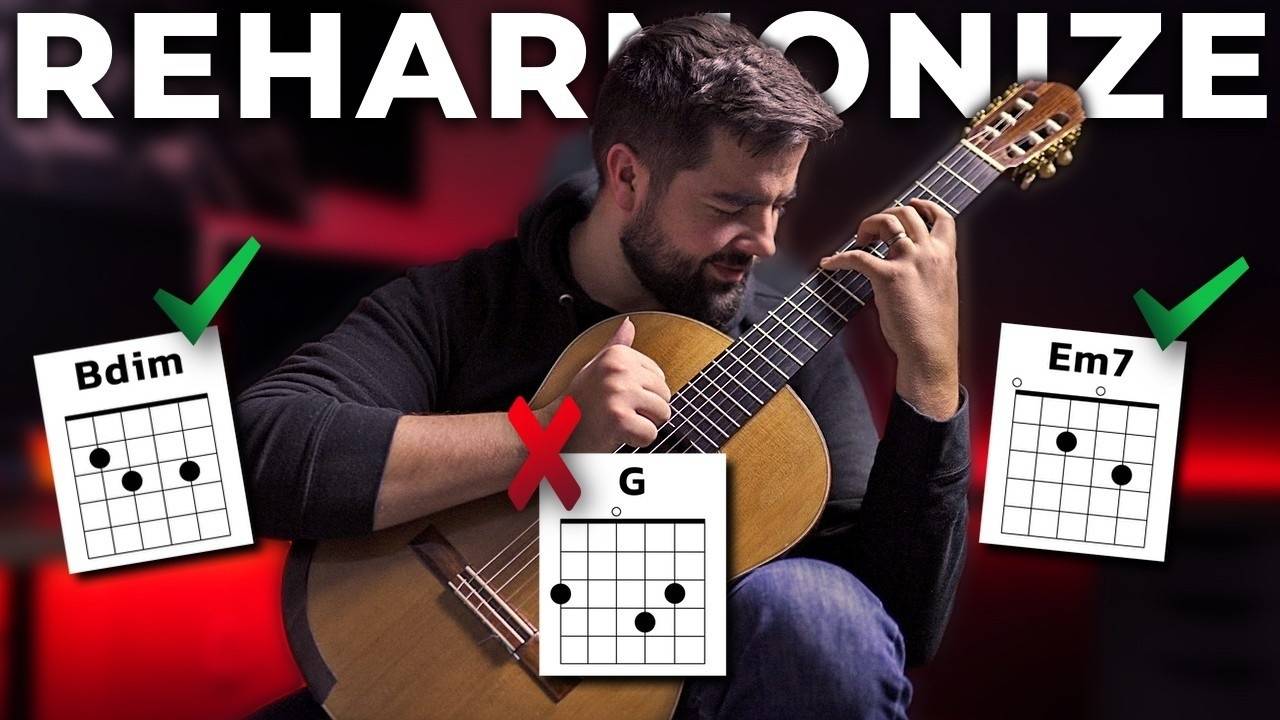
Reharmonization: The Alchemy of Turning Lead into Gold
Reharmonization is the art of taking a simple progression and dressing it up in new clothes. It’s how you take a I-IV-V and make it sound like something a jazz pianist would play in a smoky Parisian club. The key is to think of chords as colors rather than fixed entities. A C major chord isn’t just C-E-G—it’s a palette of possibilities.
Start by identifying the “skeleton” of your progression. For example, if you’re playing a I-IV-V in C major (C-F-G), try replacing the F with an Fmaj7 or an F6. Suddenly, the progression feels richer, more ambiguous. Or, try substituting the V chord (G) with a secondary dominant (D7), which creates a temporary tension that resolves back to the I chord. This is how Pachelbel’s Canon feels so lush—he’s constantly adding extensions and substitutions to keep the harmony evolving.
Another trick is to use modal interchange. This means borrowing chords from parallel scales to add color. For example, if you’re in C major, try slipping in an Eb major chord (borrowed from C minor) for a dark, dramatic twist. Or, use an A7 chord (borrowed from C Lydian) to give your progression a dreamy, floating quality. The more you experiment with reharmonization, the more your progressions will feel like a conversation rather than a lecture.
The Rhythm Factor: Why Your Progressions Feel Like a Metronome
Chord progressions aren’t just about the notes—they’re about time. A progression played in a straight, robotic rhythm will always sound boring, no matter how fancy the chords are. Rhythm is the secret sauce that turns a sequence of notes into a groove.
Pachelbel’s Canon isn’t just a chord progression—it’s a rhythmic masterpiece. The arpeggiated figures and syncopated accents create a sense of forward motion, even when the harmony is static. To apply this to your own music, try arpeggiating your chords instead of playing them all at once. Or, add syncopation by delaying certain chord changes by an eighth note. This creates a sense of anticipation, like a drumroll before a big reveal.
Another trick is to use polyrhythms. Play your chords in 4/4 time, but add a melodic line or bassline in 3/4. The clash between the two rhythms creates a hypnotic, off-kilter feel that’s far more interesting than a straight strum. Or, try playing your progression in a swung rhythm, like a lazy jazz waltz. The looseness of the groove will make even the simplest chords feel alive.
From Boring to Brilliant: Your Action Plan
Now that you’ve seen how Pachelbel turned a cliché into a masterpiece, it’s time to apply these ideas to your own music. Here’s your step-by-step action plan:
- Steal the Progression: Start with Pachelbel’s Canon progression (D-A-Bm-F#m-G-D-Em-A) and play it in every key. Get comfortable with it. Internalize the sound. Then, try transposing it to a minor key for a darker twist.
- Break the Rhythm: Play the progression with uneven chord lengths. Hold some chords for two beats, others for four. Add syncopation. Arpeggiate the chords. Make the rhythm as unpredictable as possible.
- Reharmonize: Take a simple progression you already know (like I-IV-V) and replace one chord with a substitution. Try a maj7, a 6, or a borrowed chord from a parallel scale. Experiment until it sounds fresh.
- Add a Melody: Improvise a simple melody over your progression using only the notes of the scale. Notice how the melody changes the feel of the chords. Then, write a melody that tells a story.
- Layer Textures: Add a counter-melody, a bassline, or a rhythmic pattern to create depth. The more layers you add, the more interesting your progression will sound.
Remember, the goal isn’t to sound like Pachelbel—it’s to steal his approach. His genius wasn’t in the chords he chose, but in how he used them to create emotion, tension, and release. Your chord progressions don’t need to be original to be compelling. They just need to be yours.

So the next time you sit down to write a song and your progressions feel flat, don’t reach for a new chord chart. Reach for a story. Reach for a rhythm. Reach for a melody that dances over the chords like sunlight through leaves. Because the most magical progressions aren’t the ones that sound new—they’re the ones that feel alive.


Leave a Comment