

In the vast, shifting landscape of 20th-century art, few movements have encapsulated the contradictions of a nation as vividly as Chinese Cynical Realism. Emerging from the ashes of Mao Zedong’s Cultural Revolution and flourishing amid Deng Xiaoping’s economic reforms, this audacious artistic rebellion became a mirror reflecting the tumultuous soul of a country caught between revolutionary idealism and consumerist fervor. It was not merely a style—it was a defiant scream into the void, a visual manifesto of disillusionment, humor, and raw honesty. Through grotesque smiles, vacant stares, and surreal distortions, Cynical Realism painted a portrait of a society grappling with identity, power, and the seductive allure of modernity. This movement did not just depict reality; it dissected it, twisted it, and served it back with a knowing wink.
For those unacquainted with its visual lexicon, Cynical Realism might appear as a cacophony of exaggerated features and jarring colors—faces frozen in rictus grins, bodies suspended in existential limbo, and backdrops that oscillate between oppressive gray and garish neon. Yet beneath its surface lies a profound commentary on the human condition in an era of unprecedented transformation. It is a genre that thrives on paradox: simultaneously biting and playful, despairing yet darkly humorous, politically charged yet deliberately ambiguous. To understand Cynical Realism is to peer into the fractured psyche of a nation that has sprinted from collectivist dogma to capitalist excess in less than a generation. It is the art of a people who have learned to laugh through the pain of progress.
The Birth of a Provocative Aesthetic: From Revolution to Rebellion
The seeds of Cynical Realism were sown in the crucible of the Cultural Revolution (1966–1976), a decade of ideological frenzy that sought to erase individuality in favor of Maoist purity. Artists were coerced into creating propagandistic works that glorified the state, while personal expression was crushed under the weight of revolutionary rhetoric. When the dust settled, however, a generation of creators emerged—many of whom had been sent to the countryside during the Down to the Countryside Movement—with a seething resentment toward the very system that had stifled them. Their art became a rebellion not just against the past, but against the sanitized narratives of the present.
By the late 1980s and early 1990s, as China’s economic liberalization accelerated, so too did the disillusionment of its artists. The promise of prosperity was real, but so too was the erosion of moral certainties. The old revolutionary ideals had crumbled, replaced by a new gospel of wealth accumulation. In this vacuum, Cynical Realism found its voice. It rejected the socialist realism of the Mao era, which had peddled utopian fantasies, and instead embraced a raw, unflinching gaze at the contradictions of post-Mao China. Artists like Yue Minjun, Fang Lijun, and Zhang Xiaogang became the movement’s vanguards, their works serving as visual manifestos of a society adrift between ideology and avarice.
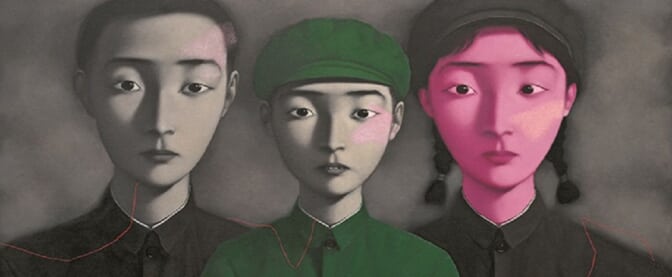
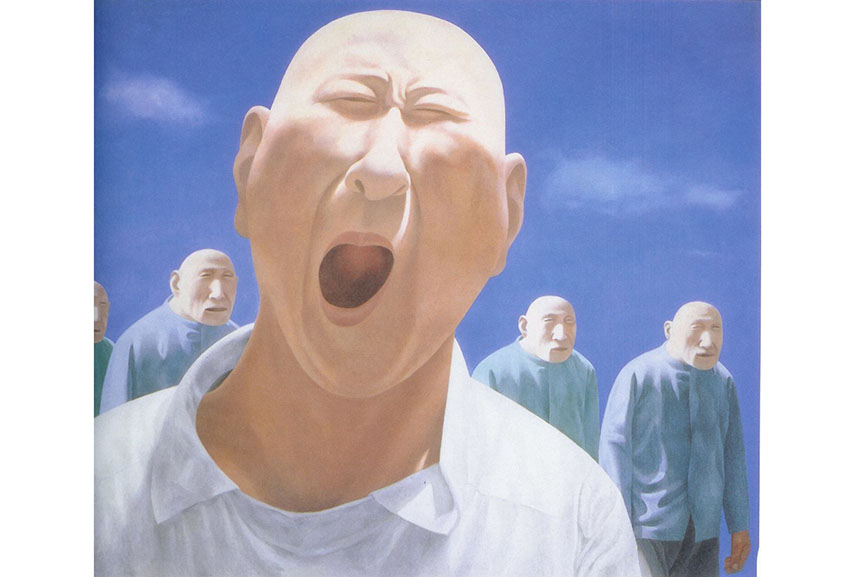
The aesthetic choices were deliberate. The exaggerated, almost cartoonish smiles of Yue Minjun’s figures—often repeated in endless, identical rows—mocked the hollow optimism of the new economic order. Fang Lijun’s bald, expressionless figures, floating in monochromatic voids, evoked the alienation of urban life in a rapidly modernizing nation. Zhang Xiaogang’s haunting portraits, with their elongated faces and muted palettes, blurred the line between personal memory and collective trauma, suggesting that the scars of the past were far from healed. These artists did not just paint; they dissected the zeitgeist, exposing the absurdity of a nation caught between Mao’s ghost and the allure of money.
The Visual Language of Disillusionment: Smiles, Shadows, and Surrealism
To decode Cynical Realism is to decipher a visual codex of disillusionment, where every element—from the color palette to the composition—serves as a deliberate provocation. The most iconic motif is the grin, often stretched into a grotesque rictus, frozen in a moment of eternal, hollow mirth. This is not joy; it is a mask, a performative act that conceals the emptiness beneath. In Yue Minjun’s Execution series, rows of identical figures laugh as one is shot, a macabre commentary on the performative nature of compliance in a society where dissent is both dangerous and futile.
The use of repetition is equally telling. In Fang Lijun’s Series 2, figures appear in endless, identical rows, their bald heads and vacant expressions evoking the dehumanizing conformity of urban life. The repetition is not just aesthetic; it is existential. It suggests a world where individuality is erased, where people are reduced to cogs in a machine that promises prosperity but delivers alienation. The monochromatic backgrounds—often shades of gray or sickly yellow—further emphasize this sense of detachment, as if the figures exist in a liminal space between reality and dream.
Surrealism plays a crucial role in Cynical Realism, blurring the boundaries between the tangible and the imagined. Zhang Xiaogang’s portraits, with their elongated faces and subtle distortions, evoke the uncanny, as if the figures are both present and spectral. The muted colors—pinks, blues, and grays—lend a dreamlike quality to the works, as if the past is not just remembered but relived. This surrealism is not escapist; it is a confrontation. It forces the viewer to confront the dissonance between the idealized narratives of progress and the messy, often painful reality of life in post-Mao China.
Themes That Transcend the Canvas: Power, Identity, and the Illusion of Choice
Cynical Realism is not merely a stylistic rebellion; it is a thematic one. At its core, the movement interrogates the nature of power, identity, and the illusion of agency in a society undergoing seismic shifts. The figures in these works are rarely individuals; they are archetypes—representatives of a collective experience. Their expressions are not personal; they are communal. This is art that speaks to the soul of a nation, not just the sensibilities of an artist.
Power is a recurring motif, often depicted through the lens of authority and submission. In Yue Minjun’s works, the grinning figures can be read as both oppressors and oppressed, their laughter a coping mechanism in the face of systemic control. The repetition of figures in Fang Lijun’s compositions suggests a world where individuality is subsumed by collective identity, where the state’s demands override personal desire. Even in Zhang Xiaogang’s family portraits, the elongated faces and muted colors evoke the stifling influence of tradition and ideology, where personal aspirations are often sacrificed for the sake of stability.
Identity, too, is a central preoccupation. In a society where the old certainties of Maoist ideology have collapsed and the new gospel of consumerism is still taking shape, identity becomes a fluid, contested terrain. The figures in Cynical Realist works often appear as if they are searching for something—whether it is meaning, connection, or simply a way to belong. Their expressions are ambiguous, their postures uncertain. They are not heroes; they are survivors, navigating a world that offers little in the way of guidance or solace.
The illusion of choice is another critical theme. In a nation where economic liberalization has created the illusion of freedom, Cynical Realism exposes the reality: that choice is often an illusion, a carefully constructed narrative designed to keep the machinery of capitalism running smoothly. The grinning figures, the repeated rows, the surreal distortions—all serve as reminders that beneath the surface of progress lies a landscape of constraint, where the individual is often powerless to shape their own destiny.
Cynical Realism in the Global Context: A Movement That Resonates Worldwide
While Cynical Realism is undeniably rooted in the specific historical and cultural context of post-Mao China, its themes resonate far beyond its borders. In an era of globalization, where the boundaries between nations and ideologies are increasingly blurred, the movement’s exploration of power, identity, and disillusionment feels eerily prescient. It is art that speaks to the human condition in a world where old certainties are crumbling and new ones are yet to take shape.
In the West, where consumerism and individualism have long been dominant forces, Cynical Realism offers a mirror that reflects back the absurdity and alienation of modern life. The grinning figures of Yue Minjun could just as easily be read as critiques of the performative nature of social media, where authenticity is often sacrificed for the sake of likes and shares. The monochromatic voids of Fang Lijun’s compositions evoke the desolation of suburban sprawl, where communities are fragmented and connections are fleeting. Even the surreal distortions of Zhang Xiaogang’s portraits resonate in a world where reality is increasingly mediated by algorithms and curated identities.
Moreover, Cynical Realism challenges the Western-centric narrative of contemporary art, which often prioritizes abstraction and conceptualism over narrative and figuration. By embracing a style that is both visually striking and thematically rich, the movement asserts the importance of storytelling in art. It reminds us that art is not just about form; it is about meaning, about the human experience in all its complexity and contradiction.

The Legacy of Cynical Realism: Art as a Mirror and a Weapon
The impact of Cynical Realism extends far beyond the canvas. It is a movement that has redefined the role of art in society, transforming it from a tool of propaganda or a vehicle for beauty into a weapon of critique and a mirror of collective consciousness. In a nation where art has long been subservient to political or commercial interests, Cynical Realism asserted the autonomy of the artist, the power of individual expression, and the importance of challenging the status quo.
Today, the movement’s legacy can be seen in the works of a new generation of Chinese artists who continue to explore its themes. From the politically charged installations of Ai Weiwei to the surreal, dreamlike landscapes of Liu Xiaodong, the spirit of Cynical Realism lives on, adapting to new contexts and new challenges. It is a reminder that art is not just a reflection of the world; it is a force that can shape it, challenge it, and ultimately transform it.
For those who engage with Cynical Realism, the experience is often unsettling. The grinning faces, the vacant stares, the surreal distortions—all serve as reminders of the contradictions that define our world. But in that unsettling quality lies the movement’s power. It forces us to confront uncomfortable truths, to question the narratives we are fed, and to seek out our own truths in a world that often feels like a hall of mirrors.
The story of Chinese Cynical Realism is not just the story of a movement; it is the story of a nation caught between the ghosts of its past and the promises of its future. It is a tale of disillusionment and resilience, of laughter in the face of despair, and of art as both a weapon and a balm. In the end, Cynical Realism is not just about China—it is about the human experience in all its complexity, contradiction, and beauty. It is a reminder that even in the darkest of times, art has the power to illuminate, to provoke, and to inspire.


Leave a Comment