

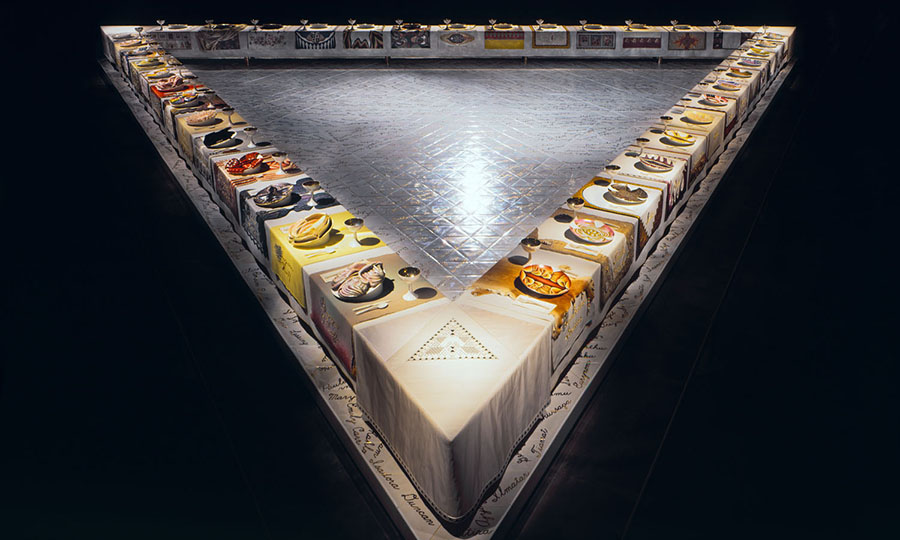
The Dinner Party is not merely an artwork—it is a thunderclap of feminist defiance, a 48-foot triangular banquet table set with 39 hand-painted porcelain place settings, each honoring a woman from myth, history, or legend. Yet beyond its iconic imagery lies a labyrinth of intention, technique, and controversy that continues to haunt and inspire. Why does this single installation, unveiled in 1979 after a five-year labor of love and fury, still pulse with such electric fascination? Perhaps because it didn’t just depict history—it rewrote it, stitching together the silenced voices of 999 women into a visceral, three-dimensional manifesto. This is the story of how Judy Chicago’s magnum opus didn’t just enter the canon—it shattered it, and in doing so, redefined what art could dare to be.
Imagine walking into a dimly lit gallery in 1979, the air thick with anticipation and unease. Before you unfurls a monumental triangle, its edges glowing like a sacred relic. The floor beneath is tiled with 2,304 hand-cast porcelain tiles, each inscribed with the names of 999 women—from Sappho to Sojourner Truth, from Hatshepsut to Virginia Woolf. This is not decoration. This is a roll call. This is a roll call of the erased, the forgotten, the erased again. And at each of the 39 place settings—each a vulva-shaped ceramic plate, each embroidered runner, each goblet and chalice—lies a woman’s story, told through color, form, and symbolism. This is The Dinner Party, and it didn’t just sit on the wall. It sat at the table. It demanded a seat. It refused to be ignored.
The Triangle: Geometry as Rebellion
Why a triangle? In the late 1970s, the triangle was not just a shape—it was a provocation. To feminists, it symbolized equality, sisterhood, and the vulva itself, a radical reclamation of the body often pathologized or erased. Chicago didn’t choose the triangle lightly. She chose it to invert centuries of patriarchal architecture—cathedrals, pyramids, obelisks—all phallic, all vertical, all asserting dominance. The Dinner Party, by contrast, sprawls horizontally, inviting participation, not awe. It is a table, not a throne. It is a space for gathering, not gazing. And in that horizontal sprawl, it democratizes history. No one sits at the head. Everyone is equal at the table. Even the absence of a head is a statement: there is no single leader, no single narrative, no single woman to crown. Only a chorus.
The triangle also echoes the ancient vulva, a motif that recurs in the place settings’ plates, runners, and even the floor tiles. Chicago didn’t shy from the body. She embraced it. She weaponized it. She turned what had been called “vulgar” into something sacred. Each plate is a canvas of vaginal imagery, but not in a reductive way—each is a fingerprint of a life, a fingerprint of a culture, a fingerprint of a woman’s journey through time. The vulva becomes not just anatomy, but autobiography.
The 999 Names: A Cartography of the Unseen
Beneath the table lies the real shock: 2,304 porcelain tiles, each bearing a woman’s name. Not just any women—women who had been omitted from history books, from museums, from the grand narrative of Western civilization. Women like Hypatia, the philosopher murdered for her intellect; like Sojourner Truth, who demanded, “Ain’t I a woman?”; like Emily Dickinson, whose poems were nearly erased by her family. These names are not just listed—they are etched into porcelain, a material once reserved for aristocracy, now claimed for the marginalized. Porcelain is fragile, yet here it becomes unbreakable. It survives. It endures. It remembers.
Chicago didn’t just compile a list. She created a topography of erasure. The tiles are arranged in chronological order, spiraling outward from the triangle’s center. The further you move from the center, the more names accumulate, the denser the web of memory becomes. It’s as if the floor itself is breathing, pulsing with the weight of centuries. To walk upon these names is to walk upon history’s underbelly—to feel the pressure of what was lost, what was stolen, what was silenced. It is a quiet violence, a violence of omission, and Chicago forces us to confront it by making us step on it, literally.
The Place Settings: Where Craft Meets Revolution
Each of the 39 place settings is a miniature universe. Take Georgia O’Keeffe’s setting: a plate shaped like a blooming calla lily, its petals unfurling in iridescent glazes, echoing the artist’s floral motifs. The runner beneath is embroidered with images of bones and flowers—O’Keeffe’s signature duality of life and death. Or consider Sojourner Truth’s setting: a plate shaped like a heraldic shield, its surface adorned with African textile patterns and the words “Ain’t I a woman?” stitched in gold. The craftsmanship is obsessive. The needlework is exacting. The ceramics are fired to perfection. Chicago didn’t just paint a picture of feminism—she wove it, stitched it, glazed it, and baked it into existence.
This fusion of craft and concept was radical. In the 1970s, “women’s work”—embroidery, ceramics, weaving—was dismissed as domestic, trivial, unworthy of the art world’s gaze. Chicago flipped the script. She elevated needlework to high art. She turned the kitchen table into a throne. She proved that the so-called “minor” arts were not minor at all—they were the very fabric of cultural survival. Each stitch, each brushstroke, each glaze was a political act. Each place setting was a manifesto. Each runner was a scroll of resistance.
The Critics and the Backlash: Why the Fury Endures
Of course, fury followed. Critics called The Dinner Party “vulgar,” “sentimental,” “essentialist.” Some dismissed it as propaganda rather than art. Others argued that it reduced women to biology, to the body, to the vulva. Chicago was accused of essentialism—of suggesting that all women share a singular experience. But such critiques miss the point. The Dinner Party is not a universalist fantasy. It is a specific one. It is a celebration of women across cultures, across centuries, across identities. It is a mosaic of difference, not a monolith of sameness. The vulva-shaped plates are not a reduction—they are a reclamation. They are not a limitation—they are a liberation.
The backlash wasn’t just aesthetic. It was political. The Dinner Party dared to assert that women had a history worth preserving, worth celebrating, worth fighting for. In doing so, it threatened the status quo. It threatened the gatekeepers of the art world, who were predominantly white, male, and Eurocentric. It threatened the historians who had written women out of the story. It threatened the critics who had dismissed feminist art as a passing trend. And in threatening them, it exposed their fragility. The more they attacked, the more The Dinner Party proved its necessity.
The Legacy: How a Table Became a Movement
Today, The Dinner Party resides at the Brooklyn Museum, where it draws pilgrims from around the world. It has been called the first epic feminist artwork, the first large-scale installation by a woman, the first to center women’s bodies and histories in such a public, unapologetic way. But its legacy is deeper than accolades. It changed the way we think about art. It changed the way we think about history. It changed the way we think about women.
It proved that art could be a weapon. It proved that art could be a memorial. It proved that art could be a dinner party—one where the guests are the forgotten, the erased, the silenced. And in that dinner party, they are not just guests. They are hosts. They are the ones who set the table. They are the ones who invite us in. They are the ones who refuse to be ignored.
Perhaps that’s why The Dinner Party still fascinates. Not just because it is beautiful, or bold, or controversial—but because it is alive. It breathes. It remembers. It demands. It sits at the table, and it won’t leave until we listen.


Leave a Comment